Fortune India Best Banks & NBFCs 2026: Karur Vysya Bank's comeback story
/ 7 min read
The winner in the Best Small-sized bank category this year, Karur Vysya was a leaky boat in 2020. Six years on, the 110-year-old lender has shown impressive return metrics, and a 9-fold jump in market value.
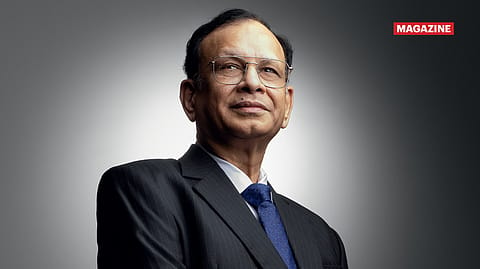
B. Ramesh Babu, MD & CEO, Karur Vysya Bank; Best Small-sized Bank | Credits: Selvaprakash Lakshmanan
This story belongs to the Fortune India Magazine november-2026-best-banks-and-nbfcs-2026 issue.
LONG BEFORE he moved into the corner office of the 110-year-old Karur Vysya Bank (KVB), Ramesh Babu Boddu had tried to poach its customers.
In the late 2010s, as the chief general manager for Tamil Nadu and Puducherry, at the country’s oldest and largest public sector bank, the State Bank of India, SBI’s relationship managers would line up breakfast sessions for Babu with prospective customers. Their pitch would be: “Sir, more or less everything is set, once you have breakfast with this [KVB] customer, the account will come to us.”
Babu would go through the customary ritual of exchanging pleasantries and having a sumptuous meal, but these customers would not switch. Their reason was: “In a bigger organisation [such as SBI], people move around. Many a time we may not be able to meet even the next level. Whereas at Karur, every time a manager changes, the next manager is better than the earlier one. Also, we can straightaway call the MD or ED. They know our track record. We may be paying a higher interest rate, but we are getting the benefit of it.”
Babu knew that the country’s biggest bank couldn’t match what a regional bank started by two traders in the small textile town of Tamil Nadu offered: culture, access, and a manager who knew the business. “I was amazed by the customer stickiness,” Babu says. That observation would go on to shape his next career move.
In January 2020, three months before he was due to retire as SBI’s deputy managing director, KVB advertised that it was looking for a MD. Of the more than 80 applicants, Babu was one. His framing was that if the bank had a basic underlying culture, he had to just build on it.
He got the job in July 2020, in the middle of the pandemic. That’s when he got to see the picture.
INSIDE OUT
More Stories from this Issue
Once the RBI cleared his name, his phone started ringing incessantly not to congratulate him but calling in surprised to know as to why he wanted the job. In fact, some institutional investors said: “We are really surprised. Why did you opt for that bank? In fact, we are not touching it with a bargepole.”
The concerns were genuine given that the bank with a corporate-heavy book had gross bad loans of over 9%. Return on assets (RoA) was just 0.32%. Since advances weren’t growing, the bank was buying inter-bank participation certificates from other lenders to shore up its loan book. “I was shocked. I had kept only that one point, culture, in mind and nothing else,” recalls Babu, in an interaction with Fortune India, sitting in KVB’s office in Coimbatore.
Two-and-a-half years into a three-year term, his predecessor had left. Babu assumed he would have moved out because of a better opportunity, only to realise that the former MD would have concluded that nothing in the bank would change.
To top it all, in the very first week of taking over, Babu had an interaction with Rakesh Jhunjhunwala, the late Big Bull of Dalal Street, who held about 4.5% in KVB. Jhunjhunwala was not amused to see the share price slide from around ₹80 levels to ₹20. For an hour over a virtual call, he didn’t hold back: “What is it you guys are doing? I think you people are working for salaries and not for stakeholders. When will RoA become 1[%]?” questioned Jhunjhunwala.
{{#most-powerful-women-snapshot-individual.slug}} {{/most-powerful-women-snapshot-individual.slug}} {{^most-powerful-women-snapshot-individual.slug}} {{/most-powerful-women-snapshot-individual.slug}} {{#showRanking}} {{current-rank}} {{/showRanking}} {{#photo.0.url}}
{{name}}
Babu let him finish. Then, very coolly, he said the one thing no investor would want to hear, especially from an incoming CEO. “Please understand, I do not know [the depth of the clean-up]. It [RoA] may even become 0.2[%].”
Hearing this Jhunjhunwala lost his cool: “I’m extremely unhappy with your statement… You cannot start the bank like this.”
Babu held his ground: “I am totally new. How far down it [RoA] goes, I do not know. One is too much for me... but give me some time, I will work on it.”
It was a deliberate choice to play it safe than rosy.
The first two months were the hardest. Babu admits he felt he made the biggest blunder of his life. “I wondered why I should be listening to people shouting at me, when there were so many better opportunities for me in Mumbai.”
But he didn’t let the angst get the better of him and instead chose to be positive about the steps that he could take: one at a time.
The investors in the bank set two conditions. First, he could not bring a team from SBI, and second, no new initiatives will be taken for a year. “Get value out [of] what your predecessors have done,” they told him.
He kept both the promises: every fix came from within the bank’s own architecture and employees.
After taking over, Babu’s first move was to rebuild employee morale. He told his staff: “People are calling us useless. But my strong feeling is that no one is useless, they are used less.”
He offered ESOPs at around ₹30 levels. The team was sceptical as the previous ESOPs had never moved into money and no one had exercised them. That’s when Babu chose to make it free, vesting it over three years against each employee’s score. “No one will see your success until your numbers speak,” Babu told employees.
The biggest block on its asset book was corporate loans making up for 45% of the book in the ₹25 crore to `200 crore basket. Many were disbursed during the FY12 infra boom. For a bank with annual profit of ₹200-250 crore, a single ₹300-crore account going bad could sink it.
The decision was made to let corporate loans shrink and focus on retail, agriculture and MSME, the segments the bank was founded on in 1916. The strategy on corporate loans was to get new borrowers at sub-₹75 crore. “If you bring him at ₹75 [crore], he’ll be with the bank for 10 years. You can give him enhancements even up to ₹250 crore, but if you get a borrower at ₹250 crore it’s a challenge for a bank the size of Karur,” explains Babu.
Thankfully, the bank had a Salesforce-based loan origination system with a business rule engine that scored borrowers on surrogate data. The staff found it useless as approval rates would fall from 95% to 45%. Babu’s response: “If approvals fall to 45, then double the sourcing.” His message to the team was: If you succeed without putting in the legwork, no one appreciates it.
Instead of hiring an external consultant, Babu chose to leverage the Century Scoreboard, a 100-mark internal risk assessment, performance evaluation, and rating framework that no one discussed in reviews. The scorecard soon became the calling card for employees: “What is your Century Score?”
Every branch’s score is now visible, promoting healthy competition. In monthly reviews, the top five divisions show in green and the bottom five in red. “My intention is just to create a feel of guilt,” says Babu with a grin. It has worked. Today, the gaps between divisions are 0.1 or 0.2 points. The scorecard with 42 parameters is now the performance guide.
HOT NUMBERS
The hard yards put in by Babu and his team are now showing up in the numbers.
With gross NPAs at 9.5%, KVB wrote off nearly ₹3,000 crore between FY21 and FY25, while staying profitable every single quarter. It has not posted a loss in any year since 1960.
But the write-off was just technical. Babu wanted the team to get the money. Not a rupee of stressed assets went to ARCs, with the asset-disposal cells working closely with enforcement agencies and real estate firms. Auctions pushed borrowers to find their own buyers than see the property go cheap. Babu sat with the team half a day every week, cutting the book by geography and property type. The bank recovered ₹650 crore in FY26 and is targeting ₹600 crore this year. The bank now has an analytics team to predict which accounts would go bad within a year. What began as a model predicting 40-50% accuracy is now flagging 70% a year in advances after the back-testing was moved to past-quarter NPAs. This is giving the bank the time to either exit, tighten collateral, or ask promoters for more skin in the game.
Next came in the DuPont analysis with focus on beefing up the RoA.
He questioned products other banks chased by habit. A vehicle loan bought through a dealer meant paying 3% upfront commission, a fixed rate, a 150% risk weight, high delinquency and a repossessed asset that will be worth half its price. Also, a home loan at 7.75-8.25% makes little sense while costs of deposits is high. “Instead, we said we will focus where we can make money,” says Babu.
The bank leaned into loans against property, gold loans, and property-backed MSME loans. He told the risk and audit team to act as advisors in a king's court: “You must tell where we are throwing caution to the wind and going wrong.”
With savings chasing mutual funds and equities, Babu accepted costlier term deposits as long as the margins held. CASA fell from 33% to 27.5% as term deposits grew faster.
For the first time, the bank built a dedicated sales force: about 1,200 hired from other banks, split into teams for salary accounts, institutions, NRIs and retail. When they complained that KVB’s products were too traditional, he “made” them consultants. They pooled what they knew from their old banks and designed 24 new products, which it built. Instead of buying tablets, the bank went for Bring Your Own Device: a locked-down account-opening app on each salesperson’s personal phone, plus a small biometric device.
When Babu took over, 97% of the bank’s staff were on Indian Banks’ Association’s pay scales. In six years, he hasn’t made a single IBA hire, despite union resistance. Campus recruits, MBAs and engineers are being hired at ₹4-5 lakh a year and they can become officers within two years. As a result, 43% of staff are outside the IBA ambit, and the average age at the bank is now 36.
The effect is showing up.
KVB’s market value has risen about nine-fold, from roughly ₹3,650 crore at the end of 2020 to around ₹33,900 crore. It took the bank 104 years, from 1916 to 2020, to cross ₹1 lakh crore of total business, but it is now adding roughly ₹1 lakh crore every three years. S&P Global’s latest report crowns KVB as the leader across seven weighted financial metrics.
At one staff meeting, Babu told the staff about how a dog is trained to chase a rabbit for its own owner’s amusement. The owner then tells the trainer the chase looks nothing like a cheetah hunting a deer, to which the trainer tells the owner: “Both the dog and the rabbit are fully fed, but both are running to please the boss.” Babu’s question to the staff was: Do you want to be in a dog and rabbit chase? The message was clear: do what is right for the organisation, and self-development.
The biggest validation came from the late Big Bull who called Babu 18 months into the role, that an investor would connect with him: Just say “hello,” is what Jhunjhunwala told him. The call came and the investor said Rakesh had told him to invest ₹200 crore in the stock: “Shut your eyes and invest. As long as that man is in the seat, you are safe”.
Babu has achieved what very few bankers can in their lifetime.
Follow Fortune India
Sign in to read full story
To access our exclusive magazine content, sign in to your Fortune India account.
Sign In NowNEXT STORY