Fortune India Best Banks & NBFCs 2026: Kotak Mahindra Bank’s consumer pivot
/ 7 min read
The winner in the Best Private Sector Bank category, the lender enters a new phase after a technology and retail reset as Ashok Vaswani exits. Incoming CEO Anup Saha must now turn that groundwork into profitable growth.
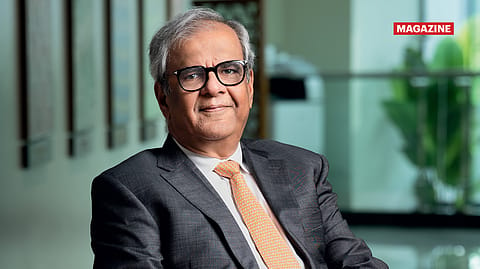
Ashok Vaswani, MD and CEO, Kotak Mahindra Bank. | Credits: Padmini B
This story belongs to the Fortune India Magazine november-2026-best-banks-and-nbfcs-2026 issue.
FOR ASHOK VASWANI, taking charge of Kotak Mahindra Bank (KMB) was a test of leadership from the outset. The former Citi and Barclays banker inherited one of India’s largest private sector lenders, but barely three months into his tenure, the Reserve Bank of India (RBI) barred the bank from onboarding new customers through its online and mobile banking channels, including Kotak811, and issuing fresh credit cards.
The restrictions followed the regulator’s assessment that KMB had deficiencies in IT risk and information security governance in 2022 and 2023, contrary to regulatory guidelines. The credit card business subsequently recorded a 7% year-on-year decline, according to the bank’s Q4FY25 investor presentation. The ban was lifted in February 2025.
The regulatory setback was compounded by stress in the retail portfolio. Higher delinquencies and weak disbursements forced KMB to shrink its retail microfinance book by 33% YoY and take a loss of ₹91 crore. Its unsecured loan portfolio also contracted, while profitability fell 7.5% during the quarter. Alongside these asset-quality concerns, the bank had to address technology gaps, leadership attrition, and the need to build a stronger consumer franchise.
Technology investments consequently became a priority. In FY25, technology spending accounted for 12.5% of total operating expenditure. By June, Kotak group CFO Devang Gheewalla told analysts that it continued to account for 13% of the bank’s total cost.
Vaswani, who took charge on January 1, 2024, will complete his term on December 31, 2026. The RBI has chosen Anup Saha, KMB’s whole-time director and consumer banking head, as his successor. By the end of 2026, the bank will have seen the exit of two MDs and CEOs — Uday Kotak and Vaswani — and one interim CEO, Dipak Gupta, within a span of three years and three months.
For Vaswani, the task was not simply to get the bank back on track, but to rebuild it for its next phase of growth.
That rebuilding exercise extended beyond technology and asset quality to the bank’s leadership. Several members of the old guard — including Dipak Gupta, Jaimin Bhatt, K.V.S. Manian and Shanti Ekambaram — had moved on before Vaswani’s arrival. Building a credible second line of leadership and addressing attrition, therefore, became key priorities.
More Stories from this Issue
Nitin Aggarwal, senior group vice president and head of BFSI at Motilal Oswal Financial Services, says: “Vaswani’s three-year term was spent on addressing the gaps on the regulatory and tech front, attrition issues, asset quality, and growing the unsecured pieces... Most of these issues have been addressed over the past three years, and the bank is well positioned to move ahead.”
Vaswani’s decision not to seek an extension has, however, drawn mixed reactions. While some market experts believe the leadership could have achieved more, others argue that the challenges were too extensive to resolve fully within a short tenure.
“While Vaswani brought global banking experience and a technology-led perspective, the key challenge was translating that vision into measurable gains in growth, customer engagement, and execution. In banking, strategic ambition ultimately has to be reflected in stronger business outcomes,” says a senior banker at a private bank.
A veteran banker who has closely observed KMB describes it as an institution balancing an aggressive regulatory history with ambitions to “fly higher”.
{{#most-powerful-women-snapshot-individual.slug}} {{/most-powerful-women-snapshot-individual.slug}} {{^most-powerful-women-snapshot-individual.slug}} {{/most-powerful-women-snapshot-individual.slug}} {{#showRanking}} {{current-rank}} {{/showRanking}} {{#photo.0.url}}
{{name}}
Vaswani, meanwhile, believes the bank is better placed for its next phase, after spending its recent years rebuilding its management team and cleaning up its personal banking, credit card, and microfinance businesses. “We have been doing hard, heavy lifting at the bank in recent years — rebuilding the management team, cleaning up the personal banking, credit card, and the microfinance book. All of this indicates that the bank is well set to accelerate its journey,” Vaswani said after announcing the bank’s Q1FY27 earnings on July 18.
“There is never a good time to call it a day. My decision [not to seek an extension] was well thought through,” he added.
Banking’s technology reset
A central part of that rebuilding has been technology. The RBI’s action in 2024 forced KMB to rebuild its technology platform, but the agenda now extends beyond regulatory compliance to customer experience, operating efficiency, and the delivery of financial services.
KMB has dedicated technology and AI verticals, with Nilesh Chaudhari as chief technology officer and Vijay Narayanan heading innovation and AI. Manish Agarwal leads Kotak811 alongside co-head Jay Kotak.
For Vaswani, these capabilities will increasingly determine how banks compete. “All the business models in financial services are going to change dramatically due to technology and AI. An AI agent can now tell you how to save your money and optimise the same,” he tells Fortune India. “Everything will depend on in-house capabilities. Banks will have to become disruptors, there is no choice,” he adds.
The shift is also changing how banks establish customer trust. As lenders such as SBI, HDFC Bank, ICICI Bank, Axis Bank, KMB, and DBS Bank expand their digital-first offerings, customer experience is becoming increasingly important. “Now that trust is seen through a digital world,” Vaswani says. He expects the transformation to accelerate despite potential setbacks. “Digitisation and AI will become far more important. There will be bumps along the way, but AI will fundamentally transform the industry.”
KMB has already introduced several AI-led initiatives. Keya was India’s first AI-powered voice assistant integrated into phone banking through interactive voice response (IVR). In mid-2025, the bank introduced Kotak Kompanion, a conversational AI assistant for frontline and sales staff, providing access to insights on consumer inputs, product building and digital penetration.
The bank has rebranded Kotak Securities as Kotak Neo, its consumer-facing retail trading arm. Its Neome AI tool enables customers to interact with the platform in the local language. Kotak Neo has also launched MCP (model context protocol), connecting the platform with Claude and Cursor so that customers can access holdings, portfolio details, order books and research recommendations through conversational queries.
Meanwhile, Kotak811 remains central to customer acquisition. Saha told analysts in June that it was the core India strategy for a scalable, digital-first platform spanning customer acquisition and lifecycle engagement across branch, sales and corporate salary channels.
New offerings include a metal debit card and SuperX, a 3-in-1 bundled proposition — one account containing savings, FDs, and a secured credit card. According to the bank’s Q1FY27 investor presentation, Kotak811 delivered a 32% YoY growth in savings account balances and currently contributes 12.7% of the bank’s total savings book.
The investments underline the bank’s ambitions, but the next test is translating them into stronger customer engagement, greater efficiency and sustainable profitability.
From corporate deals to consumers
Technology is only one part of KMB’s transformation. Equally important is its effort to become more customer-facing. Historically known for complex corporate deals and structured transactions, the bank has had to strengthen its processes, technology and retail orientation, particularly in personal banking and credit cards.
Vaswani has acknowledged that the challenge lay as much in execution as in strategy. “The tougher part for the bank was not the ‘what’ part. It was the ‘how’ part; the way of doing things. The truth is that the underbelly of the bank had been exposed in the Covid-19 pandemic… technology needed more investments, customer-centric banking was [the need of the hour]. We shifted the mindset.”
But the shift does not mean abandoning the corporate franchise. Asked whether KMB was on track to become a non-corporate bank, pat comes his reply, “I'm not worried about that.” In fact, the bank’s consumer ambitions predate Vaswani’s tenure. KMB built its current account and savings account (CASA) deposit base over the years, while the acquisition of ING Vysya Bank in 2015 strengthened its consumer-facing presence.
More recently, KMB has pursued acquisitions to deepen its retail and wealth management businesses. It acquired the personal loan book of Standard Chartered Bank’s India business in October 2024. In late June 2026, it announced the acquisition of Deutsche Bank’s retail, affluent private banking, and wealth management businesses in India. The deal, valued at ₹281.7 crore, was executed on a slump sale basis. Approximately 1,000 Deutsche Bank employees in India are expected to join KMB. The business comprises approximately ₹29,000 crore in loans, ₹16,000 crore in deposits and ₹10,500 crore in assets under management (AUM).
These acquisitions are expected to help KMB deepen relationships with affluent customers and cross-sell products across banking, insurance, securities and wealth management. Kotak811’s digital reach, combined with the profitability of subsidiaries such as life insurance and wealth management, could further support this strategy.
“The fact that they are wholly owned subsidiaries makes a massive difference. Also, there’s embedded value being created every year,” Vaswani says.
Going forward, the bank intends to focus on affluent customers, small and medium enterprises (SMEs) and institutional clients. The challenge will be to scale these businesses while maintaining asset quality and generating adequate returns.
Saha's next test
This is the franchise Anup Saha will inherit: one with technology investments and a broader consumer presence, but with focus on profitability and deposit mobilisation. For the incoming CEO, the priority is to turn Vaswani’s groundwork into profitable growth. That means building high-yielding consumer assets, expanding secured lending and strengthening the liability franchise.
According to Aggarwal, Saha will need to focus on profitability, consumer assets and secured lending.
Deposits remain a key challenge, though. KMB’s CASA ratio fell to 38.2% in Q2FY27 from 45.5% in Q4FY24. The bank has been seeking more granular savings growth among affluent and high-end customers, alongside its core Kotak811 franchise, Aggarwal says.
The leadership change could also affect investor sentiment. According to ICICI Securities analysts Jai Prakash Mundhra and Amansingh Sahajsinghani: “The appointment of credible bankers (Anup Saha at KMB and Anup Bagchi at HDFC Bank) is a re-rating event for the two heavyweight banks and for the sector.”
For Saha, the challenge will be to build on KMB’s corporate strengths while making consumer banking a more powerful growth engine, and ensuring that technology investments and an expanded retail franchise translate into consistent returns even for shareholders. The bank’s share price compounded at just 2.6% over the last five years.
For Vaswani, meanwhile, the decision to leave was shaped by personal and professional considerations. He cited family developments and his belief that the bank was positioned for stronger growth. “I just became a grandfather.” He is contemplating moving to Silicon Valley and exploring whether he can play a role in technology or consultancy.
And what does he think about his tenure?
“At the end of the assignment, look at yourself in the mirror, don’t go to superiors or peers. You can’t lie to the man in the mirror. The reflection tells me that I feel very good about what I’ve accomplished... [But] I could have done it differently. I worried a lot about taking the team along,” says Vaswani, while signing off.
Follow Fortune India
Sign in to read full story
To access our exclusive magazine content, sign in to your Fortune India account.
Sign In NowNEXT STORY