Fortune India Best Banks & NBFCs 2026: SBI’s digital leap
/ 6 min read
The winner in the super-large category, India’s largest lender is reimagining its digital architecture and leveraging its wider financial services ecosystem to drive growth.
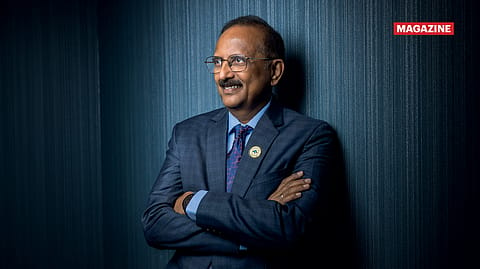
C.S. Setty, Chairman, State Bank of India | Credits: Nishikant Gamre
This story belongs to the Fortune India Magazine november-2026-best-banks-and-nbfcs-2026 issue.
A QUIET CALM greets visitors at State Bank of India’s (SBI) imposing 22-storey headquarters at Mumbai’s Nariman Point. It is a fitting setting for a banking giant defined by scale and heft — India’s largest bank, a listed, government-owned behemoth, with a consolidated balance sheet of ₹84.03 lakh crore, a network of over 23,200 branches across the country and a customer base of 530 million. Few institutions loom as large over India’s financial landscape as SBI.
But appearances can be deceptive. In a rapidly evolving financial landscape, where traditional savers are turning into technology-savvy young investors, SBI is positioning itself not merely as a custodian of household savings but as a financial services provider for a new generation. Chairman Challa Sreenivasulu Setty’s strategy reflects a bank adapting to structural shifts in household savings, investing in digital infrastructure and rethinking how it engages with customers.
Over the past decade, Indian households have diversified their savings away from traditional fixed deposits towards market-linked products, including mutual funds, equities, bonds and gold. Setty has often described this as the irreversible ‘financialisation of household savings’.
According to investment advisory firm Finnovate, between FY12 and FY25, the share of equities and mutual funds in annual household financial savings rose to 15.2% from around 2%, based on the Economic Survey 2025-26. Additionally, RBI-linked data shows the share of bank deposits in household financial savings declining to 35.7% in FY26, from 40.9% in FY21.
For SBI, this raises a critical question: how can it retain its deposit franchise as customers diversify into competing financial products?
“The structural shift is here to stay. Households, which have traditionally been strong supporters of bank deposits, are diversifying their savings, often without explicitly thinking about asset allocation,” says Setty. “But we have also seen that after a certain level, deposits continue to be the most preferred instrument. It is a cycle.”
He believes savings behaviour evolves with income and life stages. A young professional may prioritise systematic investment plans (SIPs) early in their career, but rising income can lead to a broader mix of investments later.
More Stories from this Issue
This does not mean deposits are becoming irrelevant, though. Rather, customers are becoming more selective about where to park their money. Savings accounts face competition from market-linked products as well as FDs within the banking system.
“Overall, CASA, which used to be 40-41%, is unlikely to be maintained in the system [at that level]. There will be a progressive decline,” Setty says. “Each bank would have its own way of dealing with it. But broadly, a bank of our size, [with a] 38-39% CASA, is at a fairly good level. You cannot increase CASA just by acquiring customers.”
SBI’s response is to deepen engagement with existing customers. Linking savings accounts to investment products can encourage customers to maintain higher balances while allowing the bank to participate in their wider financial lives.
“One has to hyper-personalise customers’ requirements and understand exactly what they are doing with their savings. We have seen balances go up when a bank account is linked to an SIP or a demat account. Once you see the pattern, those products become complementary. If you are able to offer that, customer stickiness improves,” adds Setty.
{{#most-powerful-women-snapshot-individual.slug}} {{/most-powerful-women-snapshot-individual.slug}} {{^most-powerful-women-snapshot-individual.slug}} {{/most-powerful-women-snapshot-individual.slug}} {{#showRanking}} {{current-rank}} {{/showRanking}} {{#photo.0.url}}
{{name}}
The strategy also addresses a wider industry concern. In an earlier note, Crisil associate director Vani Ojasvi had said “the decline in CASA deposits, coupled with a decreasing household share in term deposits, highlight the need for banks to proactively manage their deposit bases to mitigate potential risks to stability and costs.”
SBI, however, has an advantage most standalone lenders lack: being a diversified financial services group. As customers move money into MFs, insurance, and pension products, the bank can retain a larger share of their savings within its wider ecosystem.
“Interestingly, when bank deposits started shifting elsewhere, we were already present across those product categories. Today, we have life, non-life, mutual fund and pension fund businesses, which means the overall savings [kitty] stays within the ecosystem. It is a very interesting and powerful construct for the State Bank group,” Setty explains.
Retaining customers is only half the challenge. SBI must also ensure that serving them remains profitable as competition intensifies and traditional sources of banking income come under pressure.
REIMAGINING THE COST OF BANKING
Setty feels net interest margins (NIMs) across the industry are likely to moderate over time. “As the banking system becomes more efficient and customers more aware, NIMs will fall.”
For SBI, that makes non-interest income, operational efficiency, and operating leverage increasingly important. Lower costs can help protect profitability while allowing the bank to offer more competitive pricing to customers. “This means banks [will] need to bring down the cost of serving and intermediation,” Setty adds.
The opportunity is significant given SBI’s scale. Its standalone balance sheet size doubled to ₹76.62 lakh crore in Q1FY27 from a post-merger level (with five associate banks) of ₹37.06 lakh crore. Share price compounded at 13.8% over the past five years.
“While we have augmented both, the increase has not been linear, and we are still able to serve our 530+ million customers,” says Setty. “India is all about scale. If you are not building scale, you are not operating in the country.”
Technology is central to making this equation work. Digital channels allow SBI to serve more customers without a corresponding increase in physical infrastructure, while customer data can help improve engagement and service delivery. And that is where YONO, the bank’s digital platform, becomes central to its transformation.
YONO 2.0 AND THE AI PUSH
According to SBI’s FY26 annual report, 98.7% of transactions take place via digital and alternative channels. About a fifth of all SBI customers — 100.2 million — are registered YONO 2.0 mobile app users.
The platform also commands a significant share of banking transactions. It has a 23.65% market share in debit card spends, 31.04% in ATMs, 29.4% in mobile banking transaction volumes and 24.8% by transaction value (Q1FY27).
Setty says the latest version represents a fundamental redesign rather than a routine upgrade.
“The latest avatar of YONO is not an upgrade; it is a completely rebuilt application. We have completely revamped the technology, adopted microservices and worked with fintechs to develop journeys that appeal to customers. We have now built a layer of MarTech that enables hyper-personalisation on YONO.”
The ambition extends beyond the app. SBI wants digital processes to work seamlessly across mobile banking and physical branches, making process redesign essential.
As Setty once famously said: “Why can’t we YONO-ise our processes? If you have implemented something on your digital platform, it should happen in the branch.”
This redesign will also determine how effectively the bank can deploy AI. While AI offers opportunities to personalise services and improve productivity, the underlying processes and infrastructure must be in tune as well.
As an industry, AI adoption is still in nascent stages, says Setty. “We have not invested heavily in AI tools for cybersecurity.”
He, however, adds that SBI is working with the wider banking system to prepare for emerging AI-driven risks, including those associated with Mythos. “We have given a broader framework to all banks that needs to be followed. It talks about how to strengthen their technology platforms, protect their supply chains and build the supply chain for AI,” says Setty.
The bank is also considering whether capabilities developed for YONO could be extended to the wider banking industry.
“YONO will not stop at being an app, or monetising some of its features...SBI is evaluating whether it can develop processes, such as an authorisation or engagement layer, which can be made available to the [banking] system. It is part of the YONO 3.0 discussion.”
SBI’s digital transformation, therefore, is more than just expanding app usage. It aims to improve processes, deepen customer relationships, reduce costs, and strengthen cybersecurity — capabilities that will also influence its lending strategy.
LENDING TO A RESILIENT ECONOMY
India’s economic momentum offers SBI opportunities to deploy credit, even as global uncertainties complicate the outlook. The West Asia war has disrupted oil supplies, pushed up fuel prices, and put Asian currencies under pressure against the dollar. The international price of crude oil (India basket) is at $122.01 per barrel for October 2026, a seven-month high. Bank credit growth stands at 18% year-on-year, says RBI data.
“While we have larger external issues in terms of geopolitics and fragmentation, credit growth in the system remains robust. The consumption story continues to be strong, as reflected in both credit growth and GST collection. So the headwinds are essentially external,” Setty says.
India reported a real GDP growth of 7.8% in Q1FY27, riding on manufacturing and services, according to official data from the Ministry of Statistics & Programme Implementation (MoSPI).
Setty points to the economy’s ability to withstand successive shocks, from the pandemic and tariff issues to the fallout of the Russia-Ukraine war and the West Asia conflict.
“Over the last 5-6 years, India has tackled unprecedented challenges, including the pandemic, tariff issues and the fallout of the Russia-Ukraine, and West Asia wars. As an economy, we have handled things better.”
He also sees a strong banking system as a source of resilience, with cleaner balance sheets, prudent underwriting, better credit risk management, and improved digital lending systems.
“The whole scenario gives me confidence that banks will remain calibrated in their lending approach, supported or supplemented, of course, by the RBI's absorption of liquidity,” Setty says.
The bank, meanwhile, has several avenues for growth, including a reported corporate loan pipeline prospect of ₹5 lakh crore, which could support investments in data centres, renewable energy, and battery storage. Longer-term commercialisation of the YONO platform could also be on the cards.
For SBI, the next phase is about using scale while adapting to a more demanding customer. As household savings diversify, the bank aims to retain customer relationships through its wider financial services ecosystem, with digital architecture, process redesign and AI striving to make that ecosystem more efficient.
The test for Setty’s strategy will be whether these investments translate into deeper customer relationships, a more resilient deposit base and improved operating efficiency, without compromising the scale and stability that define India’s largest bank.
Follow Fortune India
Sign in to read full story
To access our exclusive magazine content, sign in to your Fortune India account.
Sign In NowNEXT STORY