Fortune India Exclusive: Adani moves forward with next-gen leaders driving a mega $120-bn investment plan
/ 15 min read
Pranav, Karan, Sagar and Jeet Adani will drive Gautam Adani’s mega capex plan for the next five years.
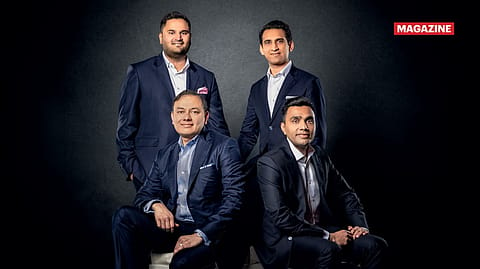
(Clockwise from top left) Jeet, Sagar, Karan and Pranav Adani. | Credits: Narendra Bisht
This story belongs to the Fortune India Magazine november-2026-best-banks-and-nbfcs-2026 issue.
The Fortune India team first met Adani Group founder and chairman Gautam Adani in the summer of 2022 at the group’s 16-storey headquarters in Shantigram, a modern township created 16 years ago on 600 acres along the SG Highway near Vaishnodevi Circle in Ahmedabad, Gujarat.
It was his first detailed interview with any English business magazine in recent years. He was about to turn 60 on June 24, 2022, and it would ordinarily have been considered too early to ask a businessman of his age and stature about succession plans.
But we did ask. Some family members were already working across the group, including two of his four brothers, two sons, and nephews and nieces. The businesses had also grown enormously in scale and complexity. If the group revenues were near ₹98,000 crore in FY20, they grew to almost ₹2.3 lakh crore by FY22 and to near ₹3 lakh crore in FY26.
Four years on, the group operates across more than two dozen businesses and is eyeing further expansions. Gautam Adani is one of the world’s richest billionaires. He owns 10 private jets, including a ₹1,000-crore Boeing 737-8 BBJ and a Bombardier BD-700 Global Express. His expensive car fleet follows a personal quirk: the numbers on their registration plates add up to 20, his lucky number.
And yet, even today, there is little of the billionaire aura one might expect. His demeanour is remarkably understated. He speaks in plain, simple English, using short, carefully considered sentences. Complex business equations and management jargon are often distilled into easy one-liners, punctuated by apt similes and euphemisms.
Four years ago, he did not offer a direct answer to our question about succession. Instead, with a broad smile, he had said: “Family is nothing but a partnership of multiple generations, and it depends on your family structure, responsibility, and respect among members. You can’t have all ‘five fingers’ of the same size, yet five fingers together will have more power.”
Four years on, much has changed. The business has expanded at express speed, despite challenges. And Gautam Adani has chosen four next-generation leaders to eventually take forward his sprawling business empire: Pranav Adani (the son of his elder brother Vinod Adani), Karan Adani (his elder son), Sagar Adani (the son of his brother Rajesh Adani) and Jeet Adani (his younger son).
More Stories from this Issue
“The next generation does not inherit leadership. They inherit the responsibility to earn it. I expect them to challenge our assumptions, think on a scale larger than ours, and move with greater speed, while having the patience to build businesses that may take decades to mature. They must have the courage to enter difficult sectors, the wisdom to learn from those around them, and the humility to realise that the institution will always be bigger than any individual or family,’’ Gautam Adani tells Fortune India. “Ultimately, I do not want them to be measured by how faithfully they preserve what we have built, but by how much stronger, more trusted, and more enduring they make the businesses for generations that follow.”
All four joined the group after completing their education overseas and were groomed directly by Gautam Adani. Over the years, they have stayed together, taking on larger responsibilities across different businesses. They have worked on the group’s most complex projects and proven themselves through execution. At an appropriate time in the near future, Gautam Adani will step back and hand over the reins to the “G2” leadership team.
One striking similarity in their thought process and demeanour with the founder himself is their ability to look ahead, identify business adjacencies, and emerging opportunities. Like him, they think at scale and remain passionate about building the infrastructure of future India. Like Gautam Adani, they also relish the challenge of choosing high-risk, big business opportunities that never existed before, and building large-scale infrastructure projects within near-impossible timelines.
“Taking charge of a group with such a diverse portfolio and significant market capitalisation requires strategic clarity, operational discipline, and a relentless focus on institution building. Pranav, Karan, Sagar, and Jeet bring complementary experiences across infrastructure, energy, ports and logistics, consumer businesses and emerging sectors,’’ says Vishal Kampani, vice chairman and MD, JM Financial. He notes that their decision to embrace a shared leadership model underscores the importance of continuity, collective decision-making, and individual accountability in sustaining a diversified group.
{{#most-powerful-women-snapshot-individual.slug}} {{/most-powerful-women-snapshot-individual.slug}} {{^most-powerful-women-snapshot-individual.slug}} {{/most-powerful-women-snapshot-individual.slug}} {{#showRanking}} {{current-rank}} {{/showRanking}} {{#photo.0.url}}
{{name}}
Professor Kavil Ramachandran, member, Supervisory Council, Thomas Schmidheiny Centre for Family Enterprise at the Indian School of Business (ISB), Hyderabad, points out that for strong and very successful founders across the world, the succession plan remains more on paper than in reality. The biggest challenge that successors face is to develop the skills and play the game together without the founder watching like a coach or manager.
“Their shadows are so long and their influence so strong, with loyalists all around, that successors find it difficult to step out on their own until the founders [are no longer in the picture],” says Ramachandran.
The big picture
With fresh legs taking guard, Gautam Adani and the group want to leapfrog their businesses to the next level and beyond. The group spent more than ₹1 lakh crore on some 35 acquisitions during 2017 to 2022. In comparison, it spent nearly ₹2.65 lakh crore on 55-plus acquisitions in the last four years, including its foray into cement. About 18 new businesses are in the incubation or take-off stage.
“India is entering what could be the most significant infrastructure investment cycle in its history. As India moves towards becoming a $10-trillion (around ₹960-lakh-crore) economy, demand across energy, transport, logistics, airports, digital infrastructure, and manufacturing will expand dramatically. Meeting that demand requires long-term capital, disciplined execution, and the confidence to invest ahead of the curve,’’ says the Adani Group chairman.
Against this backdrop, the group is preparing to invest $120 billion—approximately ₹11.4 lakh crore—in greenfield capital expenditure over the next five years across its core infrastructure businesses and emerging growth platforms, says Pranav Adani, the eldest of the four G2 leaders. “This plan does not include the group’s capex guidance into areas such as coal gasification, nuclear energy or aluminium,” adds Karan Adani.
If executed as planned, the investment programme could rank among the largest private sector investment programmes anywhere in the world, outside the extraordinary capital spending of giant U.S. technology hyperscalers such as Amazon, Microsoft, Alphabet and Meta. It offers a glimpse into the scale of the group’s ambitions and the next phase of its expansion through second-generation leaders.
Focus on asset creation
Gautam adani began his business in trading, mainly coal. He soon became one of the largest players in the world in the business and listed his firm, Adani Exports (now known as Adani Enterprises), in 1994. Within a couple of years, however, he realised that people perceived the business as just a trading house with ‘no assets on the ground’.
The realisation prompted him to own a port at Mundra, as the trading business was being routed through over 20 ports. He formed a joint venture in agri-commodities with Wilmar, a Singapore-based edible oil major looking for edible oil refineries near ports (he exited the business last year). Adani owned land near the Mundra port and became the largest importer and trader of coal. When an energy crisis hit India in 2006-07, and the government promoted thermal power plants, the group ventured into coal-fired thermal power generation. After three to four years, it moved into power transmission and distribution. After 2014, when the government decided to promote renewables, Adani jumped in with plans of becoming the world’s largest renewables player.
About 15 years ago, the group ventured into piped gas distribution in Gujarat and later teamed up with France’s Total to set up Adani Total Gas, now India’s largest private city gas distributor (CGD). The group, thus, expanded into multiple adjacencies, ranging from cement to copper, natural resources and airports, as well as allied businesses in aviation, roads, water, defence and the like.
Over time, the group has built a substantial asset base across businesses. Most are national assets of strategic importance, such as airports, roads, and power plants with operating lives spanning decades. By the end of FY26, the asset base had reached ₹7.85 lakh crore ($82.2 billion).
The group invested around ₹1.5 lakh crore in FY26, the highest private annual capex in the country. Investments in FY27 are expected to reach ₹2 lakh crore. It is preparing to expand its annual investment to around ₹3.5 lakh crore, 75% above its current planned annual capital expenditure, reveals Gautam Adani.
A pioneer in scripting the India infrastructure story, Gautam Adani knows what’s in store. “There are rare moments in a nation’s history when the infrastructure it builds determines the destiny of generations to come. I believe India is entering one such moment,” he says.
“India is approaching a historic inflection point, entering what could be the most consequential infrastructure investment cycle in its history,” he adds. “As our nation advances towards a $10-trillion economy, the next two decades will require investments of unprecedented scale across energy, transport, logistics, airports, manufacturing and digital infrastructure, including nearly 2,000 GW of additional power generation capacity.”
Gautam Adani, chairman, Adani Group | Credits: Narendra Bisht
The restructuring
To meet its unprecedented expansion plans, address capital requirements, reduce bureaucracy, and accelerate execution, the group plans to restructure and implement a three-layer organisational structure over the next three to five years. The aim is to create a leaner organisation with clearer accountability and significantly faster decision-making. By moving authority closer to project sites, leaders can make decisions in hours rather than days.
The move is expected to create larger leadership opportunities for younger professionals. Senior leadership can devote more time to strategy, capability building, and long-term value creation. Routine, transactional, and highly standardised activities will progressively move to global capability centres (GCCs) or be automated through artificial intelligence. That will allow people to focus on innovation, execution, and high-value decisions. Standardised site-execution activities will move to a select group of long-term strategic partners.
Technology will be a key enabler. The group is investing heavily in digital engineering, predictive analytics, and AI-enabled project management across every stage of all its projects, say the G2 leaders.
Around 65-70% of the $120-billion capex will go into energy, including renewables and their equipment, thermal power, T&D, data centres, and new energy forms. Around 20% will be in transport and logistics, while the remaining 10% will go into adjacencies such as cement, copper, and aluminium.
Energy to the core
Khavda is one of the most remote and little-known villages in Gujarat’s vast Kutch region—a windswept landscape of barren earth, brown mud, and scrub vegetation. There, Adani Green Energy—led by Sagar Adani—is executing a mammoth 30-GW renewable energy project comprising 26 GW of solar power and 4 GW of wind energy.
Spread across 538 sq. km—roughly five times the size of Paris and almost as large as Mumbai city—the project will deploy nearly 60 million solar modules and 770 advanced wind turbines. By 2029, the project aims to transform Khavda into the world’s largest power plant across all energy sources. That will also become the pivot for Adani’s growth plans.
By October, a 6.63 gigawatt-hour Battery Energy Storage System (BESS) had also come up at the site. It is the world’s largest single-location battery storage deployment and ranks among the fastest utility-scale battery storage projects executed globally.
That scale is not new to Sagar Adani. He is used to staying at project sites while executing large renewable energy projects. When Adani ventured into renewable power generation, the first project itself was mammoth: a 648-MW single-location solar plant at Kamuthi in Tamil Nadu, at a time when Indian developers were venturing into 10 MW to 50 MW plants.
Adani Green has established 20 GW of renewable energy capacity and plans to add another 30 GW by 2030. “Our plan is to have 50 GW of renewables, and an additional almost 40 GW of coal-based thermal capacity and 12–15 GW of pumped hydro—more than 100 GW of power generation capacity by 2032—and 100 GWh of storage capacity. Beyond that, we are working on a pipeline of another 200 GW post 2030, and a significant majority of that will be renewables—at least 60–65%—and another 10 GW of nuclear,” says Sagar Adani.
As the group builds more data centres, manufacturing facilities, copper and aluminium plants and other energy-intensive businesses, Adani Green will be the core energy provider, building additional renewable capacity to meet that demand.
But the group’s energy strategy is not about renewables alone. Adani Power, India’s largest private thermal power producer, has an operating capacity of 18,330 MW across 13 assets in nine states. It currently has a pipeline of 40 GW by FY35.
When the government changed its policy after 2014 to promote renewables and discourage polluting thermal plants, Adani Power had put its thermal power project pipeline on hold. But when the government decided to add thermal power capacity—as the country requires 100 GW of additional thermal capacity by 2032 to meet growing base-load and peak demand—Adani Power revived its thermal power projects and undertook a string of acquisitions involving stressed assets totalling 7.5 GW.
The other critical piece of the electricity architecture is transmission and distribution. Adani Energy Solutions Ltd (AESL), India’s largest private sector power transmission company with a 29% market share, plans to invest about $17 billion by 2030 in the T&D sector. Its transmission order book already exceeds ₹87,000 crore.
The group’s energy ambitions extend further downstream. In CGD, it has around one-fifth of the market share and has been allotted 53 geographical areas (GAs). According to Pranav Adani, Adani Total Gas will invest another ₹18,000-20,000 crore to develop the allotted CGDs. Another area is coal gasification and coal-to-chemicals such as PVC, where plans are to invest about ₹30,000 crore. It is developing a Mundra petrochem coal-to-PVC complex, a phased 2-MMT-per-annum PVC project, with the first capacity of 1 MMT per annum slated for commissioning by FY28.
Adani Enterprises, meanwhile, has applied for three coal-to-urea gasification projects under the Centre’s ₹37,500-crore Scheme for Promotion of Surface Coal/Lignite Gasification Projects. The Maharashtra government has also approved a separate ₹70,000-crore coal gasification project for the group in Nagpur. “We are assessing the required suitable technology for coal gasification,” says Jeet Adani.
Other forms of energy and natural resources are also set to power Adani’s ambitions. The group wants to become big in copper and has started Kutch Copper (KCL) with a 500-KTPA (0.5-MTPA) refined copper capacity at Mundra. It plans to double capacity to 1 MTPA, making it one of the world’s largest single-location custom copper smelters. The investment for Phase 1 is about $1.2 billion.
Coming to aluminium, the plans are even bigger. AEL and Abu Dhabi’s International Holding Company, through its subsidiary International Resources Holding, are teaming up for a 50:50 joint venture to build a mega integrated greenfield aluminium complex in Odisha. The investment will be around $11.5 billion (₹1.10 lakh crore), one of the largest such projects globally. Both these businesses are being spearheaded by Jeet Adani.
Another plan is to enter into the mining and processing of beach sand minerals and the titanium value chain. “Like ensuring energy security, India requires natural resources security. They are the foundational bedrock for the country’s industrial growth and energy security, whether it is coal, bauxite, iron ore, critical minerals or any other commodity,’’ says Pranav Adani. Already, Adani is India’s largest private miner. The group wants to become one of the largest mining groups globally. It has made huge investments in coal mines in Australia.
Creating future cities
Adani has started implementing one of the largest city redevelopment programmes in the world—the Dharavi Redevelopment Project in Mumbai.
“As part of Dharavi redevelopment, the mission we undertook is to build housing and civic infrastructure for nearly one million people—to construct over 1.5 lakh residential and commercial units. This means we will be constructing over 200 million sq. ft,” says Pranav Adani, who also heads the privately held Adani Realty.
Adani will spend over $4-5 billion in the initial phase, which is estimated to take about seven years. The project includes residential and commercial infrastructure, schools, colleges, parks and places of worship, integrating quality housing with essential civic infrastructure. It will include transportation connectivity, water supply, hospitals, electricity, sanitation, and digital services. The project will also rejuvenate the Mithi Riverfront, on the lines of Singapore’s Boat Quay. A 3.3-km elaborate, decorated riverfront promenade will run along the river, from the Matunga culvert to the Mithi Riverfront.
The group is also handling the redevelopment of the 143-acre Motilal Nagar MHADA flats in Goregaon, and the Maharashtra State Road Development Corp. headquarters. It is also bidding for more such projects in Mumbai.
Also on the cards is an over 1,000-acre township near the Navi Mumbai International Airport in Panvel. “The initial spending will be $1-2 billion to create basic infrastructure; land acquisition is done,” says Pranav Adani.
Cement, ports & airports
Adani Enterprises started a cement subsidiary in 2021 and, in September 2022, acquired Holcim Ltd’s stakes in Ambuja Cements and ACC Ltd for $10.5 billion to become the second-largest cement player in India behind Aditya Birla Group’s UltraTech Cement. Since then, Adani has made six acquisitions in cement, spending over ₹25,000 crore. “We are currently at roughly 114 million tonnes (MT) of cement capacity and expect to reach around 140 MT by 2030,” says Karan Adani, who also heads the cement business.
But the company closest to his heart, and nurtured over the years, is APSEZ, which he wants to make the world’s largest port operator and double its capacity to 1,000 MTPA. “As we move towards one billion tonnes by 2030, APSEZ’s Ebitda should increase by 130%, or about 2.3x its current level. The ports business will make a significant contribution to the group’s Ebitda growth,” says Karan Adani.
APSEZ will invest ₹1 lakh crore, excluding acquisitions, in the next five years. Around `70,000 crore will go into the expansion of ports—mainly Mundra, Dhamra, Vizhinjam, Krishnapatnam and Hazira, where the group has significant room to expand capacity. The marine business will attract investment of ₹20,000 crore, including oil and gas-related marine services and tugs. The remaining ₹10,000 crore will go into logistics.
His brother Jeet, meanwhile, has a tougher job to accomplish: completing the remaining three phases of the Navi Mumbai International Airport in Panvel and integrating it with the Mumbai airport, besides modernising the Ahmedabad, Lucknow, Mangaluru, Jaipur, Guwahati, and Thiruvananthapuram airports.
AAHL’s passenger capacity is around 125 million per year, and the target is to reach 200 million passengers by 2030, says Jeet Adani. “We are going to spend ₹80,000 crore in airport development and ₹20,000 crore in the first phase of airport-related city-side infrastructure developments.”
Data centres & defence
A young Jeet Adani appears more excited about the future play than the three elder G2 leaders. “We are witnessing a once-in-a-millennium kind of infrastructure build-up. Consider this to contextualise: the total spend for the 50,000-mile U.S. interstate highway system, plus the entire Apollo programme and the International Space Station over 50 years, was $1 trillion. Next year, the four big tech companies alone are going to spend $1 trillion. That is in one year,” he says, highlighting the scale of the opportunity before him.
The group is positioning itself to become one of the largest service providers to these technology giants through its data centre business. The group has also committed a direct investment of $100 billion to develop renewable energy-powered, hyperscale, AI-ready data centres by 2035, along with an additional $150 billion across server manufacturing, advanced electrical infrastructure, sovereign cloud platforms and supporting industries. Together, it is projecting a $250-billion AI infrastructure ecosystem in India over the next decade.
Work has already begun. Adani Enterprises has formed a 50:50 joint venture with the U.S.-based Jabil Inc. to manufacture and assemble AI and data-centre hardware in India. Google and Adani are partnering to build India’s largest GW-scale AI and data centre campus in Visakhapatnam, with an investment of $15 billion.
Jeet Adani’s other responsibility is to build on the group’s fledgeling defence and aerospace business. It entered the space in 2015, and has since expanded from a portfolio of unmanned systems and small arms into a broader, integrated defence manufacturing platform covering ammunition, missiles, UAVs, counter-drone systems, and aircraft services/MRO. In aerospace, it has acquired Air Works, Indamer Technics, and Flight Simulation Technique Centre, creating big capabilities across MRO, flight training, and simulation. In 2026, Adani Defence announced tie-ups with Embraer for a regional transport aircraft manufacturing ecosystem and Leonardo for an integrated helicopter manufacturing ecosystem.
The group has invested ₹18,000–20,000 crore to create the infrastructure in defence and aerospace, and the business is now looking forward to big orders from India’s defence services and abroad, says Jeet Adani.
The road ahead
The next phase will be defined by the ability of the next generation of leaders to convert scale and ambition into durable, inclusive growth. The opportunity is immense, but so are the challenges: execution, and capital discipline, governance and public trust being the key issues.
Another issue is that the group’s businesses are policy-dependent, says Kavil Ramachandran of ISB. Just as Dhirubhai Ambani, the Adanis will have to master the art of navigating the political landscape, he adds. He also notes that although the Adanis have ring-fenced ownership via trusts, they need to have very strong family governance in practice and also an independent board of directors at the group level, more like a holding company board.
The group had a gross debt of ₹3.71 lakh crore in FY26. Although it has a strong track record of debt management, it could become more challenging as plans are to raise annual capex spending by 75% to ₹3.5 lakh crore a year. Kampani says though the next generation builds on Gautam Adani’s entrepreneurial legacy, the priority will be to drive innovation, strengthen institutional capabilities, and respond with agility to market dynamics.
If the group delivers on its plans, it could emerge not merely as one of India’s largest conglomerates, but as a defining force in the country’s next era of economic transformation.
Follow Fortune India
Sign in to read full story
To access our exclusive magazine content, sign in to your Fortune India account.
Sign In NowNEXT STORY