Fortune India Exclusive: APSEZ could potentially be net debt-free by 2030, says Karan Adani
/ 5 min read
Adani Ports and Special Economic Zone targets 1 billion tonnes of capacity by 2030; group also eyeing a bigger play in cement, aluminium and copper.
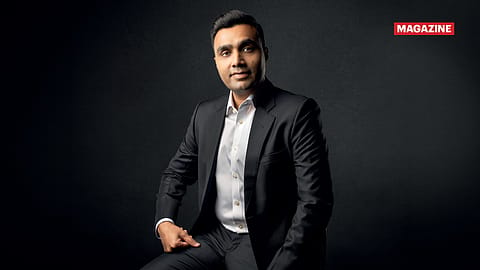
Karan Adani, MD, APSEZ | Credits: Narendra Bisht
Karan Adani, 39, is closely involved in the Adani Group’s ports, logistics, transportation and cement businesses, with a focus on translating investment plans into operating performance. He joined the group in 2009 at Mundra Port, became CEO of Adani Ports and Special Economic Zone (APSEZ) in 2016 and was appointed MD in January 2024. During this period, APSEZ grew into a network of 20 ports and terminals across India and international markets. Edited excerpts.
On APSEZ’s growth plans
I see our growth opportunity as closely linked to India’s growth. We are still in the early stages of a much larger journey. As manufacturing, consumption and incomes increase, the country will need more efficient ports and logistics. The changes in global supply chains also create an opportunity for India, given its location between the Middle East and Southeast Asia.
I have always believed that identifying an opportunity is the easy part. The real challenge is execution. At Mundra, Dhamra, Krishnapatnam, Gangavaram, Vizhinjam and Hazira, we have spent years building the fundamentals—land, waterfront, connectivity and approvals. That gives us room to grow. Now we have to keep improving how those assets perform: vessel turnaround, equipment productivity, customer service and the cost of moving cargo.
We also see more cargo moving in containers and shipping lines deploying larger vessels. We need to be prepared for that change. I do not think we should take market share for granted. We have to earn it every day by being more reliable and efficient. To me, a port’s success is not just how much cargo it handles, but how well it serves the customer.
On keeping India first while expanding internationally
India remains our first priority. Trade here has been growing much faster than in many mature markets, and there is still a lot of infrastructure to build. We must make sure we do not get distracted from that.
At the same time, our experience in India has given us capabilities that can be useful elsewhere. We have invested in Haifa, Dar es Salaam and Australia, and we will continue to evaluate opportunities. I do not believe in acquiring an asset simply to add another location to the map. We have to understand what we can improve, what capital it will require and whether the returns justify the risk. Buying an asset is one decision. Making it perform consistently over the next 10 or 20 years is the real test.
We are fortunate that APSEZ has a strong balance sheet. Our net debt to Ebitda is around 1.7x, while Ebitda has been growing at approximately 25% annually. With normal capex of about ₹10,000–12,000 crore a year and no major acquisitions, we could potentially be net debt-free by 2030. We have set an internal guardrail of 3x net debt to Ebitda, but that is not a target. Financial discipline gives us the freedom to invest when the right opportunity comes.
More Stories from this Issue
Our ambition is to move towards 1 billion tonnes of capacity by 2030, with Ebitda potentially reaching about 2.3x its current level. Those are important aspirations. But targets on paper mean very little unless our teams deliver the projects on time, operate them well and generate the returns we have committed to.
On aluminium, copper and titanium
Whenever we look at a new sector, the starting question should be: what advantage do we bring to it? The group has spent years developing capabilities in energy and logistics. So businesses where those two strengths make a meaningful difference are a natural area for us to examine.
Aluminium is highly power-intensive. Copper is already operational for us, and we intend to expand it. We are also studying the titanium value chain, including beach-sand resources and downstream products. These materials are important for India’s manufacturing and defence ambitions.
But being excited about a sector is not enough. We need to understand the technology, cost structure, execution risks and long-term competitiveness. We should enter a business only when we are confident we can build and operate it well. I would rather move carefully and get the fundamentals right than chase growth for its own sake.
{{#most-powerful-women-snapshot-individual.slug}} {{/most-powerful-women-snapshot-individual.slug}} {{^most-powerful-women-snapshot-individual.slug}} {{/most-powerful-women-snapshot-individual.slug}} {{#showRanking}} {{current-rank}} {{/showRanking}} {{#photo.0.url}}
{{name}}
On cement and the importance of cost competitiveness
When we entered cement through Ambuja and ACC, it was a new industry for us. We had a lot to learn, and we still do. The people who have run these plants for years understand the business in a way that no presentation can fully capture. My job is to ask the right questions, support the teams and remove the obstacles that prevent them from performing better.
What gave us confidence was the fit with our existing capabilities. Coal, power and logistics account for a very significant share of cement costs. We have experience in all three. Our goal is to use that advantage to build a structurally low-cost business, not to rely on favourable pricing cycles.
At the time of acquisition, our costs were around ₹5,000 per tonne. We have brought them down to approximately ₹4,200, and we believe there is another ₹500-600 per tonne we can take out. These improvements do not come from one big announcement. They come from detailed work at every plant—energy efficiency, maintenance, procurement, logistics, better processes and accountability. It is not glamorous work, but it is what builds a competitive business.
We are at roughly at 114 million tonnes of capacity today and expect to reach about 140 million tonnes by 2030. We are targeting an Ebitda of ₹14,000–15,000 crore. I pay close attention to those goals, but I also look at cost per tonne, plant-by-plant performance, cash generation and return on capital. Adding capacity without improving the quality of the business is not enough.
The industry has already gone through a period of consolidation. We may see less of it over the next four or five years, although these cycles are difficult to predict. We will stay alert to opportunities. For now, there is a great deal we can achieve simply by making our existing operations better.
On the group’s next phase of growth
Around 65% of the group’s planned greenfield capex is directed towards energy, across thermal and renewable capacity. The guidance we have shared is based on the businesses and growth plans already in place. New areas such as aluminium and coal gasification are opportunities beyond that base plan, not something we have assumed in those numbers.
I have learned that large infrastructure projects test your patience. There are always challenges on the ground. Plans change, timelines get tested and problems come up that you cannot anticipate from an office. The only way forward is to stay close to the details, listen to the people doing the work and keep solving problems.
I have also been fortunate to learn from people who have spent decades building these businesses. Whatever progress we have made is the result of the efforts of thousands of colleagues across our sites, plants and offices. That is something I never want to lose sight of.
For me, growth is not an end in itself. We have to earn the right to grow by delivering on our commitments, protecting our balance sheet and making each business stronger. If we can keep doing that, we will build companies that remain relevant for decades and contribute meaningfully to India’s development.
(For details on the Adani Forward gameplan, read the November issue of Fortune India.)
Follow Fortune India
Sign in to read full story
To access our exclusive magazine content, sign in to your Fortune India account.
Sign In NowNEXT STORY