Fortune India Exclusive: How Roshni Nadar Malhotra is reshaping HCLTech
/ 6 min read
The chairperson of one of India’s original ‘IT garage startups’, Roshni Nadar Malholtra believes in focussing on business fundamentals and simplified decision-making as the cornerstone of HCLTech’s success.
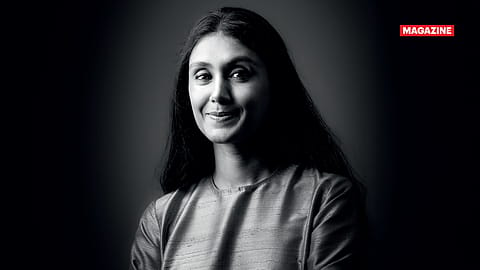
Roshni Nadar Malholtra, Chairperson, HCL Technologies. | Credits: Narendra Bisht
This story belongs to the Fortune India Magazine july-2026-mpw-100-most-powerful-women issue.
GROOMED TO TAKE over the HCL empire from her father Shiv Nadar, one of the OGs of India’s IT and tech stories, Roshni Nadar Malhotra has steadily carved out her own place in India’s corporate landscape. She not just sits on the boards of several group companies such as HCL Corp. Private Limited and HCL Capital Private Limited — she also chairs the board of its flagship IT services and consulting firm, HCL Technologies Ltd. The country’s richest woman, according to the Hurun India Rich List 2025, she also made history as the first woman to chair a major Indian IT company — an industry that has shaped the country’s economic story for more than five decades.
Leadership lessons
“If you know him, and if you met Shiv [Nadar], there is nothing subtle. Whatever he does, he does it with a lot of deliberate clarity,” is how Malhotra recalls her father’s succession and leadership planning, likening it to a chessboard. “He was deliberately grooming different people for different roles, because he had a certain vision for HCLTech, and we all sort of fit the chessboard.”
Long before she formally joined HCL Corp. in 2008, Malhotra was being immersed in the business from the ground up. Summer breaks from the Kellogg School of Management saw her spend time at HCL’s Puducherry computer-manufacturing facility, while internships took her to California to work alongside HCL Technologies’ teams. The exposure was no accident. It was part of Shiv Nadar’s deliberate effort to give his daughter — and future successor — a ringside view of every facet of the HCL group. Hence, in 2009, as a 27-year-old taking over as the CEO of HCL Corp. from Shiv Nadar, “it was like a strategy. Throwing you into the deep-end sort of move because, you feel like you’ve got that title. So, I better get serious about everything ”, she says.
Malhotra met current MD and CEO C. Vijayakumar (popularly known as C.V.K.) during the intermittent years between her joining the board of HCLTech in 2013 to her elevation as vice chairperson in 2018. “One of the things I did when I joined the board was to make a conscious effort to go to a lot of locations so that I could meet a lot of leaders, because our largest market is North America and then Europe,” she says.
Crediting her father for allowing her to build independent equations with the leaders of the company, especially insisting on making the effort to meet them, Malhotra says, “I give kudos to Shiv [Nadar] because he said you make the effort, you get on the calendar… everyone is busy.” This familiarity, with not just the operations, but also the leaders of the company, is something that made the transition into her next job, as the chairperson of HCL Technologies not just easier, but also more effective.
Building strategy
Amid the pandemic and virtual working hours, on July 17, 2020, the board of HCL Technologies — which met over a video call — appointed Malhotra as non-executive chairperson, following Shiv Nadar’s decision to step down as chairman.
One of her strategic focus areas has been running a much tighter board for effective and quicker decision-making, which a couple of years ago, in FY23, had reached up to 14 members. “Strategically, it became easier for the management and the board to communicate a lot more. Not that they weren’t communicating earlier, but having a much more focussed strategic vision, which is aligned both ways, putting in some more parameters which were important, helped us focus, even from a market perspective.”
More Stories from this Issue
The streamlined board structure was not merely a governance overhaul; it also created the space for sharper, more focussed conversations about HCLTech’s long-term direction. Despite operating in a fiercely competitive market, conversations with her father were seldom about competition, reveals Malhotra. The focus was on HCLTech’s core strengths — customer depth, engineering excellence, and strategic bets such as the $1.8-billion acquisition of select IBM software products in 2019.
“It was much more about leaning into our core strengths. And our core strengths are a little different. So, there was a lot more discussion about that,” she adds.
For the company, the past three years have been a story of industry-leading growth, outpacing peers such as TCS, Infosys, and Wipro. In FY24, HCLTech registered revenues of $13.27 billion, up 5.4% year-on-year, which went up to $13.84 billion in FY25. Fiscal year FY26 proved to be a standout, with the company recording its fastest growth at 6%, with consolidated revenues of $14.7 billion, while peers such as TCS and Infosys recorded a dollar revenue growth of –0.5% and 4.6%, respectively.
Malhotra credits the success to C.V.K. and his team and believes the momentum was set when she took over as vice chair and Vijayakumar became the CEO and later the MD of the company. “In a highly competitive environment, and it’s only gotten more competitive, chemistry is important. Luck is important. Perhaps some of that has helped us in the last couple of years,” she says.
{{#most-powerful-women-snapshot-individual.slug}} {{/most-powerful-women-snapshot-individual.slug}} {{^most-powerful-women-snapshot-individual.slug}} {{/most-powerful-women-snapshot-individual.slug}} {{#showRanking}} {{current-rank}} {{/showRanking}} {{#photo.0.url}}
{{name}}
AI and the future of Indian IT
At a time when global technology conversations have moved to artificial intelligence and agentic AI, Malhotra refers to the earlier pivot to software products and carving out HCL Software as ‘serendipitous’, and preparing the organisation ‘culturally’ by making teams and leaders adapt to change, especially the ability to learn and execute in real time and prepare for the AI-led change. “What the software business allowed us to do is understand this non-linearity and growth equation. Today, when you apply AI and see how companies like us in our industry evolve, you have to decouple revenue growth from headcount growth, and some of that already happens in software,” she says.
Malhotra points to the decoupling of revenue from headcount — with AI driving productivity and sharper talent utilisation — as a key shift. She also credits a series of strategic bets for helping HCLTech outpace peers: an all-weather portfolio spanning engineering, digital, cloud, software, and AI; a leaner workforce; a relentless focus on engineering-led differentiation; and an aggressive push into new growth areas such as Physical AI, AI factories, and outcome-based solutions for customers. “Lastly, a stable leadership and one large shareholder didn’t allow not too many interests in the room,” she says, adding, her focus as the chairperson has been to simplify decision-making and make it easier for the management to function.
With customer relationships dating back years, trust and a deep relationship that brings unprecedented understanding to the needs of enterprises, Malhotra sees being able to change with the needs of the clients and staying relevant with tech offerings assuming even more significance in the AI era. IT stocks have faced a sentiment-driven sell-off this year, with every new frontier AI model release reigniting questions about the long-term value proposition of traditional IT services firms. Malhotra, however, says valuation matters only if one is going to sell the company, and parallels with American companies’ valuation structure doesn’t paint a clear picture.
“It’s a little boring, but we focus on fundamentals like profit, cash and margins. Since we all are fairly debt-free as an industry, and we sit on good cash reserves, this is probably a good time to also put it to good use.”
HCLTech has had a history of acquisitions and joint ventures as an active growth route. Malhotra considers it a strategy to stay on top of the tech cycle. On future acquisition, she says, for those assets that are in the adjacencies, the services and the platform-based IP-led growth strategy would have to be a strategic fit, as well as relevant to the customer. Those would always be on the radar.
Earlier this year, the HCL group announced its foray into the semiconductor space through a joint venture with Hon Hai Technology Group (Foxconn) to set up an OSAT (Outsourced Semiconductor Assembly and Test) unit at an investment of ₹3,706 crore. “Some of that bluish portion investment is what we are doing at the HCL group… getting into semiconductors and some of those things because they have a longer lead time,” Malhotra says.
When not ‘HCL-ing’, Malhotra is a ‘homebody’, and prefers to spend time with her family and pets. Being passionate about wildlife conservation, she founded The Habitats Trust in 2018, which focusses on the conservation of lesser-known species and habitats. Not surprising that her preferred holiday destinations are wildlife sanctuaries. Though not a foodie, Sundays are reserved for South Indian. And for burning the calories? Exercise is an unmissable part of her daily routine.
Follow Fortune India
Sign in to read full story
To access our exclusive magazine content, sign in to your Fortune India account.
Sign In NowNEXT STORY