Fortune India Exclusive: We see our data centre business scaling to at least 5-10 GW, says Jeet Adani
/ 5 min read
City-side development set to be a major part of the group's airport strategy; AAHL is constructing around 22 million square feet of real estate across Mumbai, Navi Mumbai, Ahmedabad, Lucknow, Jaipur and Guwahati in the first phase.
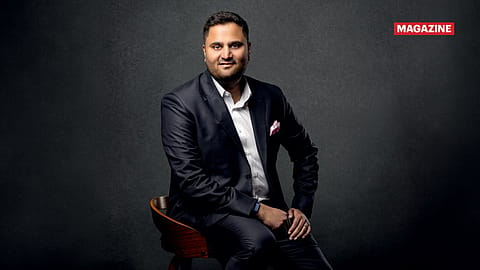
Jeet Adani, director, Adani Airport Holdings Ltd | Credits: Narendra Bisht
This story belongs to the Fortune India Magazine november-2026-best-banks-and-nbfcs-2026 issue.
Jeet Adani, 29, is director at Adani Airport Holdings Ltd (AAHL), which manages and develops eight airports. He leads several future-focussed verticals across the group, including AI, data centres, defence, petrochemicals and metals (copper and aluminium), reflecting his expanding role in shaping the group. He joined the group in 2019 after attending the University of Pennsylvania School of Engineering and Applied Sciences, U.S. He began his career in the group chief financial officer’s office, working across capital markets, risk and governance policy, and strategic finance, with exposure to all listed businesses. Edited excerpts.
On Mumbai and Navi Mumbai airport expansions
Post Navi Mumbai, our current passenger-handling capacity is about 125 million passengers a year. With the expansions we are planning, we expect to reach about 200 million passengers annually by around 2030-31 across our existing airport assets. This does not include any acquisitions or further privatisations.
The biggest capacity addition will come from Navi Mumbai’s Phase 2. Given the latent, unserved demand in the Mumbai region, we believe the current phase will be full in the next 2-3 years. We are kick-starting the expansion this year, adding 50-million passenger capacity. It will include a massive new terminal, a second runway, additional aircraft parking, metro connectivity and an automated people mover across the airport. Navi Mumbai will eventually have a 70-million-passenger nameplate capacity, compared with 55 million at Mumbai airport.
We are also advocating combining the tariffs of both airports. From an airline and consumer perspective, regardless of which airport passengers use, the pricing should remain the same. Navi Mumbai still needs better connectivity. Metro Line 8 will connect directly to the terminal, with the expansion and connectivity projects running broadly together.
We are also discussing with major airlines and cargo-freighter networks how operations should be divided between the two airports. Airlines such as Air India and IndiGo, which have a large presence in Mumbai, are likely to operate from both, while some international carriers may choose one airport.
Capacity expansion is also happening across the regional portfolio. Ahmedabad’s new terminal, which will be ready around the Commonwealth Games, will double its capacity. Jaipur and Trivandrum are also being expanded, while Lucknow’s Phase 2 is already under construction.
On city-side development near airports
City-side development is a major part of our airport strategy. Airports globally have evolved into economic and, in some cases, entertainment centres. In India, apart from limited development at Delhi Aerocity and Bengaluru, there has been little substantial placemaking around airports.
More Stories from this Issue
We want airports to become destinations where people can work, live and play, rather than simply go to catch a flight. We are currently constructing about 22 million square feet of real estate across Mumbai, Navi Mumbai, Ahmedabad, Lucknow, Jaipur and Guwahati. This is only Phase 1; subsequent phases will develop additional areas.
The focus is on hospitality, commercial and entertainment assets—the live, work, play concept. Phase 1 of the city-side development represents about 20% of the total area with development potential. We have budgeted around Rs 20,000 crore of capex for this phase.
The government is also expected to launch another round of airport privatisation, similar to the six airports privatised in 2019. We will also keep some capital available for opportunistic acquisitions, greenfield projects or other opportunities.
On capturing the data centre opportunity
With AI and data centres, we are witnessing a once-in-a-millennium infrastructure build-up. For context, the entire U.S. interstate system, the Apollo programme and the International Space Station together cost about $1 trillion over 50 years. The four big technology companies alone are expected to spend $1 trillion next year. That is the huge opportunity.
{{#most-powerful-women-snapshot-individual.slug}} {{/most-powerful-women-snapshot-individual.slug}} {{^most-powerful-women-snapshot-individual.slug}} {{/most-powerful-women-snapshot-individual.slug}} {{#showRanking}} {{current-rank}} {{/showRanking}} {{#photo.0.url}}
{{name}}
When we started AdaniConneX in 2020-21, the focus was on data localisation, cloud services and software as a service. Our initial plan was to reach 500 MW of contracted capacity by 2030.
Today, demand has changed dramatically. We have contracted about 1.82 GW of capacity, all of which is being delivered over the next 18 months, and we continue to contract additional capacity. If current trends continue, we see our data centre business scaling to at least 5-10 GW.
The strength of AdaniConneX is that we provide an integrated solution—from site development and buildings to power connectivity and generation. A customer such as Google or Microsoft does not have to coordinate with multiple contractors; it can work with one partner providing the complete solution. We believe no other company in Asia or India currently offers this at the same scale.
We have said we would invest under $250 billion in the entire data centre infrastructure ecosystem, including green energy, battery storage, transmission, distribution and downstream network connectivity. AdaniConneX is the data centre development vehicle, working with Adani Energy Solutions and Adani Green for the power solution.
On building defence & aerospace verticals
We started the defence business in response to the national requirement of India becoming self-reliant in critical defence equipment. We began investing in capabilities in 2016 and spent 4-5 years developing manufacturing, R&D, materials and supply chain capabilities before selling a single product.
From 2021, the armed forces began accepting our products more widely. The business is organised mainly into four verticals: ammunition; gun systems; ordnance systems such as missiles and bombs; and aerospace.
The ammunition facility in Kanpur is being expanded as we approach capacity. In Gwalior, we manufacture pistols, small arms, rifles, sniper rifles and large machine guns. In missiles and bombs, we work with international partners as well as DRDO programmes. Our products have been successfully tested and accepted by the armed forces for quality and efficacy.
We have invested about Rs 18,000 crore in the defence business, including acquisitions, capex and development costs. Most of the heavy development investment has already been made. We expect another Rs 5,000-10,000 crore at most, including acquisitions.
We are now entering the phase where we start realising returns on those investments.
On aerospace ecosystem development
The aerospace vertical includes MRO services and manufacturing plans. Aerospace manufacturing initiatives are with Embraer and Leonardo. The objective is capability creation first, followed by self-reliance and eventually exports.
In aerospace, our ambition goes beyond being a tier-one or comprehensive supplier. We want to deepen the entire supply chain. We are exploring engine MRO as well as engine manufacturing, potentially beginning with components and assembly before moving deeper into the value chain. We are discussing this with potential partners, although some engine technologies are subject to restrictions.
We are also looking at aircraft manufacturing in India through our tie-up with Embraer. This will be dual-use: fixed-wing aircraft will be civilian, while rotary platforms such as helicopters will be dual-use.
On broader group business strategy
The underlying philosophy is capability creation. In defence, our first objective is to make India self-reliant; once India becomes self-reliant, we believe it can become a net exporter because the country has some of the best engineering talent and cost competitiveness in the world.
The same philosophy applies to airports and data centres. We are not simply adding capacity; we are building integrated ecosystems. Airports are being developed as economic destinations, while data centres combine land, buildings, power, renewable energy, storage and connectivity.
Across these businesses, the objective is to use the group’s strengths in infrastructure, energy, capital and execution to build at scale and create long-term strategic capabilities in India.
(For details on the Adani Forward gameplan, read the November issue of Fortune India.)
Follow Fortune India
Sign in to read full story
To access our exclusive magazine content, sign in to your Fortune India account.
Sign In NowNEXT STORY