Global fashion's Indian touch
/ 6 min read
Indian fashion creators are increasingly becoming valuable partners for global companies seeking authenticity, craftsmanship, and access to one of the world’s most dynamic consumer markets.
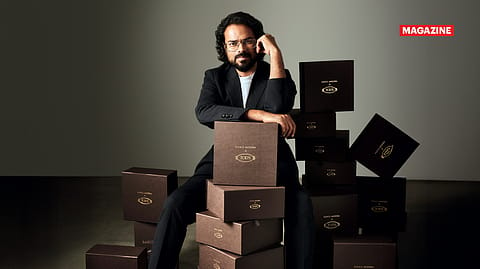
The collaboration between Tod’s and Rahul Mishra saw an amalgamation of Italian and Indian luxury craftsmanship.
This story belongs to the Fortune India Magazine july-2026-mpw-100-most-powerful-women issue.
IN 2014, when Rahul Mishra became the first Indian to win the prestigious International Woolmark Prize, he put the brilliance of Indian artisans and slow fashion into the global spotlight. The prize took him and Indian designs to places. It gained him a ticket to the Paris Haute Couture Week, an association that continues to date. And, that was only the beginning. Cut to 2026, and Mishra’s collaboration list boasts of the likes of Italian luxury brand Tod’s, Johnnie Walker, and Swarovski.
Today, joint ventures between Indian designers and global brands have become a defining feature of the luxury and lifestyle landscape. Brands such as Bergdorf Goodman, H&M, Pottery Barn, Starbucks, and Christian Louboutin introduced Sabyasachi Mukherjee’s signature blend of heritage and luxury to the world. Manish Malhotra has lent his design sensibilities to Golden Goose, Air India, Marriott Bonvoy, and Range Rover. Yet, before all of them was Manish Arora, whose pioneering collaborations demonstrated that an Indian designer could not only participate in global conversations but also shape them.
Arora’s aura
At a time when Indian fashion was still striving for sustained visibility on the global stage, Arora emerged as one of the country’s most recognisable creative exports. Celebrated for his exuberant aesthetic, fearless use of colour, and unmistakable design language, his opulent designs made him one of the earliest Indian designers to successfully bridge the worlds of fashion, luxury, beauty, lifestyle, and consumer brands through a series of high-profile international collaborations.
At his peak, Arora’s name was synonymous with creative partnerships that transcended conventional fashion boundaries. An impressive roster of global names, including Reebok, Nespresso, Swatch, MAC Cosmetics, Champagne Pommery, Absolut Vodka, Nivea, 3Suisses, Café de la Paix, Swarovski, and Disney, among others, made a beeline to get him to inject freshness and cultural relevance into their offerings. These partnerships not only showcased his ability to adapt his maximalist vision, which often bordered on outlandishness, across diverse product categories but also demonstrated that Indian design talent could command attention from some of the world’s most influential brands. From becoming the first to debut at the London Fashion Week to later graduating to the Paris Couture Week runways, Arora was perhaps the only known Indian name known internationally, with several prestigious global brand associations coming his way.
But the designer maverick’s stay at the top was short-lived. After a successful creative stint, he decided to hang up his boots when his brand took a tumultuous turn at the peak of his fame a few years ago. Nevertheless, he taught a new generation of ambitious Indian designers to aspire.
Tod's T Timeless Gommino loafers and Di Bag designed by Rahul Mishra.
The world of collabs
Collaborations between brands and creative visionaries have long served as powerful cultural and commercial milestones in global fashion. More often than not, the designer commands as much influence as the brands — sometimes even more. The venture between the late fashion icon Karl Lagerfeld and H&M redefined the potential of designer-high street partnerships. H&M added more to its collab kitty: it teamed up with celebrated names such as Versace, Julian Watanabe, and Comme des Garçons.
The trend transcends H&M. Victoria Beckham’s partnership with Gap and Roberto Cavalli’s with SKIMS demonstrated how brands sought to leverage the creative capital and global appeal of designers. Then came luxury houses. Louis Vuitton’s landmark partnership with Japanese artist Takashi Murakami, for instance, blurred the boundaries between fashion and contemporary art, creating some of the most recognisable and sought-after products in the history of opulence.
More Stories from this Issue
Slowly, global brands began warming up to India’s designer geniuses, too. Following the significant hiatus after Arora’s era, Rahul Mishra emerged as the Indian trailblazer. Through his much-talked-about Paris Haute Couture Week presentations each season, red carpet appearances of celebrities in his inimitable couture pieces, and collaborations such as Tod’s and Johnnie Walker Blue Label, Mishra continues to create ripples. But even when the opportunities are plenty, associations are signed and sealed rather carefully. “For us, it’s one yes to hundreds of noes, as we don’t just look for collaborations or the fees associated with them. I also look for opportunities to learn from such associations, which otherwise may not be possible,” says Mishra. “For instance, when we collaborated with Tod’s, being at their production facilities, associating with their artisans and craftspeople, and being exposed to their ways of producing, brought in vast knowledge.”
Designer and couturier Manish Malhotra concurs. The idea is always about heritage: of Indian craftsmanship meeting the present even as traditions move forward. “Indian craftsmanship has so much depth, history, and emotion. Working with western luxury brands helps take that story to a global audience. It shows that Indian craft is not just traditional, but modern, relevant, and truly luxurious. It’s a two-way exchange, where both sides learn from each other.”
Citing his Golden Goose experience, he says, “It’s about pride in craft. Whether it’s Italian artisans or Indian karigars, there’s deep respect for detail, patience, and process. Both cultures value things made by hand, with time and intention. Both cultures understand that good craft can’t be rushed. That shared philosophy made the collaboration feel very honest and seamless.”
From left: The Byzantine Cravate, a Sabyasachi masterpiece launched exclusively for Bergdorf Goodman; The Manish Malhotra partnership was the first time Golden Goose partnered with an Indian couturier.
Collaborations create a dialogue between global heritage and local culture, says Angelique Dhama, director of Thomas Goode, the British luxury brand that partnered with Sabyasachi Mukherjee a few years ago. “Such collaborations reflect a philosophy that has been part of the house for nearly two centuries,” she says. “They create a dialogue between global heritage and local culture, allowing Thomas Goode to engage with audiences in a manner that feels authentic, relevant, and deeply rooted in place.”
{{#most-powerful-women-snapshot-individual.slug}} {{/most-powerful-women-snapshot-individual.slug}} {{^most-powerful-women-snapshot-individual.slug}} {{/most-powerful-women-snapshot-individual.slug}} {{#showRanking}} {{current-rank}} {{/showRanking}} {{#photo.0.url}}
{{name}}
Collaborations work in multiple ways. Apart from infusing fresh ideas and energies into core lines, the creation of ‘limited edition’ scarcity to boost sales is among the outcomes. Apart from the hefty pay packets, lesser known fashion designers can leverage these by pushing design boundaries and sharing resources, thus reaffirming their positions in consumers’ minds. “I’ve worked with brands like Starbucks, Air India, American Express, Range Rover, Marriott Bonvoy, Samsonite, Asian Paints, and Oppo, among others. These collaborations aren’t about validation; they’re about conversations,” says Malhotra.
Dhama says such partnerships are never simply about creating products. “They are about building cultural conversations, celebrating and preserving craftsmanship, and strengthening the brand’s connection with patrons through a shared appreciation for heritage, artistry, and excellence. In a world where many traditional crafts are under pressure, these collaborations also play an important role in ensuring that exceptional skills and cultural knowledge are carried forward for future generations.” Currently, Thomas Goode is in discussions with another Indian artist. “Through this partnership, the brand will explore the rich heritage, craftsmanship, and cultural traditions of India across its diverse regions. The initiative will extend beyond product and encompass curated experiences, private client engagements, and celebrations inspired by the country’s festive spirit,” Dhama adds.
Yet another luxury lifestyle brand looking to join hands with an Indian designer is U.S.-based L’Objet. For its founder, Elad Yifrach, such collaborations are the result of human connections, not recognition or market strategy. “For me, it’s always about human connection and creative synergy,” he emphasises. L’Objet’s collaborators over the years include artists such as The Haas Brothers and Ruan Hoffmann, among others. “The collaborations happened because they felt natural — born out of shared ideas and mutual respect,” he adds. With India’s rich artistic heritage and a growing number of globally recognised creatives, are more collaborations in store? “The hunt is on,” he told Fortune India at the time of the brand’s launch last year. “It’ll happen when it’s meant to. After many interactions, that one special connection will emerge.”
Needless to say, Indian fashion designers are no longer on the periphery; they’re influential contributors to the global creative economy. From Manish Arora’s trailblazing partnerships to the carefully curated alliances of Rahul Mishra, Manish Malhotra, and Sabyasachi Mukherjee, the growing confidence and international appeal of Indian designs is undeniable. More than commercial ventures, they have become platforms for cultural exchange, helping Indian craftsmanship, heritage, and creativity find a larger global audience while redefining the role of Indian fashion in the worldwide luxury conversation.
Follow Fortune India
NEXT STORY