How Amrapali Jewels Group turned heritage into a scalable brand
/ 8 min read
Jaipur-based Amrapali Jewels Group has evolved from a passionate pursuit of India’s jewellery traditions into a global symbol of craftsmanship and culture.
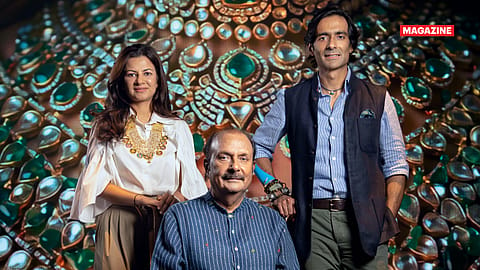
Rajiv Arora (middle) with Akanksha and Tarang Arora. | Credits: Sanjay Rawat
This story belongs to the Fortune India Magazine august-2026-40u40-indias-brightest-young-business-minds issue.
HIDDEN BEHIND AN unassuming façade in C-Scheme — an upscale, centrally located neighbourhood in Jaipur — the one-of-a-kind museum feels less like a jewellery exhibition and more like a carefully preserved archive of the Indian subcontinent. Glass cases hold centuries-old silver anklets worn by nomadic tribes, elaborate bridal necklaces that once travelled through royal households, thick ivory bangles, ritual ornaments, temple jewellery, headpieces, waist belts and everyday adornments that have quietly disappeared from modern wardrobes, thanks to the recent trend of more minimalism and less affordability.
Opened in 2018, the museum houses thousands of traditional ornaments collected by Amrapali founders Rajiv Arora and Rajesh Ajmera over decades of travelling across India. This one is not a company museum in the conventional sense — there are no timelines celebrating business milestones or showcases dedicated to the brand’s bestsellers. Instead, it documents India’s jewellery traditions, region by region and community by community, making visible an extraordinary diversity. It is balanced by one shop floor.
It all began with an investment of ₹392 — the amount Rajiv Arora withdrew from a recurring deposit account he had built by saving ₹10 from his monthly pocket money as a college student. It was the only capital he and his friend, Rajesh Ajmera, had, when they decided to start a business in Jaipur in 1978. Jewellery was nowhere in the plan. They simply wanted to build something around Indian art and handicrafts.
Nearly five decades later, that modest beginning has evolved into one of India’s most recognisable jewellery houses. Today, the Amrapali Jewels Group, which houses the contemporary label Tribe Amrapali, is eyeing a turnover of around ₹330 crore in FY26 (against ₹302 crore in FY25). Tribe alone is projected to touch ₹110 crore.
TWO FRIENDS, ONE IDEA
The 71-year-old Arora jokes that his father had a very different future planned for him. “He wanted me to become an IAS or IPS [officer],” Arora recalls. But fate had other plans.
After completing his Master’s in History and pursuing an MBA, Arora found himself drawn towards entrepreneurship. His friend and co-founder Ajmera shared the same fascination for Indian history, culture and art. Neither came from a jewellery family. Neither had experience in retail. What they had in common was an appreciation for traditional craftsmanship and an eagerness to build something rooted in Jaipur. “We had no money. We never thought about jewellery at that time,” Arora says. “We both loved Indian heritage, culture and art. We thought we should do something related to those.”
The ₹392 they scraped together was used to buy handcrafted wooden Tarkashi boxes (made from sheesham wood) from a President’s Award-winning artisan, who had rented a shop in the Arora family’s ancestral property. Armed with those boxes, the two travelled by bus to Delhi, stayed with relatives to avoid hotel expenses, and walked into the Central Cottage Industries Emporium the next day. The government-run emporium immediately placed an order.
More Stories from this Issue
The following months were defined less by grand strategy, and more by relentless hustle. Orders meant overnight bus journeys, early morning meetings and even squeezing business trips between university examinations. The business earned between ₹47,000 and ₹48,000 in its first year. Within two years, it had crossed ₹1 lakh in turnover. The founders travelled to Delhi five days a week, meeting buyers, accepting feedback and expanding their product range to almost anything related to handicrafts.
AN ACCIDENTAL BIZ
If handicrafts were the business they started with, jewellery was the business that found them.
The turning point came in the early 1980s, when Jaipur was witnessing an influx of backpackers travelling across India in search of spirituality, local art, and handcrafted objects. The city’s Chameliwala market, where Amrapali rented one of its earliest shops because it was affordable rather than prominent, became a meeting point for these travellers. “There used to be so many foreigners coming in. Backpackers, artistic people… It was the hippie era,” Arora recalls.
Around the same time, traders collecting vintage textiles through barter transactions began bringing old, tribal silver ornaments into the market. The Amrapali founders saw possibilities others did not. “They (the traders) showed me an old necklace,” Arora says. “It was in a dirty and rotten condition. We cut it, converted the pendants into earrings. I made them with my own hands.” The earrings sold almost immediately.
{{#most-powerful-women-snapshot-individual.slug}} {{/most-powerful-women-snapshot-individual.slug}} {{^most-powerful-women-snapshot-individual.slug}} {{/most-powerful-women-snapshot-individual.slug}} {{#showRanking}} {{current-rank}} {{/showRanking}} {{#photo.0.url}}
{{name}}
Customers returned asking for more, but therein lay the problem. Every vintage piece was unique. “That was an old piece. How can I get the same piece again?... That is how manufacturing of jewellery, which looked old and vintage, started,” says Arora.
What emerged was not imitation but reinterpretation. Traditional tribal motifs, old silver techniques, coral, turquoise, and handcrafted detailing were adapted into contemporary designs that retained the spirit of antique jewellery without copying individual heirlooms.
Tarang Arora, who now leads the company as CEO, believes Amrapali was among the earliest brands to systematically reinterpret India’s tribal silver traditions for a wider market. “We were one of the first to make and popularise old silver,” he says.
When Arora and Ajmera began redesigning old tribal silver ornaments back in the early 1980s, India’s jewellery industry revolved almost entirely around gold. Silver was associated either with rural India or heirlooms tucked away in family trunks. Antique jewellery belonged to collectors, not fashion-conscious consumers.
“There was a change in fashion,” Arora recalls. “People started wearing cotton saris, khadi, silver jhumkis. Indian clothes, Indian jewellery, and antique jewellery became fashionable.”
Instead of mass-producing winning designs, Amrapali anchored its brand identity around individualism. In its fine jewellery line, pieces were created as one-of-a-kind, standalone masterworks. “Big is beautiful for us. Our customers were people who really wanted to show off — models, royals, famous stars, and performers on stage,” Arora says proudly.
“We don’t copy,” adds Tarang. “We reinterpret. The inspiration comes from India’s heritage, but every collection has to work for today’s customer.”
And so, the business gradually moved beyond one-off vintage finds, to original design and manufacturing. As demand increased, the founders realised that relying on antique jewellery alone would never create a scalable business. The design-driven model, steeped in intense hand craftsmanship, required a different kind of financial discipline. Over decades, as venture capital funds and large corporate houses approached the founders with offers to invest and rapidly scale store counts, the family turned them down. The company was built strictly through internal accruals and standard bank finance.
“We never went after the numbers,” Arora explains. “We wanted to make the foundation very, very strong first. We would rather stay small, but profitable, concrete, and true to our designing philosophy.”
That commitment to hand craftsmanship has translated into a substantial employment ecosystem. Across four manufacturing units — including an SEZ facility in Jaipur — the group employs over 1,600 craftspeople, lapidaries, bench smiths, and supervisors, alongside more than 400 retail staff across India.
The business model naturally balanced itself into three distinct verticals, each generating roughly one-third of group revenue: fine gold and gemstone jewellery, silver jewellery, and fashion jewellery with B2B exports. Overall, domestic sales account for around 70% of revenues, while exports generate the remaining 30%.
WHY TRIBE HAPPENED
For nearly three decades, Amrapali built its reputation around handcrafted silver and high-value jewellery. But by the late 2010s, another shift was visible. While core Amrapali flagships catered to luxury clients, a younger, independent generation of women was looking for accessible, everyday jewellery.
Akanksha Arora, CEO of Tribe Amrapali, recalls taking photos of jewellery pieces on BlackBerry phones and posting them on an early Facebook page. “Americans and tech workers who had moved to California or Texas started commenting, asking where they could buy. We actually sold high-value necklaces through Facebook direct messages — people would literally wire bank transfers and we would ship them.”
However, selling one-of-a-kind fine jewellery online had its own structural challenges — high insurance costs, custom clearance complexities, and non-repeatable inventory. “Amrapali has one-of-a-kind pieces, so the online model doesn’t work easily for that,” Akanksha explains.
“We needed pieces that could be produced in larger runs, were easy to ship, and were available at more accessible price points. That’s how Tribe came to be — a sub-brand designed for high footfall in malls, airports, and e-commerce,” she adds.
Today, Tribe Amrapali operates as a mass-premium brand occupying a sweet spot in the market. While entry-level product prices range between ₹2,000 and ₹2,400, the brand’s average invoice value sits between ₹6,800 and ₹7,400. Offline retail drives 90% of Tribe’s sales, with 10% coming from online channels.
Behind Tribe lies a broader strategic pivot. Over the next 6-12 months, the group is restructuring its retail product lines: Amrapali will focus exclusively on fine gold, precious gemstones, and high jewellery, while Tribe by Amrapali will absorb all silver and fashion jewellery lines.
“Silver is going to become the new gold,” says Tarang. “As gold becomes less accessible for casual purchases over the next decade, silver is being appreciated as a wearable asset by everyone.”
The growth numbers validate the pivot. Tribe Amrapali is projected to reach ₹110 crore by FY27, a 40-50% growth YoY.
EXPANSION STRATEGY
Across the group, the domestic footprint stands at 54 stores — comprising 15 flagship Amrapali boutiques and 39 Tribe Amrapali outlets. Amrapali stores are located in major hubs such as Delhi, Mumbai, Hyderabad, Kolkata, Jaipur, Ahmedabad, and Dubai. Tribe has expanded into Tier II and III markets, including Srinagar, Kochi, Guwahati, Vadodara, and airport terminals.
The retail expansion strategy follows a disciplined path. Rather than pursuing rapid, burn-heavy store rollouts, the group aims to add 8 to 10 stores per year. “We haven’t gotten into the rat race of just creating top-line numbers, burning money, and getting investors,” Tarang emphasises. “We prefer to stay profitable and concrete. We open 8 to 10 stores a year, run them properly, understand the local market, serve it well, and then move into the next batch.”
While Amrapali fine jewellery stores remain destination locations where clients travel to make significant purchases, Tribe’s strategy focusses on accessibility across Tier II cities.
To fund this expansion, the group is contemplating a structural shift in its capital strategy. While the core Amrapali entity will remain private and family-owned, TBA Jewels Pvt. Ltd (Tribe Amrapali) could pursue an initial public offering (IPO).
“Tribe is the growth story,” says Arora. “Promoter capital and bank finance have driven us so far, but in a year’s time, we may go public. We are working on it, and in the next six to eight months, we may file papers.”
Retail sales follow a seasonal rhythm, with 65-70% of annual business generated during six months from Diwali to Holi (September through April), driven by the wedding calendar and festival shopping.
Over the years, Amrapali jewellery has appeared in more than 50 films and productions across Bollywood and Hollywood. Arora still remembers working with international studios looking for historically accurate Indian jewellery and accessories. “When Warner Brothers was making Troy, they came looking for jewellery from this part of the world... India has a living culture. These traditions survive here.”
That authenticity has also attracted global personalities. The brand has been worn by Rihanna, Angelina Jolie, Jennifer Lopez, Beyoncé, and Paris Hilton, alongside members of European royalty, including Princess Benedikte of Denmark and Catherine, Princess of Wales, who wore Amrapali earrings during her India visit in 2016.
Arora, however, says more than turnover, store count or visibility, employment remains the number he measures himself against. “When people ask what makes me happiest, I say it is that we can provide employment to 2,000 people. For them, it means education for their children and healthcare for their families.”
For a company that began with ₹392 and a handful of handcrafted wooden boxes, it has surely been a long journey.
Follow Fortune India
Sign in to read full story
To access our exclusive magazine content, sign in to your Fortune India account.
Sign In NowNEXT STORY