How Ranjan Pai built Manipal Hospitals into a domestic behemoth
/ 9 min read
Ranjan Pai has built Manipal Hospitals into India's largest healthcare network by the number of beds. The empire, however, is far diverse and widespread.
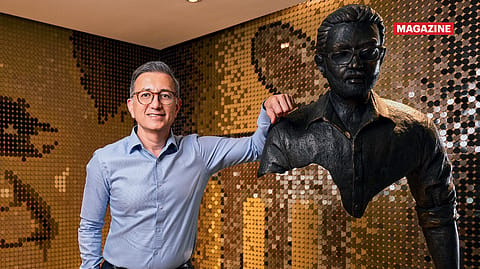
Ranjan Pai, Chairman, Manipal Group | Credits: Selvaprakash Lakshmanan
This story belongs to the Fortune India Magazine October 2026 issue.
FOR MUCH OF the last decade, Ranjan Pai was in such a tearing hurry. One after another, almost like an annual ritual, the doctor-turned-entrepreneur went about buying hospitals across the country.
It didn’t matter where they were, as long as they could help scale Pai’s family-owned Manipal Hospitals into a national goliath.
Not that Pai has had any change of heart now. This despite the fact that the recently concluded blockbuster public listing, in which his hospital chain, Manipal Health Enterprises, raised almost $1 billion, was oversubscribed almost five times, and became a near ₹1-lakh-crore healthcare behemoth.
But Pai was somewhat philosophical when we met on the 15th floor of the Manipal Group headquarters at JW Marriott Hotel, overlooking Bengaluru’s green lung, Cubbon Park. From that office, he can also look over Kasturba Road, a name that’s sure to remind him how far his family has come from Kasturba Medical College in Mangalore — India’s first private medical college, set up by his grandfather — into a healthcare giant worth $10 billion.
“I think you have got to stay patient, and you have got to be persistent, and you have got to keep doing it,” Pai says. “If you see the compounding impact of business, it is an outstanding phenomenon. People discount it.”
Pai is the living example of that phenomenon.
In 2019, Pai’s Manipal Health Enterprises had some ₹1,900 crore of revenue. “Last year, it was ₹12,500 crore. Of course, acquisitions have happened, but even without the acquisition, it could have been maybe half of that.”
More Stories from this Issue
Today, the hospital chain has over 13,000 beds, making it the country’s largest by beds, and is in leadership positions in key markets such as Karnataka, Maharashtra and eastern India. The Manipal Health Enterprises IPO was the second largest in India this year.
“I sometimes see founders losing patience, saying that it is not growing fast enough,” says the 53-year-old, who is also one of the country’s best-known investors.
Beyond scaling his medical and educational business, Pai’s personal investments over the past decade include Akasa Air, Zepto, NSE, BlueStone, and InCred, among others. He is also the largest shareholder in Aakash Educational Services, a company at the centre of the insolvency process of its former parent firm, Byju’s.
Pai is the chairman of Manipal Education and Medical Group (MEMG), commonly known as the Manipal Group, set up in 2000 as an umbrella entity to oversee five universities, including the Manipal Academy of Higher Education (MAHE), and 50 hospitals in the country. Manipal University also has overseas campuses in Malaysia, Antigua, Dubai and Nepal.
{{#most-powerful-women-snapshot-individual.slug}} {{/most-powerful-women-snapshot-individual.slug}} {{^most-powerful-women-snapshot-individual.slug}} {{/most-powerful-women-snapshot-individual.slug}} {{#showRanking}} {{current-rank}} {{/showRanking}} {{#photo.0.url}}
{{name}}
FAST-PACED GROWTH
In many ways, it’s the last six years that have brought Pai into the catbird seat.
That’s not to say Manipal had little to show before then. The brand had a stellar reputation but had remained confined to southern India.
The group began with its founder, T.M.A. Pai, who set up India’s first privately owned medical school, Kasturba Medical College, in Manipal, Karnataka, in 1953. By 1991, the group had set up Manipal Hospitals in Bengaluru.
In 2000, Ranjan Pai, T.M.A. Pai’s grandson, joined the family business with a medical degree from Kasturba Medical College and a fellowship in hospital administration. He began his career as MD of Melaka Manipal Medical College in Malaysia. With $200,000 in capital, Pai then set up MEMG in a rented house in Bengaluru as part of his plan to corporatise the family business and attract capital.
While the education vertical largely remains not-for-profit except for the foreign institutions, the hospital business is where Pai proved his mettle and built the group’s golden goose.
A decade after he set up MEMG, Pai’s hospital business had emerged on PE giants’ radar.
In 2010, Kotak Private Equity Group made a ₹110-crore institutional investment in Manipal Health Enterprises, a company Pai incorporated to operate the hospitals under the MEMG.
Two years later, Manipal Health Enterprises raised $100 million (approx. ₹438 crore) in a Series B funding round from PE firms True North (then known as India Value Fund Advisors) and Faering Capital, followed by a $146-million (₹900-crore) purchase by PE giant TPG for a 22% stake in Manipal Health Enterprises.
“I think the private equity funding helped us grow,” Pai says, now clean-shaven, unlike a few years ago when he sported a beard. “This is a very capital-intensive industry. It also helped us attract good talent. Private equity guys came, they exited, and everybody made money along the way. But the mission was the same. We had to keep growing this business and continue to provide good quality healthcare.”
But Manipal’s turning point came with the entry of Singapore’s state investor, Temasek, which bought an 18% stake from True North and Faering Capital for some ₹1,400 crore.
At that time, Manipal operated 15 hospitals in five states with around 4,900 beds. The company also had revenues of ₹1,129 crore, and the deal valued Manipal at about $1 billion.
“I think private equity brings a different perspective because there is also somebody on the other side of the table,” adds Pai.
Backed by Temasek and TPG, Pai also set out to buy the distressed hospital chain Fortis Healthcare. Fortis was the second-largest hospital chain in India at the time, with 32 hospitals and 5,000 beds, with a significant presence in the north. An acquisition would have complemented Manipal, which had largely remained a southern bigwig, and expanded its network to nearly 50 hospitals with a total bed count of over 10,000.
A deal was announced between the hospital chains, but shareholder resentment and a subsequent bidding war meant Manipal lost out to Malaysia-based IHH Healthcare Berhad.
Around the same time, flush with PE money, Pai’s rivals were also beginning to bulk up. PE giant KKR-backed Radiant had picked up Max Healthcare, with 14 hospitals mostly in Northern India, while Manipal’s own attempt to stitch a deal with Gurugram-based Naresh Trehan-owned Medanta fell through.
“It was disappointing at that time,” Pai says about the Fortis and Medanta setbacks. “In any M&A, some things work, and some things don’t. But we must also realise that in 2016, our size was also much smaller. So, we were trying to punch much higher than our weight.”
THE RESURGENCE
The next phase of Manipal’s growth began after setbacks. Covid-19, in some ways, marked a turning point for Manipal. It had been two decades since Pai set up MEMG.
In November 2020, Manipal announced its acquisition of Columbia Asia Hospitals, owned by Seattle-based Columbia Pacific Management. Pai says the acquisition had been in the works for a year and was its first.
The deal, valued at around ₹2,100 crore, gave Manipal an additional 11 hospitals across Bengaluru, Mysuru, Kolkata, Gurugram, Ghaziabad, Patiala and Pune. The group now had 27 hospitals across 15 cities.
The Columbia Asia acquisition was followed by the acquisition of Vikram Hospitals in Bengaluru. Set up in 2009, Vikram Hospitals had about 200 beds and was a high-end tertiary care facility focussing on cardiac and neurosciences.
“Acquisition is one thing,” Pai says. “After that, how you integrate it and how well it does for you are what’s important. So, the focus was on HR, value systems, integrating IT systems, and putting processes from a doctor’s perspective. We see what specialties are missing, and what we can add. I think that’s the kind of secret sauce that worked well for us.”
It’s that playbook of integration and value addition that Pai and Manipal have relied on while picking up hospitals across the country.
Manipal followed the Vikram Hospitals acquisition with its foray in the east, acquiring the Kolkata-headquartered AMRI Hospitals. Despite legal tussles — including Manipal seeking the Delhi High Court’s intervention to stop AMRI’s owners, Emami, from selling to third parties — the Bengaluru-headquartered hospital behemoth eventually bought out AMRI for ₹2,300 crore. AMRI added 1,200 beds to Manipal’s total tally, increasing its footprint to 33 hospitals across 17 cities with 9,500 beds.
Crucially, Manipal was also suddenly flush with funds when Temasek decided to increase its stake in the company and acquire an additional 41% of Manipal Health for $2 billion. The deal valued the company at $5 billion.
“It’s about whether you can have a more dominant presence,” Pai says about looking at new geographies. “You don’t need to be across India. This is a large country. I would rather have 50 hospitals in three or four states than 50 hospitals in all states of India.”
The strategy was not about simply building a nationwide footprint, but about creating concentrated strength in selected markets.
In 2025, Manipal further ramped up its play in the eastern part of the country with the acquisition of Kolkata-based Medica Synergie. The rationale, says Pai, is that a concentrated approach allows for better synergies in doctor attraction and retention. “In the West, there’s nothing like a pan-U.S. hospital chain. We have 50 hospitals today, and if you get to maybe 100 hospitals over time, we will concentrate in the cities where we have more presence.”
But that doesn’t mean shying away from venturing into new states or cities.
Even though it’s not set in stone, Manipal likes to enter a new state or region through an acquisition before looking at greenfield opportunities.
That’s precisely what it did with Pune-based Sahyadri Hospitals, an 11-hospital chain that Manipal bought for approximately ₹6,000 crore from the Ontario Teachers’ Pension Plan in 2025. Sahyadri operates 11 hospitals across Maharashtra, with more than 1,400 beds. Since the acquisition, Manipal has announced plans to set up new hospitals in Nagpur and Mumbai.
“Usually, and that’s not the rule, but what we tend to do is acquire something and then build more greenfield,” Pai adds.
Manipal currently has five greenfield hospitals under construction in Bengaluru, Raipur, Mumbai, and Kolkata, which will take the hospital tally to 55. Over the next four years, it plans to add around 2,426 beds, of which 1,943 beds are greenfield and 483 are brownfield.
“Standardised protocols, targeted capex, and disciplined operations have enabled Manipal to scale efficiently while improving profitability of the acquired assets,” brokerage firm Jefferies says in a report. “Sahyadri is already seeing profitability benefits from the deployment of its established integration playbook.”
A GROWING MARKET
The expansion comes against the backdrop of a significant gap in India’s healthcare infrastructure, which currently lags both the global average and that of other developing nations, making large multi-specialty hospitals critical to the country. With large private hospitals accounting for only approximately 20% of the overall market in a country with a bed density of 16 per 10,000 people, less than half the global average of 33, growth opportunities remain significant.
Apart from Apollo and Max, Manipal will also face competition from the combined Aster Quality Care, a merged entity between Aster DM, Care Hospitals, Evercare, and KIMSHEALTH, formed in 2025. While Manipal lags in occupancy at 64%, against 75% at Max and 67% at Apollo, highlighting a runway for earnings growth through better asset utilisation, it maintains the highest insurance share at 50% among its peers.
“It’s strong promoter ownership and proven acquisition-led expansion strategy will aid the company to narrow operational gaps with best-in-class peers over time,” adds Jefferies.
For Pai, the opportunity is closely linked to rising demand for better healthcare and greater insurance coverage. “I think there are a lot of tailwinds. India is prospering; people want better healthcare. Insurance penetration is increasing. People with insurance will want to come to better health care facilities.” Pai’s Manipal Group also has its own insurance business, in partnership with global insurance giant Cigna, catering to over 19 million users.
These tailwinds are also why Manipal pulled off the country’s second-largest IPO this year, raising $960 million in a market rattled by tensions between the U.S. and Iran.
MILES TO GO
Today, with the hospital business having reached a scale that can only be described as the stuff of dreams, Pai has no intention of slowing down.
In fact, a month before the IPO, Manipal also bought out Bengaluru’s Kinder Women’s Hospital for ₹130 crore.
“Assets are hard to come by,” Pai says. “It takes about three to four years for a hospital to be built. So, if there is a hospital with those licences, it just makes it faster. We may have to do a little bit of sprucing up.”
The numbers underline just how far the hospital business has travelled. Revenues swelled from ₹4,927 crore in FY23 to ₹10,520 crore in FY26, up 113% in three years. Net profit jumped 121% from ₹414 crore to ₹917 crore.
Despite growing competition amid rising medical inflation, Pai says his hospital business will continue to uphold the values of his father and grandfather. “Patient centricity is key. You shouldn’t lose sight of what you started from... Hold on to the core values strongly. And do the right thing. I think it’s a very exciting time frame for the next 10 to 20 years. There’s a lot of growth coming. So, you must just put your head down.”
That philosophy also informs the question of whether Manipal will slow down on its much talked about acquisition spree.
“There could be some private equity chains that may transfer or may want to exit,” Pai says. “So, there could be various permutations and combinations. But if it’s interesting, the right price, of course, we’ll look at it. But otherwise, we have enough growth coming in from greenfield. We have certain assets that we are interested in. We’ll continue to look at it, and we’ll have some other strategy in place, which will make it more efficient.”
For now, the strategy appears to be a combination of acquisitions, integration, concentrated expansion and new hospitals built from the ground up.
Pai knows that better than anybody else.
After all, his moment of reckoning is here, after many years of hustle.
Follow Fortune India
Sign in to read full story
To access our exclusive magazine content, sign in to your Fortune India account.
Sign In NowNEXT STORY