How Relais & Châteaux transformed experiential luxury travel
/ 7 min read
For Relais & Châteaux, luxury is not a uniform product — and neither are its properties.
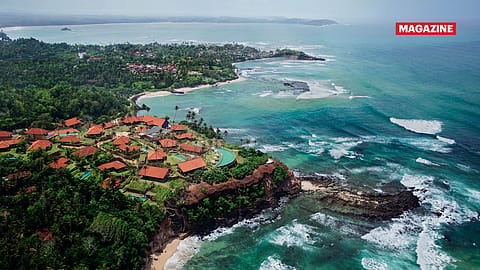
Cape Weligama, a Relais & Châteaux luxury clifftop beach resort in Sri Lanka.
This story belongs to the Fortune India Magazine september-2026-indias-top-100-billionaires issue.
Picture this: France in 1954 is rebuilding after the devastation of war, embracing industrial growth. But countryside hoteliers fear that new highways will whisk travellers past their doors. Their response is not resistance, but collaboration. Marcel and Nelly Tilloy, two music-hall artistes and owners of La Cardinale in France’s Ardèche region, partnered with a group of fellow hoteliers to form Les Relais de Campagne (The Country Roadhouses).
Their proposition was simple: a warm welcome, exceptional cuisine, and a carefully cultivated art de vivre. And thus, eight properties between Paris and Nice became the starting point for what would eventually become Relais & Châteaux. “Less than 10 years after World War II, the hoteliers and restaurateurs decided to join together, buying one advertisement page in a French newspaper,” says Laurent Gardinier, president of Relais & Châteaux.
Over 72 years later, the “unconventional” group — an association of independent hoteliers who believed that hospitality could be both deeply personal and rooted in local character — has evolved into a global collection of 580 independently operated hotels and restaurants across 65 countries. “We are an association. It means there is no equity for any member. Each member doesn’t own, but is part of the association,” he explains. “We are working for the benefit of the member and not for the benefit of any... shareholder. This association began with eight members who wanted to build a kind of a road to happiness, or route du bonheur, from Paris to the Riviera.”
The group is united less by a common visual identity than by a shared philosophy of excellence, authenticity, and a profound respect for place. Even the name hints at its philosophy: relais, a place to pause and linger; châteaux, places steeped in character and history. Gardinier exudes confidence as he says only a few hospitality organisations have understood this philosophy as instinctively as his own organisation.
The expansion of Relais & Châteaux stands as the testament. By the 1960s, the association had begun expanding beyond France. Its celebrated routes du bonheur — a collection of curated luxury road trip itineraries — and encouraged travellers to explore destinations carefully rather than simply move from one hotel to another. In 1974, Les Relais de Campagne merged with Châteaux Hôtels to form Relais & Châteaux, creating the name and philosophy that continue to this day.
Manali’s Sitara Himalaya, 8,200 feet above the Kullu Valley.
Relais & Châteaux doesn’t buy any property but makes them its affiliates if they pass the litmus test. “Members are independent owners of their businesses, and they apply to be part of this association,” says Gardinier. He adds that the association receives about 600 applications per year. “We select less than 20-30 among them. Every year, we have about 20-30 [properties] leaving, [and] 20-30 joining.” The property selection is rigorous yet done discreetly. It starts with the visit of an anonymous inspector. “We have a grid, about 500 different points of analysis. The anonymous inspector knows what is required, and then writes a report.” This report is then sent to the network department. “Then there is a network commission, comprising members. Then the board votes, or doesn’t vote, for the application to be part of the relay,” Gardinier explains.
Once the membership is granted, the property gets more than 60 specialised services from the association, including digital promotions and reservation assistance. “The secret inspector continues to make calls at these properties every two years as long as the membership is active. The property also gets to display the Relais & Châteaux logo plaque.”
More Stories from this Issue
So, is the process similar to Michelin inspection? Yes, and no, according to the CEO. “The only thing is you don’t choose to be part of Michelin. [But] you choose to be part of Relais & Châteaux. For Michelin you don’t pay; for us, you pay,” he says. “Michelin doesn’t provide any service; we provide about 60 different services. The classification works differently.” When applying to be an affiliate, the property has to showcase what it is doing, what kind of property it is, how it represents the best of the local DNA, and so on. “We don’t have any rules regarding the architecture, services, etc., because each property has to be developed.”
The Malabar House in Fort Kochi offers an immersive Kerala experience.
What makes the organisation particularly distinctive is that it does not seek uniformity. A Relais & Châteaux property in Rajasthan should feel unmistakably Indian; a house in Provence should belong to Provence; a lodge in the Himalayas should draw its character from the mountains surrounding it. Here, the definition of luxury begins with individuality. That essentially means that the size of the property is not a parameter. It’s the DNA that matters. That’s an aberration for luxury hospitality that is largely defined by its grandeur of imposing lobbies, elaborate suites, and the reassuring familiarity of a global brand. But the modern luxury traveller is also looking for something more elusive — a sense of place and authenticity — a story that could not be replicated anywhere else. And increasingly, a connection with the people, culture, cuisine and landscape of a destination. “Size doesn’t matter. The property could be a restaurant or something with just about 30 rooms to perhaps 100 rooms,” Gardinier says. “As long as the property meets our standards and has the local DNA, it could be part of our association.”
This becomes particularly apparent in India, where the Relais & Châteaux collection spans an extraordinary range of landscapes and cultural identities. Its portfolio currently includes properties and restaurants such as The Malabar House in Fort Kochi, SUJÁN Jawai in Rajasthan, SUJÁN Sher Bagh in Ranthambore, SUJÁN The Serai in Jaisalmer, Ran Baas The Palace in Patiala, Sitara Himalaya in Manali, and Masque in Mumbai, among others.
Together, they illustrate the breadth of contemporary Indian luxury. At one end is the grandeur of royal heritage; at the other, the intimacy of a wilderness camp. There are Himalayan retreats, desert experiences, wildlife lodges, and sophisticated urban dining. The common denominator is not architecture or scale but the ability to make the guest feel immersed in the destination.
{{#most-powerful-women-snapshot-individual.slug}} {{/most-powerful-women-snapshot-individual.slug}} {{^most-powerful-women-snapshot-individual.slug}} {{/most-powerful-women-snapshot-individual.slug}} {{#showRanking}} {{current-rank}} {{/showRanking}} {{#photo.0.url}}
{{name}}
That immersion extends to the table.
The cocoon-like tents of the Wild Coast Tented Lodge in Sri Lanka.
Gastronomy has always been central to the Relais & Châteaux philosophy. From its earliest days, exceptional food was one of the pillars upon which the association was built. Today, its network includes hundreds of Michelin-starred restaurants, with the organisation highlighting 376 Michelin stars, including 40 Green Stars, in its 70th-anniversary material.
Yet the emphasis is not simply on culinary prestige. Food is treated as an expression of terroir — a way of understanding a place via its produce, traditions and people. A meal becomes another form of travel. Ingredients sourced from local farmers, fishermen, breeders, and beekeepers are part of a broader philosophy in which hospitality is connected to the communities that surround each property.
This approach has become increasingly relevant as luxury itself changes. Today’s discerning traveller is less interested in conspicuous consumption and more interested in meaningful consumption. They want access rather than excess, discovery rather than display. They want to meet a chef, understand a craft, walk through a forest with someone who knows its ecology, or dine on ingredients that tell the story of a particular landscape.
This is perhaps why the organisation has remained relevant for more than seven decades. It has never really been about selling a room; it is selling a way of travelling — slower, more curious and more emotionally connected.
The Sarvato Jaipur pays homage to the cuisine of Rajasthan.
Laurent Gardinier, CEO of Relais & Châteaux.
The Routes du Bonheur remain the perfect metaphor. Rather than treating a destination as a backdrop, they turn the journey itself into the experience, connecting remarkable landscapes and distinctive properties with the people who live and work within them. There are castles, manor houses, ryokans, villas, lodges, mountain retreats, and wilderness camps, each offering its own interpretation of hospitality. That playbook finds the perfect match in India. “India has enormous growth potential. There are more and more Indian customers willing to go to high-end hotels, which was not the case 10 years ago,” says Gardinier. “It’s not just about the property. For us, we have to find the right ecosystem in which the property functions for us to consider it. We have conducted an in-depth study of the potential for Relais & Châteaux in India, during which we identified 30-40 properties that could meet our requirements. Even if 25% of it materialises, we will be very happy.”
In an industry increasingly dominated by consolidation and global hotel groups, Relais & Châteaux’s greatest luxury may, therefore, be its refusal to become standardised. Every house has its own personality. Every host has a story. Every kitchen has a point of view. And every destination has something of itself to reveal through its DNA.
That is the real sophistication of Relais & Châteaux: luxury not as a uniform product, but as a deeply personal encounter with place. Because ultimately, the finest hotels do not merely give us somewhere to stay. They give us somewhere to remember.
Follow Fortune India
Sign in to read full story
To access our exclusive magazine content, sign in to your Fortune India account.
Sign In NowNEXT STORY