How Trivitron’s G.S.K. Velu became the accidental healthcare emperor
/ 8 min read
From a remote village in Tamil Nadu to creating one of India’s largest home-grown privately held healthcare ecosystems, Velu’s entrepreneurial journey is entering its next phase — unlocking value by listing four companies within the next three years.
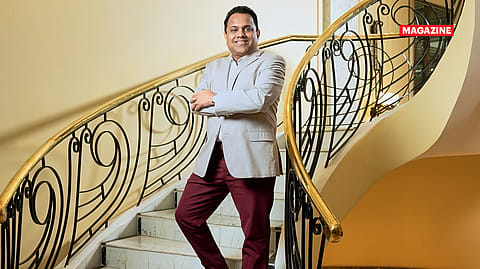
G.S.K. Velu, chairman & MD, Trivitron Group of Companies. | Credits: Nishikant Gamre
This story belongs to the Fortune India Magazine july-2026-mpw-100-most-powerful-women issue.
THE LIVES OF TWO Tamilians — Arokiaswamy Velumani and G.S.K. Velu — who pioneered and transformed organised diagnostics healthcare in India, have striking similarities.
Velumani, born to poor parents in a village near Coimbatore, travelled 25 kilometres to attend colleges that offered affordable education. He had no money for hostel accommodation or commuting. His mother, who earned just ₹3 a day selling milk, pawned her bangles to pay for his college fees.
After completing his BSc, Velumani joined a small pharmaceutical company, which later shut down. He then joined BARC (Bhabha Atomic Research Centre) as a laboratory assistant and, over the next 14 years, rose to become a scientist specialising in thyroid biochemistry. In 1995, he quit his government job and invested all his savings in launching a small thyroid testing laboratory in Mumbai. That venture grew into one of India’s largest diagnostics chains. In 2021, Velumani sold Thyrocare to PharmEasy for ₹4,546 crore. No wonder, his life is often celebrated as a classic example of the rags-to-riches story from rural India.
The life of Gomathy Babu Sadacharam Kulandaivelu Velu, or G.S.K. Velu — a serial healthcare entrepreneur and chairman of the Trivitron Group of Companies — is another inspiring example of how a young man with big dreams from an obscure village in rural Tamil Nadu fought against all odds, to become one of India’s most successful healthcare entrepreneurs.
Born into a poor traditional Tamil family in Aralvaimozhi — a remote village in the mountain pass between Tamil Nadu and Kerala in the Kanyakumari district, now known for one of Asia’s largest onshore wind farms — Velu’s early life was shaped by hardships.
His father, a librarian in the Tamil Nadu government service, was posted at a village near Madurai, where Velu studied in a Tamil-medium government school. He dreamt of becoming a doctor after realising that the nearest doctor was 25 km away! But the dream ended when he missed securing an MBBS seat by just two marks after the entrance examination was introduced in Tamil Nadu in 1984.
Though he secured admission to civil engineering at REC Surat, medicine remained his true passion. A senior from his school in Nagercoil, then studying at BITS Pilani, introduced him to its pharmacy programme with a biomedical engineering specialisation. It was exactly what he wanted, but financing his education was a challenge.
More Stories from this Issue
“The family had only a bicycle as asset. My mother had to sell her ‘Mangalsutra’ to pay my fees, which was around ₹4,000 at the time. That sacrifice stayed with me,” he recalls.
He graduated in 1988, with aspirations to pursue higher studies abroad. However, his father insisted he begin working to support the family. The very next day, after completing his internship at the Adyar Cancer Institute, he secured a job with medical devices supplier Instrumentation Machines Inc., thanks to the support of his mentor, Dr V. Shanta, chairman of the Adyar Cancer Institute and a pioneer in oncology research in India.
His first boss, Ravindran, also owned a struggling medical equipment distribution agency that was on the verge of losing its business. Ravindran asked young Velu to help revive it. He succeeded, and by 1989, Ravindran made him a partner in a new venture — Allied Healthcare Private Limited — that focussed on in-vitro diagnostics, cardiac devices, imaging and critical-care equipment.
“Those early years shaped almost everything I do today, as those first years gave me the freedom to multitask and build across areas. We even opened a lab in Calicut called Premier Diagnostic Centre in 1991,” says Velu.
{{#most-powerful-women-snapshot-individual.slug}} {{/most-powerful-women-snapshot-individual.slug}} {{^most-powerful-women-snapshot-individual.slug}} {{/most-powerful-women-snapshot-individual.slug}} {{#showRanking}} {{current-rank}} {{/showRanking}} {{#photo.0.url}}
{{name}}
Although the venture was successful, Velu soon realised that being a partner with his employer neither offered independence nor equal rewards.
“I did not want to get into a fight with my first boss, so I moved on,” he says with an innocent smile.
He joined Chiron — earlier Ciba Corning, later Bayer and eventually Siemens — nd spent five years there, between 1992 and 1997.
“Out of my five years with the multinational, I spent about two years in China and my role was to observe and report, though I did not know the language,” says Velu.
China at that time was almost entirely dependent on imported medical equipment. But the country methodically built domestic manufacturing capabilities, eventually becoming the world’s largest exporter of medical devices.
Government support, infrastructure, and disciplined execution left a lasting impression on Velu and shaped his own manufacturing ambitions.
Building, from home
Velu began his entrepreneurial journey in 1997 by establishing Trivitron, a multi-product medical devices distribution company.
At a time when multinational healthcare companies were consolidating globally, many mid-sized firms from Japan, Europe, and the U.S. needed strong national distributors in India. Trivitron represented brands such as Aloka, Fresenius, ERBE and DPC, and had around 10-15 national distribution partnerships. Imaging, particularly ultrasound, in-vitro diagnostics, renal care, dialysis, ICU equipment and operating-room products, became its focus areas. By 2000, Trivitron emerged as one of India’s largest distributors of medical devices.
Initially, the business comprised two entities. Trivitron Medical Systems handled distribution outside IVD, while Chiron Diagnostics Limited operated as a joint venture, with Chiron holding 51% and Velu 49%.
When Bayer acquired Chiron, the business model changed. Velu was offered a role in the merged company but he chose entrepreneurship instead.
“As a result, we had to drop a major part of the business and almost became bankrupt around 2000. We then regrouped, renamed, and combined the businesses under Trivitron Healthcare,” he says.
And that marked the beginning of the Trivitron story.
Between 2000 and around 2010-12, Trivitron represented several leading global companies nationally. It introduced Fresenius, then the world’s leading dialysis company, in India and later represented firms such as Boston Scientific. At its peak, the distribution business generated ₹500-600 crore in revenue — significant for a medical devices company during that period.
However, from around 2010 onwards, MNCs began establishing direct operations in India, eliminating distributors. Many Trivitron employees joined these companies, and between 2010 and 2015, Trivitron lost almost its entire distribution business.
Velu responded by pivoting decisively towards manufacturing. Trivitron acquired 25 acres near Chennai and established a medical technology park around 2012. Between 2012 and 2016, it worked with global partners through joint ventures, initially focussing on ultrasound manufacturing with Aloka and IVD reagent manufacturing with BioSystems Diagnostics.
By that time, Velu had already raised private equity funding. Around 2006, HSBC and ePlanet Ventures invested ₹35-40 crore, helping scale the distribution business. Later, in 2012-13, India Value Fund and Fidelity invested ₹220-230 crore, funding acquisitions and manufacturing expansion.
Trivitron acquired Labsystems in Finland and Kiran Medical Systems in Mumbai for around ₹100 crore each, enabling the company to move beyond JV-led manufacturing to fully owned capabilities.
Today, Trivitron operates multiple manufacturing facilities across India and overseas. In India, it has facilities in Chennai, Mumbai, and Visakhapatnam, including five factories within the Chennai medical technology park. Overall, the company operates 11 manufacturing facilities in India, besides those in Finland, Turkey and the U.S. It is also evaluating opportunities in China, Russia, and Brazil, where local manufacturing is increasingly becoming essential for market access.
The company has moved decisively towards high-end medical devices rather than commodity consumables. Its focus areas now include molecular diagnostics, mass spectrometry and next-generation sequencing in IVD, while imaging has expanded beyond X-ray and ultrasound into mammography and CT scanners, including its own CT scanner.
In fact, imaging and diagnostics remain its primary focus, alongside renal care.
Trivitron expects revenues to hit ₹1,000 crore in FY27, 95-97% manufacturing led. The ambition is to triple revenues to around ₹3,000 crore over the next five years through existing capacity, sales expansion and strategic acquisitions.
Velu has since bought back PE investors’ stake, making Trivitron — one of India’s top three domestic medical devices companies — fully owned.
Building a diagnostics powerhouse
Velu was also among the pioneers who built organised diagnostics in India. In 1998, he co-founded Metropolis with Dr Sushil Shah in a 50:50 joint venture at a time when organised diagnostic chains were emerging in markets such as Malaysia and Australia. Shah owned a single laboratory in Mumbai, and together they envisioned a scalable national diagnostics network.
At that time, India’s diagnostics industry was highly fragmented. SRL had been launched in 1996, Thyrocare was beginning to scale through its low-cost thyroid-testing model, Dr Lal PathLabs was expanding through franchises, and Piramal was also exploring diagnostics. Metropolis emerged as the fourth major organised player.
Backed by PE investors, Metropolis expanded rapidly to become one of India’s largest diagnostics chains. Differences eventually emerged between the promoter families, leading Velu to sell his nearly 37% stake to Carlyle for a reported ₹1,000 crore in September 2015.
Following the mandatory two-year non-compete period, Velu launched Neuberg Diagnostics in October 2017.
Positioned as a personalised next-generation diagnostics firm, Neuberg focusses on genomics, proteomics, metabolomics, digital pathology and molecular imaging. Built on a partnership model, it now operates around 250 laboratories. It clocked ₹1,600-1,700 crore in revenue last year, and is expected to reach around ₹2,000 crore in FY27. Last year, it raised around ₹980 crore from Kotak Strategic Situations India Fund II, and is targeting an annual growth of 25-30% over the next five years.
Maxivision, Apollo partnerships and Kauvery
Regarded as one of India’s foremost serial healthcare entrepreneurs, Velu has built a strong presence in eye care as well.
Maxivision, founded in 1996 by renowned ophthalmologist Dr Kasu Prasad Reddy, was acquired entirely by Velu in 2010. Today, it operates around 70 eye hospitals and 20 eye clinics across Andhra Pradesh, Telangana, Tamil Nadu, Kerala, Maharashtra and Gujarat, and generates around ₹600 crore in revenue.
“It has been growing at a CAGR of more than 30% over the last two to three years. The plan is to continue growing at around 30% CAGR over the next five years,” says Velu.
Velu first met Dr Prathap C. Reddy, founder and chairman of Apollo Hospitals Group, as a 19-year-old in 1988. That relationship evolved into a 35-year mentorship and eventually business partnerships.
When Apollo was considering partnering with Fresenius to establish dialysis centres, Velu persuaded Dr Reddy to tie up with Trivitron.
“Dental came later because Apollo needed someone to take it forward after the earlier operator passed away. In the Apollo ecosystem, I am probably the only non-family individual partner in such businesses,” says Velu.
Apollo owns about 70%, while Velu holds around 30% in both Apollo Dental and Apollo Dialysis.
Apollo Dialysis generates more than ₹200 crore in revenue, and Apollo Dental another ₹100 crore. While Apollo Dental operates 60-70 owned centres and over 200 franchise centres, Apollo Dialysis runs more than 200 centres, including PPP (public-private partnership) projects in Assam, Bihar, and Andhra Pradesh.
Another long-standing relationship — with healthcare entrepreneur Ajay Piramal — led Velu into hospital investments.
In 2015, when Ajay Piramal’s PE fund decided to sell its nearly 30% stake in Chennai-based Kauvery Hospital, Velu stepped in. “He asked me to take the stake because I understood the South India market. Initially, I was not keen, but eventually, I acquired the stake and also put in primary capital,” says Velu.
At the time, Kauvery had just 300-400 beds. Today, it operates around 14 hospitals with nearly 3,000 beds across Tamil Nadu and Bengaluru.
Velu is now the single-largest individual shareholder in Kauvery with a 20% stake, though he does not manage day-to-day operations. “I see myself more as an investor, mentor, and director in Kauvery, as doctor-promoters run the business, along with other investors such as Lightrock and 360 ONE,” he says.
Beyond healthcare, Velu has also established Stakeboat Capital, an investment platform that has launched an initial ₹50-crore fund, followed by another with ₹1,000 crore. Investments span companies such as LeadSquared, Ozonetel, semiconductor firms, microfinance businesses, rehabilitation-care majors such as Sukino and several technology-led ventures. In fact, more than 80% of Stakeboat’s investments are in technology companies outside healthcare. The platform now plans to raise a ₹3,000-crore fund.
Unlocking value
“If we include companies such as Trivitron, Neuberg, Maxivision, Kauvery and the Apollo partnerships, the group revenue is around ₹7,500-8,000 crore,” says Velu.
He owns 100% of Trivitron, around two-thirds of Neuberg, over 60% of Maxivision, minority stakes in Apollo Dental and Apollo Dialysis, and a little over 20% in Kauvery Hospitals.
Despite building one of India’s largest privately owned healthcare ecosystems, Velu prefers describing himself simply as an accidental entrepreneur. “I build and operate multiple businesses, but I also get emotionally involved in them. Exiting Metropolis was emotionally difficult. That is why operating businesses and private equity need different mindsets,” he says.
His roadmap for the future is already in place. The plan is to list four major businesses over the next three years. Neuberg and Maxivision are expected to go public first, possibly in 2027, followed by Kauvery. Trivitron could list after a major acquisition and another private equity round.
“Each of these businesses has billion-dollar-plus valuation potential,” says the unassuming entrepreneur.
The next generation has already begun to step in. His 28-year-old daughter, Kavya, has joined the business and is currently being trained across Neuberg’s operations.
The empire has already been built. The emperor is now extending his kingdom.
Follow Fortune India
NEXT STORY