Luxury Special: Delvaux CEO Jean-Marc Loubier on luxury's relentless quest for excellence
/ 6 min read
After decades spent mastering scale, luxury's next challenge may be learning how to evolve without losing what makes it enduring.
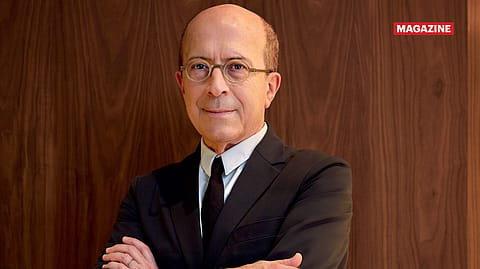
Jean-Marc Loubier, CEO, Delvaux. | Credits: Courtesy: Delvaux
This story belongs to the Fortune India Magazine october-2026-the-indian-luxury-boom issue.
LUXURY HAS SPENT the past five decades growing into one of the world’s most powerful industries. But as the sector enters a more uncertain phase, the question confronting its leaders is no longer simply how to grow. It is what growth should mean, and what luxury should ultimately stand for.
For Delvaux, the answer begins with its extraordinary history. Founded in Brussels in 1829, the maison carries nearly two centuries of uninterrupted know-how and design. It is not merely one of the oldest fine leather luxury brands; it considers itself a pioneer. That distinction matters because pioneering is inherently forward-looking. Legacy, in this context, is not about preserving the past in amber but using it as a foundation for what comes next.
That philosophy was evident as early as 1908, when Delvaux registered the world’s first patent for a fine-leather women’s handbag, le Princesse. The significance of that moment extends beyond the product itself. It coincided with a profound transformation in society, as women were assuming a greater role and autonomy in modern life. The handbag would become more than an accessory; it became a companion to a changing way of life.
This idea of continuity through change remains central to Delvaux. Its philosophy of “legacy in motion” is underpinned by a relentless quest for excellence. It also offers a useful perspective on what leadership in luxury really means.
Leadership cannot be simply measured by size. That distinction is increasingly relevant today. Since the late 1980s, luxury has enjoyed extraordinary and sustained growth. Its leading houses have evolved into large international corporations, while luxury itself has matured into a sophisticated global industry. Product categories have expanded, distribution has multiplied across wholesale, retail and digital channels, and the very meaning of the word “luxury” has become increasingly broad.
Digital has accelerated that expansion further. Today, luxury can be accessed virtually even in markets where a physical presence does not exist. At the same time, branding has assumed greater importance, with brands expected to provide not merely products but a sense of identity, emotion and “soul”.
Yet the industry now finds itself at an inflexion point.
More Stories from this Issue
The global economic environment is more complex, traditional industries are under pressure and emerging technologies are reshaping established business models. The automobile industry, which defined much of the 20th century, is being transformed, while artificial intelligence is creating both enormous opportunity and considerable uncertainty. China, the engine of luxury growth since the 1990s, has entered a more subdued phase, while consumer confidence has weakened. Europe is navigating its own challenges; the U.S. remains dynamic but divided; India is increasingly promising; and Africa is beginning to emerge as a significant new market.
There is also a broader question confronting every industry: the real cost of growth. Natural resources have been consumed intensively, often without their true value being reflected in the price of what we produce and consume.
Cyclical adjustments are inevitable. But the current moment raises questions that go beyond the economic cycle. It challenges some of the consequences of massification and standardisation that accompanied luxury’s spectacular expansion.
Growth cannot simply mean amplification. And value cannot simply mean scale.
{{#most-powerful-women-snapshot-individual.slug}} {{/most-powerful-women-snapshot-individual.slug}} {{^most-powerful-women-snapshot-individual.slug}} {{/most-powerful-women-snapshot-individual.slug}} {{#showRanking}} {{current-rank}} {{/showRanking}} {{#photo.0.url}}
{{name}}
This is where luxury needs to distinguish its values from its recipes. A successful model cannot be replicated indefinitely merely by becoming bigger, following trends or increasing distribution. Brands must continually return to what they stand for — and then ask whether the way they express those values, the products they create and the manner in which they engage with consumers remain authentic.
The encouraging reality is that there is no single formula for success. Over the past 50 years, luxury has become a major global industry offering products that combine aesthetic and functional beauty, whether for exceptional occasions or everyday life. Its foundations have traditionally been rooted in western history, craftsmanship, savoir faire, and branding. The expansion of wealth around the world, together with the rapid dissemination of fashion and its increasingly immediate trends, accelerated this momentum.
But maturity inevitably brings reassessment. Today, the word “luxury” itself has become blurred. Noise can overwhelm substance. Adopting the codes of luxury does not automatically make something luxurious, just as having a name does not necessarily make a brand. Supply chains are under scrutiny, quantities can undermine uniqueness, and ubiquity can make both shopping and discovery less compelling. Even concepts such as sustainability and heritage can be reduced to marketing exercises.
Yet, the paradox is that while luxury as an industry may be mature, luxury as an idea remains remarkably alive.
At its best, luxury brings together beauty, function, savoir faire, and excellence. It creates objects and experiences that carry a sense of meaning and individuality. In an increasingly uniform world, that ability to create moments of beauty and joy remains profoundly relevant.
The consumer, however, is changing. The extraordinary expansion of luxury over three generations has produced different relationships with the category. For the first generation, luxury could represent surprise and the symbol of a positive economic transformation. For the next, it increasingly became an expected part of life. Today, for many consumers, luxury is a choice.
That shift helps explain the prominence of concepts such as clienteling and “experience”. But technical terminology should not obscure a simple truth: consumers are individuals. Generational characteristics matter, but people cannot be reduced to demographic categories. They evolve, change and develop identities of their own.
Delvaux handbags are more than an accessory. | Credits: Courtesy: Delvaux
The greatest opportunity may, therefore, lie with a new generation or, more accurately, a global group of people whose lives are being shaped by technological disruption, particularly AI. They are creating, inventing and operating in entirely new circles. Many possess significant financial means, yet they may not necessarily feel connected to traditional luxury. Some have deliberately distanced themselves from what they perceive as the blurred codes and habits inherited from previous generations.
That should not be viewed merely as a challenge. It is an opportunity.
When luxury is true to its essence, it can speak powerfully to this new audience. Its fundamental values — beauty, design, transmission, respect for the hand and the soul, craftsmanship, technical excellence, individuality and, ultimately, humanity — remain timeless.
And there is another value that technology cannot easily manufacture: time. Not the speed of digital transactions, but the kind of time embodied in craftsmanship, expertise, patience and objects designed to endure.
This is where Delvaux believes its own proposition becomes relevant. The maison may not be among the largest luxury brands in the world, but leadership does not require scale. It can be rooted in what a company stands for and in the excellence of what it creates.
Its bags embody that philosophy in tangible form. They bring together design, craftsmanship, technical expertise and individuality while retaining a strong connection to the maison’s history. In that sense, Delvaux believes it remains in tune with the evolution of society precisely because it does not abandon the principles that have defined it.
Its international expansion offers an interesting case study in qualitative growth. Delvaux now operates a dedicated network of 50 stores across 15 countries, but its global journey is relatively recent. In 2011, only 3% of its sales were generated outside Belgium. The first international store opened in 2014. Today, international sales represent 85% of the total.
What is particularly significant is how that expansion has been achieved: through stores, rather than simply pursuing the widest possible distribution. For Delvaux, retail is not merely a sales channel. It is part of the value chain, beginning with its three workshops in Belgium and France and extending through its long design heritage to the relationship established with the customer.
Each store is intended to be culturally relevant: it is a meeting point between Delvaux’s rare Brussels heritage and the character of the city in which it arrives. The maison describes each store as a bridge between Brussels and its new home.
That is perhaps a useful metaphor for luxury itself.
The future will not belong simply to the biggest brands, the most ubiquitous brands or those with the loudest voices. It will belong to those capable of building bridges between heritage and modernity, craftsmanship and technology, individuality and scale, permanence and change.
Luxury has spent decades learning how to grow. Its next chapter may require it to relearn how to mean something.
For Delvaux, the answer is embedded in two words: legacy in motion. Not standing still in reverence to history but carrying the best of it forward, without confusing heritage with habit, values with recipes, or growth with mere amplification.
(Views are personal.)
Follow Fortune India
NEXT STORY