Luxury Special: Laudomia Pucci, a legacy defined by colour and pattern
/ 7 min read
She grew up watching her father turn the world into patterns. Today, Laudomia Pucci is ensuring that story is never forgotten.
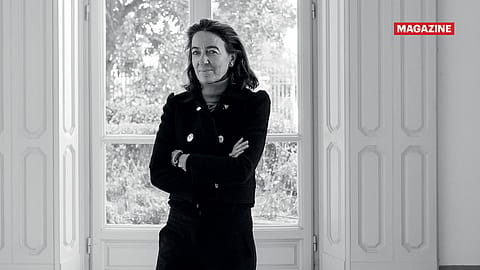
Laudomia Pucci | Credits: Federica Fioravanti
This story belongs to the Fortune India Magazine october-2026-the-indian-luxury-boom issue.
AN ARISTOCRAT, a skier who represented Italy at the 1936 Winter Olympics, and a pilot during World War II — that, in a nutshell, would have been the “not so ordinary” life of Emilio Pucci in the 1900s. Then fashion arrived, almost entirely by accident.
That happened in 1947, when Pucci was living in Switzerland. He was teaching Italian and skiing to make ends meet when he designed a grey wool ski suit for a friend. Its clean lines were borrowed from military uniforms, while stretch fabric incorporated into the heel allowed the suit to move with the body. The photograph of a woman sporting it on the slopes, taken by photographer Toni Frissell, eventually landed on the desk of Diana Vreeland at Harper’s Bazaar.
“Vreeland telephoned my father in Switzerland and asked him to design a ski collection for White Stag in Portland, Oregon, to be sold at Lord & Taylor in New York,” recalls his daughter, Laudomia Pucci. Little did Vreeland know that one phone call would set in motion the creation of one of Italy’s most distinctive luxury fashion houses — Emilio Pucci.
But Pucci’s immediate response to Vreeland’s phone call was a resounding no. “You are speaking to an officer of the Italian army,” he told her. There was an irony to the refusal. “My father had studied at Reed College in Portland in 1936, paying his way through his education by working as an instructor for the ski team. In retrospect, that experience had already marked the beginning of his career,” Laudomia recalls.
What followed would transform not only his own life but the visual language of fashion. Swirling motifs, optical illusions, unexpected colour pairings, oversized abstracts — Pucci’s prints were unlike anything the fashion world had seen. The vibrant, unmistakable visual language drew inspiration from across the world, including India. His designs fused Italian luxury with a new sense of athletic freedom and movement. “His travels widened the vocabulary further,” the daughter elaborates. Africa inspired capes and silk-chiffon pyjamas, evoking the waves of Lake Tanganyika and the setting sun over the veldt. Bali brought batiks; India provided some of the most memorable imagery of his collections, including photographs taken at Udaipur’s Lake Palace. South America, Russia, Switzerland and America all became part of his visual universe.
He began with scarves, then engineered shirts and dresses directly from them, creating a world of colour and movement that felt liberated from convention. The Mediterranean, the light of Capri, flags, heraldry, Renaissance frescoes, Sienese Palio banners and the decorative traditions of Italian nobility — all found their way into his designs. Needless to say, Pucci revolutionised the 20th-century fashion.
Hence, for Laudomia, whose childhood unfolded within the grand Palazzo in Florence — that was both her family home and, in those days, the headquarters of the Emilio Pucci business — fashion was never a world she chose to enter. It was the world she grew up in. There was no carefully constructed boundary between domestic life and the world of fashion. An office within the house was simply how things were done. “Models appeared on the roof for fashion shoots, dressed in extraordinary clothes and elaborate hairstyles, with the duomo (an Italian term for a cathedral) providing the quintessential Florentine backdrop,” she says. “From the Sala Bianca below came the applause of fashion shows.”
More Stories from this Issue
For a young Laudomia, it was not an unusual spectacle; it was normal. This cosmopolitanism was simply part of her inheritance. She says her father considered himself a citizen of the world wherever he happened to be while remaining rooted in Italy. “His curiosity was matched by that of my mother, Cristina Nannini, whose appreciation of modern art during the family’s years in New York opened another door,” the daughter recalls. Nannini, often described as her husband's muse, discovered Pop Art through galleries such as Leo Castelli’s, and that contemporary energy eventually found its way into Pucci’s increasingly psychedelic prints.
The Emilio Pucci Heritage Hub, an exclusive archive room located inside the historic Palazzo Pucci in Florence.
And by the 1950s, the world was taking notice. Stanley Marcus of Neiman Marcus became one of Pucci’s earliest and most important supporters, championing the Palio collection for the Neiman Marcus Award in 1957. The press soon bestowed upon Emilio Pucci the title that would follow him for decades: the “prince of prints”.
And the women who wore his clothes made him a legend. “Marilyn Monroe wore Pucci frequently in her private life, while Jacqueline Kennedy embraced his Capri pants. Yet the appeal went beyond celebrity. His designs captured something larger — the joie de vivre of post-war Italy and the freedom of the 1960s,” says Laudomia.
According to Laudomia, her father was at the roots of the Made in Italy movement. His clothes became an almost perfect visual expression of la dolce vita. Their colour, lightness, and freedom of movement also anticipated the changing role of women. There was an ease and independence in the clothes that resonated with the emerging spirit of female liberation.
{{#most-powerful-women-snapshot-individual.slug}} {{/most-powerful-women-snapshot-individual.slug}} {{^most-powerful-women-snapshot-individual.slug}} {{/most-powerful-women-snapshot-individual.slug}} {{#showRanking}} {{current-rank}} {{/showRanking}} {{#photo.0.url}}
{{name}}
Pucci’s instinct for extending his language went beyond clothing. What Laudomia describes as “product extensions” ranged from perfume, porcelain, and bed linen to collaborations involving the Apollo 15 mission logo and the Lincoln Continental.
A front-row view
Laudomia watched it all from within the Palazzo. The story of Italian fashion itself was taking shape in Florence. After the first presentations at Palazzo Pitti, Emilio Pucci chose to show his collections in his own Palazzo. “The house was simultaneously home, studio, office, and stage. Fashion was not an external world that arrived at the family doorstep; it was woven into everyday existence.”
Yet Laudomia did not initially imagine that she would inherit it. She followed in her father's footsteps (Pucci studied Agriculture and Political Science in the U.S.) and, for a time, considered that path. But Emilio, 47 years her senior, had other plans. He wanted his daughter beside him. In 1985, at 23, she joined the company.
What began as an early professional decision became a 35-year stewardship of her father’s name. “It’s a very Italian thing,” she says of the responsibility of taking care of a family business. In the years that followed, she would become not merely the custodian of an illustrious name but one of the key figures responsible for carrying Emilio Pucci into a dramatically different era of luxury.
From the late 1980s until 2000, she wore two hats — creative director and CEO. The company was still small enough and she often had to do almost everything herself. She relied on clients for insights, the press for inspiration, and above all, the principles her father had taught her. Her experience of working with Hubert de Givenchy for around two-and-a-half years added another layer of influence.
The fashion business, however, was changing.
(From L to R): A headpiece designed by milliner Philip Treacy for the Emilio Pucci Spring 2004 collection; Paris Hilton in a vibrant Emilio Pucci mock-neck top. | Credits: Getty Images
The intimate, almost private world of luxury that had defined earlier decades was giving way to larger markets, new consumers and an increasingly industrialised business model. LVMH and the Gucci Group (now called Kering) were reshaping the luxury landscape, bringing scale and new forms of expertise to historic maisons.
When LVMH acquired a majority stake in Emilio Pucci in 2000, Laudomia became vice president and image director, a position she held for the next two decades.
The transition allowed the house to enter a new chapter without abandoning its visual DNA. During her tenure, the universe expanded into furniture with Cappellini and Kartell, ski wear, and skateboards with Supreme and Rossignol, make-up with Guerlain, coffee cups with illycaffè, and artistic projects involving names such as Joana Vasconcelos and Francesco Vezzoli.
The breadth of these projects reflected something fundamental about the Pucci philosophy: the print was never confined to a dress. It was a visual language capable of inhabiting almost anything.
In 2019, Laudomia gathered this expansive history into Unexpected Pucci, published by Rizzoli, accompanied by an installation at Palazzo Pucci.
Two years later, another chapter closed. In June 2021, the family sold its remaining 33% stake to LVMH, giving the group complete ownership of the house. For Laudomia, the timing felt right. After more than two decades as vice president and image director, the commercial, and creative operations were firmly established. She was approaching 60 and wanted to make space for herself and her family. “Having started so young, I felt I had earned a pause.”
But for Laudomia, stepping away from the business did not mean stepping away from its history. Today, she leads Emilio Pucci Heritage from Palazzo N6 in Florence, independently of the LVMH-owned fashion house. Here, she has created a project that goes deeper into the family’s cultural legacy, bringing together the Pucci archive with the very Palazzo that shaped Emilio Pucci’s imagination.
The archive includes not only her father’s work but also the contributions of designers who followed him, among them Christian Lacroix, Matthew Williamson, Peter Dundas and Massimo Giorgetti. The setting itself adds another dimension: a Florentine family history stretching back centuries, to the Renaissance and the world of the Medici, when art and artisans occupied a central place in daily life.
For visitors, Palazzo N6 offers something increasingly rare in the luxury world: access not simply to an archive, but to a living family story. Private visits and private dining experiences allow guests to enter the Palazzo, learn about its history and its relationship with art and fashion, taste regional wines and Italian cuisine, and encounter contemporary art alongside works connected to the wider Florentine territory.
The philosophy is intimate rather than institutional.
It is less about displaying a famous name than allowing guests to understand the world that produced it. Even the preservation of the archive has become participatory. Through “adopt a dress”, visitors can contribute towards the restoration of specific pieces, helping conserve the collection for future generations. It brings the Pucci story full circle.
For Emilio Pucci, the world was a canvas. He drew from everything around him — the Mediterranean light, Renaissance art, distant cultures, travel, modern art, and the colours of everyday life. For Laudomia, the Palazzo became the place where that vision was lived before it was archived. She did not have to enter the Pucci world. She was born into it. This is perhaps the most natural evolution of Laudomia’s own story. She grew up watching fashion happen around her. Today, she is preserving the memory of how it happened.
Follow Fortune India
Sign in to read full story
To access our exclusive magazine content, sign in to your Fortune India account.
Sign In NowNEXT STORY