Luxury Special: Ramesh Nair and the pursuit of what lies beyond
/ 6 min read
Nair has built a career challenging convention, one heritage house at a time.
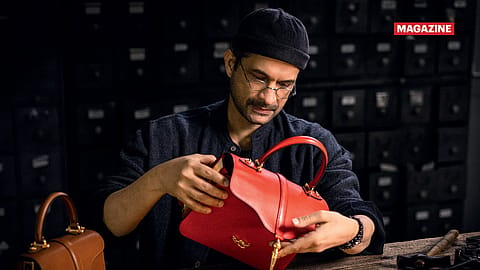
Credits: Courtesy: Ramesh Nair, Joseph Duclos
This story belongs to the Fortune India Magazine october-2026-the-indian-luxury-boom issue.
THERE IS A certain restlessness to Ramesh Nair. After spending decades inside some of the world’s most exacting luxury houses, he remains driven by the same impulse that first took him from India to Paris: the desire to test himself against the best, and then look beyond it.
“A seed was planted in my mind… to look beyond my immediate surroundings and at the global stage,” recalls Nair, the only Indian fashion designer who not only managed to hold hands with the ever-evasive Belgian fashion designer Martin Margiela, but also worked with the French fashion designer extraordinaire Jean-Paul Gaultier, both during his stint at Hermès.
As one of the first graduates of NIFT (The National Institute of Fashion Technology), Nair began building that ambition in the late 1980s. In 1992, he became the first recipient of the prestigious INLAKS scholarship for a fashion internship in Italy, an experience that allowed him to “pit my skills against the best.” Jean-Louis Dumas of Hermès saw his collection at a show and told him he belonged in Paris.
“For me, moving to Paris was the next step in this journey of self realisation,” says Nair.
Even as a student, Nair had a personal wish list of designers he wanted to work with, including Martin Margiela and Jean-Paul Gaultier. His ambitions were never modest. “My dream was to touch the ultimate in luxury, and I was not content to settle for the second best.” And that appetite has not diminished. “I don’t have it in me to be ‘satisfied’. I am constantly looking to learn, grow and challenge myself.”
When he arrived in Paris, there was no established path for an Indian designer entering the global luxury landscape. “At the time, there were no Asian or Indian designers in the luxury landscape; I had to break my own path,” says Nair. But he does not describe those years as a battle for recognition. “I didn’t [and still don’t] look at it as a struggle for prominence, but as a quest to express myself and my view of design, fashion and luxury.”
That instinct brought him to Martin Margiela.
More Stories from this Issue
After completing his master’s at the Institut Français de la Mode in Paris, Nair applied to assist the famously elusive designer. His first meeting did not go as planned. “I had been advised by several people within the luxury industry to present a ‘Hermès collection’ and I followed their advice,” he recalls. “But I could see that Martin didn’t find what he was looking for.”
As Nair was leaving, Margiela called him back. He asked him to return three weeks later with his own work, independent of any brief.
Nair returned in a week.
This time, he presented his creative process in full — references, research, details and the unexpected connections through which an idea evolved. “Before we were halfway through my presentation, he asked: ‘When can you start?’”
{{#most-powerful-women-snapshot-individual.slug}} {{/most-powerful-women-snapshot-individual.slug}} {{^most-powerful-women-snapshot-individual.slug}} {{/most-powerful-women-snapshot-individual.slug}} {{#showRanking}} {{current-rank}} {{/showRanking}} {{#photo.0.url}}
{{name}}
A defining moment
The encounter became one of the defining moments of his career. “There are designers and then there are designers’ designers,” he says of Margiela. “I consider Margiela as my mentor, the one who made me understand who I am as a designer... when I grapple with an idea or a problem, I use Martin as a benchmark for the clarity of his thought process and the constancy of his vision.”
The lesson was simple. “Martin taught me never to compromise.” Working alongside him created a creative tension that pushed Nair further. “I felt motivated to keep outdoing myself.”
Hermès offered a different kind of education. Its strict House codes, traditional structure and uncompromising standards made it one of the most demanding environments to design in.
Carla Bruni (left) and French First Lady Brigitte Macron are often seen with Joseph Duclos bags and clutches. | Credits: Courtesy: Joseph Duclos, Getty Images
“Hermès is one of the most challenging maisons to design for,” says Nair.
Yet those constraints, he believes, are what have kept Hermès “at the top of the luxury pyramid.”
His own role within the House was unusually broad. Appointed as a womenswear designer, his brief eventually stretched across almost every division. “I designed many best-selling bags while with Hermès — Paris-Bombay, Birkin Shadow, Jypsière, Médor… created accessories, concepts for perfumes, and saris, among others.”
It was an experience that would prepare him for his most audacious assignment: bringing a dead luxury name back to life.
When Gaultier moved away from Hermès, giving way to Christophe Lemaire, Nair decided to leave. A few months later came an offer to revive Moynat, the French trunk maker that had disappeared in the 1970s and got acquired by LVMH.
Reviving Moynat
Moynat, by Nair’s own description, was “like jumping into the ocean with no life jacket.” There was no established infrastructure to inherit and no functioning business to build upon. “There were only the name and three-four trunks as the archives,” recalls Nair.
There was a CEO, an artistic director and the direct scrutiny of LVMH supremo Bernard Arnault. “Being under [Mr] Arnault’s direct control, we were subjected to intense scrutiny and had to deliver results with a shoe-string budget,” he says. The experience was “challenging, exhilarating, and often roller-coaster.”
Nair responded by doing what he had done throughout his career: resisting the obvious answer. “I decided to take the brand in a direction that was opposite to the brief given — high end, focussed on truly artisanal craftsmanship and seriously excellent leathers.”
While much of the industry was outsourcing production and embracing branding, Moynat would be “100% made in France.” The decision was especially bold during the sub-prime crisis of 2008-10, but it became central to the brand’s revival. “We made Moynat a reference for how to do a brand revival and made ‘craftsmanship’ once again central to luxury,” says Nair. “We started the quiet luxury movement that everyone now talks about.”
After a decade at Moynat, Nair left during Covid to pursue his own projects. His work with Joseph Duclos, another heritage name close to extinction, was driven partly by the fate of the artisans he had worked with. “I felt a responsibility to help preserve the techniques, skills and know-how which we had developed together.”
Duclos reinforced his conviction that heritage brands could be rebuilt from the ground up, though this time without the machinery of a major luxury group. “It is more of an ‘indie’ approach because we don’t have the corporate structure and resources of a big group,” says Nair.
What Nair had was experience, relationships and a trusted network of craftspeople. “I already had the network of suppliers and artisans who knew my work, understood my standards and were happy to work with us.”
Now, Nair is returning to fashion with O. Ström & Fils, a super-exclusive brand whose rights he acquired in 2020. It is not a sudden new venture, but an idea that has lived with him for two decades.
“This is a project that I have been nurturing in my mind for 20 years,” he says.
Founded in Paris in 1848, O. Ström & Fils became purveyors to the royal courts of Sweden and Norway and the court of Belgium. With the rise of motor racing in the late 19th century, the House became known as a “couturier sportif.” And for Nair, that makes its history remarkably relevant. “They were the precursors to luxury sportswear because they were not just responding to a new way of life, they were helping invent one.”
A new journey
The intersection of fashion, movement, craftsmanship, and innovation is what he intends to revive. O. Ström & Fils plans to return to Paris in late 2026, with a proposition built around outerwear and accessories.
The launch, says Nair, will avoid spectacle. “The launch will be deliberately understated, with the House available exclusively by appointment.”
Outerwear will be crafted in Paris, while leather accessories will reinterpret everyday essentials through the lens of the House’s sporting heritage. Nair’s expertise with leather is central to the proposition. “It makes it a natural fit here, with the finest French leathers, high mastery of couture-level skills and an emphasis on details that recall the Ström racing heritage.”
There is also the freedom of beginning without an inherited collection or established commercial language. As Nair says, “This is the first collection from O. Ström & Fils, there are no existing lines.”
For all the years spent in Europe and among the great names of luxury, however, India remains embedded in Nair’s creative identity. “India is so much a part of me that I cannot separate it from my way of being,” he says.
Its presence may not always be apparent, but it is embedded in his relationship with colour, material, craft and detail. “So yes, India will always be part of my inspiration.”
Perhaps that is the thread that connects the many chapters of Nair’s career. He has moved from India to Paris, from Margiela to Gaultier, from Hermès to Moynat, from Joseph Duclos to O. Ström & Fils — but never by following a prescribed path.
His instinct has always been to question, rebuild and move forward.
And after decades in luxury, the ambition remains exactly where it began.
In Nair’s words, “I was not content to settle for second best!”
Follow Fortune India
Sign in to read full story
To access our exclusive magazine content, sign in to your Fortune India account.
Sign In NowNEXT STORY