NSE: Too big to fail, scale is the moat
/ 4 min read
The NSE, as a listed entity, now needs to showcase to its investors how scale can become a competitive advantage amid regulatory changes, shifts in trading patterns and evolving investor behaviour.
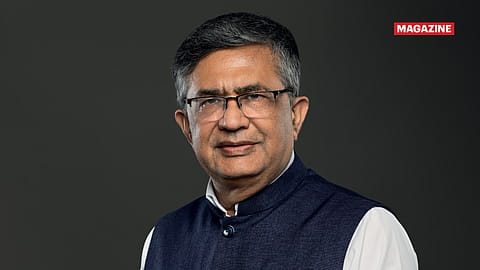
Credits: Narendra Bisht
This story belongs to the Fortune India Magazine october-2026-the-indian-luxury-boom issue.
SEPTEMBER 24, 2026, marked an important milestone in India’s capital market history as the National Stock Exchange of India (NSE) ended its long journey as an unlisted institution, giving investors direct access to the world’s largest multi-asset exchange. In FY26, NSE accounted for 93% share of equity cash trading, 99% of equity futures and 72% of equity options.
The country’s largest exchange raised ₹22,562 crore through an offer for sale, making it India’s second-largest IPO after Hyundai Motor India’s ₹27,859 crore issue.
At ₹1,785 a share, the offer valued NSE at ₹4.41 lakh crore. The debut, though, was far from spectacular. It got listed at ₹1,800 on the BSE, just 0.84% above its issue price, and ended the day at ₹1,818, a gain of 1.85% and a market capitalisation of about ₹4.5 lakh crore, making NSE the 11th most valuable company on the BSE, ahead of Sun Pharma, Titan, Adani Ports and Infosys. It was just behind Hindustan Unilever, LIC, and Larsen & Toubro.
NSE has emerged as the world’s seventh-largest listed exchange by market capitalisation following its stock-market debut, ahead of Cboe Holdings, Euronext, and several other listed exchange operators.
CME Group leads the pack at $96.1 billion, followed by Intercontinental Exchange (ICE) — the owner of the New York Stock Exchange — at $85.9 billion. Hong Kong Exchanges & Clearing is valued at $63.8 billion, Deutsche Börse at $58.9 billion, Nasdaq at $52.8 billion, and London Stock Exchange Group at $52.5 billion.
The gap with its Indian peers is much wider. BSE, Multi Commodity Exchange of India (MCX) and India Energy Exchange (IEX) had market capitalisations of ₹1.31 lakh crore, ₹86,875 crore, and ₹9,973 crore, respectively, as of September 24, 2026. At around ₹4.45 lakh crore, NSE is worth nearly twice as much as the three combined.
The bigger opportunity
The bigger question is how much more the exchange can grow as more Indian savings move into financial assets.
More Stories from this Issue
Macquarie Equity Research expects the total addressable market for Indian stock exchanges to grow 12–14% annually between FY26 and FY30, from ₹24,040 crore to ₹39,990 crore. It sees transaction revenue growing 12% and non-transaction revenue 15% during the period.
The brokerage in its report said that there is still plenty of room for financialisation. Only around 3% of India’s population is active on NSE and about 4% owns mutual funds. Cash-market turnover is just 0.2% of market cap, compared with 1.6% in the U.S. and 2.8% in China.
With a billion people in the working age bracket, Indians save around $500 billion annually in financial assets, but with a majority in cash and deposits. The brokerage expects the shift towards financial products to help the combined investment, wealth and exchange revenue pool grow at a 16% CAGR through FY30.
There is, however, a catch. A large part of India’s market activity is concentrated in derivatives. F&O accounts for around 75% of turnover across the country’s three major exchanges, according to Macquarie, while cash equities account for about 25%.
{{#most-powerful-women-snapshot-individual.slug}} {{/most-powerful-women-snapshot-individual.slug}} {{^most-powerful-women-snapshot-individual.slug}} {{/most-powerful-women-snapshot-individual.slug}} {{#showRanking}} {{current-rank}} {{/showRanking}} {{#photo.0.url}}
{{name}}
That leaves NSE exposed to changes in regulation. The Securities and Exchange Board of India (Sebi), the Reserve Bank of India (RBI), and the finance ministry have taken steps to moderate derivatives activity, particularly in the near term.
NSE has seen its index-options market share fall from 97% in FY24 to 72% in FY26 to 65% in YTDFY27, amid regulatory changes including restrictions on weekly expiries, the closing auction session, and prop-trading rules.
Unsurprisingly, NSE is already looking beyond its core trading business with plans to widen the derivatives basket, look at power markets, mutual funds, bonds, market data, connectivity and international financial services.
Keeping the faith
For now, brokerages are bullish, citing NSE’s dominant market share and the longer-term financialisation of Indian savings.
Emkay Global expects NSE’s EPS to grow around 13% annually in FY27-29, after roughly 19% growth in FY22-26. Revenue is expected to grow around 12% a year, while Ebitda and PAT are projected to rise about 13%. PL Capital values the exchange at 35 times its FY29 earnings.
Macquarie, on the other hand, has identified the resolution of issues around the closing auction session, growth in monthly options volumes, and increased activity around large IPOs as potential catalysts. It expects NSE’s revenue to grow at a 12% CAGR through FY30, helped by non-transaction revenues and new products, partly offset by some market-share loss in cash equities and F&O.
A new chapter
For Ashishkumar Chauhan, NSE’s MD and CEO, the listing is the start of another phase for an institution that has spent three decades building India’s capital-market infrastructure. “More than 34 lakh retail investors have been allotted shares in NSE’s IPO. We welcome them. We now have a 36-lakh [-strong] retail family. Before IPO, we had only 2 lakh-plus investors,” Chauhan said at the listing ceremony.
He sees NSE’s role as going beyond facilitating trades. Its primary purpose, he said, is to channel household savings into productive capital, creating jobs, income and wealth.
The numbers show how far the market has come. NSE had around 10 lakh investors in 1994. Today, it has 13.5 crore unique investors and 27 crore accounts. India’s listed market capitalisation has grown from roughly ₹4 lakh crore in 1994 to around ₹475 lakh crore today.
The exchange has already established its scale and dominance. The task is to now turn that position into steady growth while dealing with regulatory changes, shifts in trading patterns and an evolving market.
Chauhan compared the moment to a batsman reaching a century and taking a fresh stance for the next ball. The listing marks the culmination of the first innings, but a tricky next session has just begun.
Follow Fortune India
Sign in to read full story
To access our exclusive magazine content, sign in to your Fortune India account.
Sign In NowNEXT STORY