SpiceJet's final act: Can the airline turn things around and soar again?
/ 8 min read
The home-grown airline has seen many a change in its fortunes over the years but has somehow managed to beat the odds. Will it be able to turn around one final time?
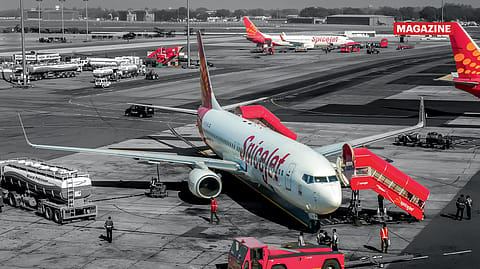
SpiceJet's market share dwindled to 1.2% as of August 2026. | Credits: Fortune India
This story belongs to the Fortune India Magazine november-2026-best-banks-and-nbfcs-2026 issue.
ALMOST A DECADE AGO, SpiceJet was the toast of the town after Donald Trump — during his first stint as U.S. President — publicly acknowledged the airline after it announced a deal to buy 205 Boeing aircraft.
Nearly 10 years later, it was the turn of Smit Machchhar — who was flying planes for SpiceJet when Trump had acknowledged the airline — to come in for praise from the U.S. President; this was for warding off an attack from his co-pilot and saving 180 passengers on board a flydubai flight between Dubai and Tel Aviv.
At home, SpiceJet’s CMD, Ajay Singh, went on a media blitzkrieg to say how proud he was of Machchhar. But even as that unfolded, social media had some brickbats and snide remarks for SpiceJet and Singh, ranging from how the airline’s broken business over the past few years might have forced the pilot to seek better avenues, to facetiously claiming that the stint at SpiceJet helped him to face anything that came his way.
While Machchhar left SpiceJet in 2022, the airline has struggled for years. It hasn’t paid wages for months, and the government has put the airline under financial and operational scrutiny. Market share has dwindled to 1.2% as of August 2026. That number stood at 3.9% in March this year and 16.3% at the end of 2019, when it was the country’s second-largest airline.
Today, market capitalisation is at just about ₹1,300 crore, while debt has swelled to over ₹4,000 crore. A ₹3,600-crore fundraise completed two years ago hasn’t helped improve fortunes, with losses widening and operational performance worsening. Frequent run-ins with passengers, airports, and even the regulator have raised questions about its long-term viability, especially as Indian aviation faces serious turbulence from fluctuating fuel prices and geopolitical instability.
“Our immediate priority is to rebuild capacity, improve schedule reliability, and strengthen the airline’s financial position,” the airline’s spokesperson tells Fortune India. “We remain committed to this process and believe that consistent progress on these fronts will be key to a sustainable recovery.”
But that may not be easy. “My judgment is that SpiceJet has a reasonable chance of continuing to fly in some form over the next 12 months, but a less-than-even chance of rebuilding a stable, self-funding airline in that period,” says aviation expert Alok Anand, chairman of Acumen Aviation, an aircraft asset management and leasing company. “The strongest warning is in SpiceJet’s own December 2025 accounts: its auditor highlighted a material uncertainty about its ability to continue as a going concern. Current liabilities exceeded current assets by about ₹4,281 crore. That is a substantial hole to manage while paying for aircraft, crew, and day-to-day operations.”
More Stories from this Issue
According to Amit Mittal, director of aviation consulting firm AeroIntellect Aviation, Singh may have turned around difficult situations before, but those required capital, credible growth plans, and a cooperative vendor/lessor ecosystem — conditions that are harder to assemble with a shrunken fleet. “SpiceJet’s prospects look precarious: with DGCA scrutiny, a market share of near 1%, delayed salaries and a tiny market cap, a full recovery is possible only if it secures fresh capital and restores operational reliability quickly,” he says.
WHERE DID IT ALL GO WRONG?
Between 2015 and 2019, SpiceJet was like a phoenix rising from the ashes. The airline nearly shut in 2014 after three straight years of losses, with lessors taking back some aircraft and forcing more than 2,000 flight cancellations in a month. State oil companies added to the airline’s troubles by refusing to fuel the jets unless the airline cleared its dues. Singh, who founded the airline with London-based Bhupendra S. Kansagra before Kalanithi Maran bought it, rushed in to give it a fresh lease of life. He also settled dues of some ₹2,200 crore. Maran exited SpiceJet in 2015 after selling his stake to Singh.
What followed was 18 consecutive months of profits, driven by tight cost control and expanding revenue. In three years, its shares zoomed by some 800% and made it the world’s best airline stock. SpiceJet also grew to become India’s third-largest airline after IndiGo and Jet Airways, with a fleet of 34 Boeing 737 aircraft and 20 Bombardier Q400s by 2016. Over the next few years, the brand underwent transition and went on to firm up orders for 155 Boeing 737-8 Max and 50 purchase rights for wide-body long-haul planes like Boeing 787 Dreamliners. The airline wanted to go big on international routes — to cities such as Bangkok, Colombo, Dhaka, Muscat, Kabul, Male, Hong Kong, Dubai, and Jeddah.
{{#most-powerful-women-snapshot-individual.slug}} {{/most-powerful-women-snapshot-individual.slug}} {{^most-powerful-women-snapshot-individual.slug}} {{/most-powerful-women-snapshot-individual.slug}} {{#showRanking}} {{current-rank}} {{/showRanking}} {{#photo.0.url}}
{{name}}
By 2019, when Jet Airways folded, SpiceJet emerged as India’s second-largest airline, with a 15% market share. Yet the airline began to feel the heat from the rupee’s depreciation and the government’s decision to ground all Boeing Max aircraft. That came as a blow, particularly since it was steadily replacing its older aircraft with the new Max and hoped to cut costs and make operations more efficient.
“I think the turning point was 2019-22, but the fall to roughly 1% was a longer process,” says Anand. “Ajay Singh’s 2015 turnaround was real; SpiceJet reported three consecutive profitable years through FY18 and had about 12% of the domestic market. It then reached 15.6% in June 2019, partly by taking aircraft released after Jet Airways stopped flying.”
Although Boeing paid compensation for the grounding, it affected operations. Then came Covid-19, when most airlines were grounded, and operations were crippled, forcing SpiceJet to shift its focus to cargo. Even that didn’t stop the downward spiral. IndiGo, its closest rival, had built up a coffer that helped it sail through the crisis.
Lenders soon began knocking on Singh’s doors, and just as he managed to fix it with the compensation from Boeing, the airline faced incidents that forced India’s aviation regulator to step in. Between May and July 2022, SpiceJet saw nine incidents, from smoke in the cabin to a cracked windshield and an emergency landing in Karachi, prompting the regulator to order it to fly at 50% of its approved flights for two months.
“The challenges began with the Boeing 737 MAX crashes, which led to the worldwide grounding of the aircraft and halted deliveries of what was a critical part of our fleet expansion plans,” the SpiceJet spokesperson says. “The pandemic followed, bringing unprecedented disruption to global aviation. In the years since, multiple conflicts, geopolitical instability, and airspace closures have further pressured an already challenging operating environment. These were events largely beyond our control, but their impact on the airline’s capacity and operations was significant.”
But that really can’t be an excuse for the airline’s descent. “Those were the blows; the failure to establish a durable funding base and keep a dependable fleet flying turned them into a prolonged contraction,” says Anand. “The hard task now is restoring creditor confidence and earning power at the same time, in a market where rivals have absorbed the capacity SpiceJet lost.”
In 2024, the airline announced a plan to raise ₹2,200 crore from 63 entities, including financial institutions, foreign institutional investors, high-net-worth individuals, and private investors, through the issuance of equity shares and warrants. The idea was also to attempt to acquire Go Air, an airline owned by billionaire Nusli Wadia, which had shut operations. However, weak investor participation reduced the expected proceeds to ₹1,060 crore, of which the airline eventually received ₹678.19 crore.
Eventually, SpiceJet raised ₹3,000 crore through a qualified institutional placement (QIP) in September 2024 at ₹61.60 a share.
“We believe India has ample room for multiple strong airlines, and the experience of recent years has shown why a competitive aviation market, with meaningful choice for passengers, is important,” the spokesperson adds. “A market dominated by too few players can limit choice and leave passengers vulnerable to capacity constraints and fare pressures.”
WHAT LIES AHEAD
In 2026, the company’s stock has tanked. Market capitalisation has collapsed to ₹1,358 crore as of October 13, 2026, from ₹10,397 crore in October 2024, a serious concern for new investors. IndiGo, meanwhile, has a market capitalisation of ₹1,85,000 crore.
And winning back customers won’t be easy. In August this year, SpiceJet had as many as 21% flight cancellations, compared to 1.1% at Air India and 0.33% at IndiGo. It also had the lowest on-time arrivals at airports, at 17.9%, compared to 91.5% for IndiGo.
“The company’s liquidity is stretched as marked by high debt repayment liabilities of ₹242.7 crore and ₹218.8 crore in FY26 and FY27, respectively,” ratings agency CareEdge said in a report in April. “The company almost fully utilised its funds raised in the past, with available free cash balances of ₹170 crore and ₹110 crore of unutilised QIP funds as of December 2025. The company is expected to fund its repayment liabilities and to fund future cash outflows through available free cash, monetisation of spare parts/unutilised fleet; however, the same remains contingent upon completion in the next 12-18 months. The company has no sanctioned fund-based working capital limits.”
The spokesperson says that SpiceJet is evaluating multiple avenues to strengthen its financial position. “We have been working on improving liquidity, managing costs and addressing obligations while progressing with our fleet expansion plans. The airline has also received support under the government’s Emergency Credit Line Guarantee Scheme (ECLGS). Our focus is on ensuring that available resources are deployed prudently and that the measures being pursued support a sustainable recovery.”
Meanwhile, IndiGo, Air India, and Akasa have already put in place serious plans to grab more market share.
IndiGo is growing its international capacity to 40%, with mid- and long-haul operations increasing to 10-15% from about 4% currently. The airline will operate these flights with its Airbus A321 XLR and A350 aircraft. IndiGo also plans to offer Stretch seats on 105 aircraft by FY27-end, up from 53 now. Under a new CEO, Air India is already considering merging Air India Express into Air India to streamline operations and cut costs, as the Tata Group continues to bet heavily on the 94-year-old airline’s prospects.
Meanwhile, SpiceJet has finalised lease agreements for 20 aircraft ahead of the upcoming winter schedule. The airline plans to induct 15 Boeing aircraft and five Airbus aircraft under wet lease arrangements. The five Airbus aircraft are expected to arrive between mid-October and mid-November, and the fleet addition will also include the Airbus A321 variant. The company is targeting 200 flights per day.
“The proposed 20-aircraft winter lease programme could restore scale quickly,” Anand says. “The test is whether those aircraft arrive, fly consistently and earn enough after lease and operating costs, while SpiceJet also pays staff and suppliers and reduces overdue liabilities.”
That means the airline has very limited options. “I would put the priorities in this order,” Anand says. “Fund the next 12–18 months, not just the winter season. Agree on a credible cash plan with investors and lenders, including overdue salaries, maintenance, airports, and suppliers. The auditor’s going-concern warning and the gap between current liabilities and assets make short-term fixes insufficient.”
The SpiceJet spokesperson says that employee payments remain a priority for the company and “are being disbursed in a phased manner, consistent with the process followed over the past several months”.
SpiceJet’s fleet has reportedly shrunk to 11 aircraft — two De Havilland Canada DHC-8-400s and nine 737s. “The company should settle the obligations that keep aircraft on the ground, negotiate binding arrangements with lessors, engine providers and critical vendors,” adds Anand.
Its flying capacity has shrunk even faster. Spicejet operated 1,153 domestic departures in August 2026, down from 2,330 a year earlier. International departures have fallen 49%, from 1,067 in August 2022 to 543 this year.
Meanwhile, new entrants are likely to spark competition in the skies unless SpiceJet acts quickly with a recovery plan.
“I have low confidence in a broad turnaround, moderate confidence in a narrower survival and rebuild, provided SpiceJet secures enough funding to clear critical dues and sustain operations through more than one peak season,” says Anand.
That means concentrating the aircraft on routes with sound margins, maintaining operational reserves, and reducing cancellations. At the same time, higher fuel prices following the unrest in the Middle East have made it increasingly difficult for airlines such as SpiceJet to fly.
“Passengers will return through reliability, not a large, published network,” says Anand. Even SpiceJet is well-aware of that. “We recognise that a turnaround of this scale takes sustained effort, but we are firmly focussed on delivering results and building a stronger, more sustainable SpiceJet,” the spokesperson adds. “Mr Singh’s experience, combined with the measures now under way to expand the fleet, restore capacity and improve operational stability, gives us confidence in the path ahead.”
It’s definitely a tough flight path. But Singh knows a thing or two about getting it going when the chips are truly down. The question is, can he pull it off once again?
Follow Fortune India
Sign in to read full story
To access our exclusive magazine content, sign in to your Fortune India account.
Sign In NowNEXT STORY