Uttar Pradesh powers indigenous defence manufacturing
/ 8 min read
With ₹39,804 crore in proposed investments, Uttar Pradesh is building an ecosystem spanning missiles, ammunition, aerospace components, and precision engineering.
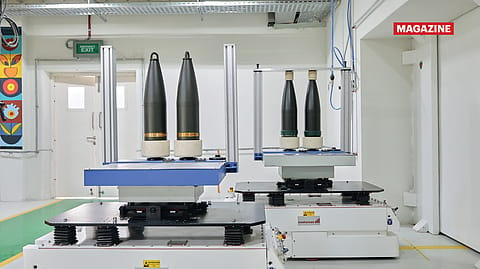
A drone manufacturing unit at Adani Defence’s Kanpur facility.
This story belongs to the Fortune India Magazine November 2026 issue.
FOR DECADES, Uttar Pradesh has been known as India’s largest consumer market, with pockets of traditional industries, small manufacturing clusters, and British-era ordnance factories that were set up to make leather saddlery, boots, and uniforms. That is changing, as the Uttar Pradesh Expressways Industrial Development Authority (UPEIDA) has carved out five expressways while setting up armaments manufacturing nodes alongside.
This “defence corridor” has attracted private-sector and government companies, from manufacturers of drones, missiles, and aerospace components to suppliers of standard ammunition and specialised equipment.
Launched in 2018 as part of the Union government’s Aatmanirbhar Bharat initiative, the UP Defence Industrial Corridor (UPDIC) is one of two planned defence corridors; the other is in Tamil Nadu. India aims to reach ₹3 lakh crore in annual defence production and ₹50,000 crore in exports by 2029.
The UPEIDA has the mandate to build an expressway as well as industrial hubs alongside. The hubs are Lucknow, Kanpur, Jhansi, Aligarh, Agra, and Chitrakoot. Each node will support different parts of the defence supply chain, from missile systems and ammunition to aerospace materials, electronics, and precision engineering. Only Kanpur has a defence production history, with five government factories that used to make, among other things, large calibre guns, small arms, field guns, leather goods, and parachutes.
The UPDIC, an initiative of the UPEIDA, says it has attracted 217 MoUs, of which 192 are industrial and 25 institutional.
Col Sanjay Singh (retired), UPDIC’s chief general manager, says the MoUs represent investments totalling ₹39,804 crore, which could translate into 60,000-plus jobs. Of the industrial MoUs, 67 have been realised, involving investments of ₹13,906.93 crore.
“The corridor has emerged as one of India’s flagship defence manufacturing initiatives, creating a robust ecosystem for indigenous defence production,” says Col Singh, a BTech in electrical engineering who served for over three decades in the Indian Army’s Corps of Electronics & Mechanical Engineers (EME), picking up an MTech from IIT Bombay during his career.
More Stories from this Issue
ADANI, BRAHMOS LEAD
Adani Defence Systems & Technologies Ltd is already running a ₹1,500-crore ammunition manufacturing facility in Kanpur, the corridor’s largest investment so far and one of the nine operational facilities.
BrahMos Aerospace, a joint venture between the Indian and Russian governments, has operationalised its ₹300-crore missile facility in Lucknow, delivered its first batch of missiles to the Indian Army, and is assembling the second batch. The Lucknow plant, its second production line, will increase India’s overall missile manufacturing capacity by around 20%. With demand from Southeast Asian countries, the facility can produce 80-100 missiles annually and will scale to 100-150 missiles a year, including the BrahMos-NG variant. The company secured its first export order in 2022 and later signed a deal with the Philippines. This year, it bagged orders from Indonesia and Vietnam.
Other operational units include Aerolloy Technologies, a subsidiary of PTC Industries, which makes titanium castings for aerospace applications at its ₹320-crore Lucknow plant. In Aligarh, famous for its lock-making industry, Amitec Electronics has begun producing electronic warfare systems and satellite technology at its ₹330-crore facility, while Werywin Defence manufactures pistols, revolvers, and a rifle based on the Armalite platform at its ₹65-crore unit.
AR Polymers makes tactical defence equipment and fibre-reinforced plastic (FRP) composites in Kanpur; Aadhunik Materials & Sciences produces non-woven textiles used in aerospace and protective gear for soldiers, among others; and Sankalp Safety Solutions makes safety equipment, woven fabrics, and tapes and webbing.
{{#most-powerful-women-snapshot-individual.slug}} {{/most-powerful-women-snapshot-individual.slug}} {{^most-powerful-women-snapshot-individual.slug}} {{/most-powerful-women-snapshot-individual.slug}} {{#showRanking}} {{current-rank}} {{/showRanking}} {{#photo.0.url}}
{{name}}
The corridor is also attracting investments from public-sector defence companies. Bharat Dynamics Ltd (BDL) is setting up a missile propulsion manufacturing unit in Jhansi, while Bharat Electronics Ltd (BEL) has been allotted land in Chitrakoot for an integration and testing facility.
Ashish Rajvanshi, CEO, Adani Defence & Aerospace, says its integrated complex will turn Kanpur into an ammunition hub.
“Our investments in Kanpur go beyond manufacturing capacity. We are creating an integrated defence ecosystem with deep supply-chain linkages, advanced manufacturing technologies and export-oriented capabilities. The Kanpur complex is emerging as one of South Asia’s largest private-sector ammunition ecosystems,” Rajvanshi says.
The company’s small-calibre ammunition facility has an annual capacity of around 300 million rounds across 5.56 mm, 7.62 mm, 9 mm and .338-inch sniper ammunition. It plans to raise this to 500 million rounds by 2030. Large-calibre capacity stands at 150,000 rounds a year, with plans to double it. Medium-calibre ammunition production — 23 mm, 30 mm and 40 mm — has an initial capacity of 2 million rounds annually, targeted to rise to 4 million.
Adani is also looking to produce critical inputs such as primers, fuses, and single-, double-, and triple-base propellants. Localising these components could deepen the supply chain and reduce reliance on imports.
SIX NODES, DISTINCT CAPABILITIES
UPDIC will have specialised manufacturing centres rather than a single industrial zone. Lucknow is focussed on missiles, aerospace, and advanced materials, while Kanpur is attracting ammunition and defence-materials manufacturers. Jhansi is being developed for explosives, propellants, and ammunition. Aligarh is drawing companies in small arms, drones, counter-drone systems, and precision engineering. Chitrakoot, known for its wooden toys, is being developed for strategic manufacturing and testing, while Agra offers opportunities in electronics, aerospace, and advanced technologies.
Chief minister Yogi Adityanath has cited the state’s existing industrial base as an advantage in developing the corridor.
“The required ecosystem for defence manufacturing corridors exists in Uttar Pradesh. The state has 56% skilled manpower. There is also a strong base of MSMEs, with 96 lakh units already operational across sectors ranging from hardware to leather and textiles,” he has said.
The Reserve Bank of India classifies MSMEs (micro, small and medium enterprises) as those with investment in plant and machinery up to ₹2.5 crore and turnover of ₹10 crore (micro in MSME) to investment of ₹125 crore and turnover up to ₹500 crore (medium). All MSMEs have to be registered on the government’s Udyam portal.
“Aligarh has emerged as a hub for small arms, defence equipment and military supplies, while Kanpur — traditionally known as the Manchester of the East — is becoming a centre for ammunition, missiles, defence textiles, and protective gear,” Adityanath told a seminar in Prayagraj in May. Kanpur was the first major industrial city of north India, famous for its massive textiles and leather industries.
MSMEs MOVE UP THE VALUE CHAIN
The corridor’s wider economic impact will depend on how much of its activity reaches smaller manufacturers. Uttar Pradesh has around 96 lakh MSMEs, accounting for about 14.2% of India’s total, according to official figures. Defence manufacturing offers these businesses an opportunity to move into specialised products and supply large manufacturers and public-sector defence companies.
“MSMEs are the backbone of the corridor. We are facilitating their integration with large defence manufacturers and public sector undertakings through vendor development, localisation of imported components, and opportunities across precision engineering, electronics, defence textiles, and advanced materials,” says Col Singh.
The supplier base already spans several capabilities. Aligarh-based Nitya Creations produces precision-machined components and arms sub-assemblies. Datum Advanced Composites supplies carbon-fibre components, and Amitec Electronics works on electronic warfare sub-systems.
For smaller manufacturers, the opportunity lies in supplying precision components, specialised metals, electronics, composites, and protective materials. Building capabilities that serve multiple customers and applications could help them move beyond project-based orders into more sustained manufacturing relationships.
Nitya Creations began investing in the corridor in 2021, initially planning to commit around ₹12 crore. It has invested ₹6–7 crore so far and expects total investment to reach ₹25–30 crore.
“We have seen comparatively rapid development of the Uttar Pradesh Defence Industrial Corridor since Prime Minister Narendra Modi announced the two defence corridors in Uttar Pradesh and Tamil Nadu. It is remarkable how quickly the industrial area has developed,” says Navneet Varshney, managing director, Nitya Creations.
The company supplies components to Bharat Electronics and Advanced Weapons & Equipment India, and is involved in the AK-203 rifle programme for Indo-Russian Rifles Pvt. Ltd. Its capabilities include machining, castings, sheet-metal fabrication, four-axis and five-axis machining, turning, inspection and metallurgy.
Defence contributes around 50% of Nitya Creations India’s revenue, according to director Sunil Kumar Varshney. The business is expanding into aerospace, drones and counter-drone systems, and developing indigenous magazines for small- and medium-calibre firearms. Over the next five years, it aims to take its 15,000-sq. m facility to full capacity and employ more than 1,000 people.
Aligarh-based Werywin Defence illustrates the growth of the state’s small-arms manufacturing base. It began its licensing process in 2021 and started production in 2024. It can manufacture 2,500 units a month of revolvers, pistols, and rifles. The company has established a second unit, plans a third and has a joint venture with U.S.-based Smith & Wesson.
“Our current customers are primarily in the civilian market, but our ambition is to export to markets across the world. We cannot depend solely on the Indian market,” says Abhishek Singh, assistant chief manager, Werywin Defence.
Scaling this supplier base will require more than investment. Defence procurement involves stringent qualification standards and long development cycles. MSMEs need access to testing facilities, skilled workers, technology, and large customers, along with sustained orders, to become reliable suppliers.
BEYOND IMPORT SUBSTITUTION
Reducing imports is an immediate objective of domestic defence manufacturing. The larger opportunity is to develop products and technologies that can compete in the international markets.
Nitya Creations is working to manufacture components that were previously imported. “India has a massive defence budget, of which 60–70% is spent on imports. If we start manufacturing these products in India, it could make a significant contribution to the country’s GDP,” says Navneet Varshney.
Large manufacturers are also seeking to localise critical inputs. Adani Defence’s plans for primers, fuses, and propellants could expand domestic capabilities beyond ammunition assembly, while the BrahMos facility adds missile manufacturing capacity. Such investments could create opportunities for local suppliers and strengthen the domestic defence supply chain.
That transition requires research, testing, certification and validation infrastructure, particularly for drones, advanced materials, and communications systems.
UPDIC is developing three specialised testing facilities with a combined investment of ₹156 crore. These include the Unmanned Aerial Systems Defence Testing Foundation at IIT Kanpur, with an allocation of ₹60 crore; the Advanced Materials Defence Testing Foundation in Lucknow, with ₹54.26 crore; and the Communication Defence Testing Foundation at IIT Kanpur, with ₹41.84 crore.
The facilities are intended to support testing of unmanned aerial systems, advanced materials, and defence communication technologies. They could allow smaller manufacturers and startups to validate products without building all the necessary infrastructure themselves.
The state is also seeking to link research institutions with industry. IIT Kanpur and IIT-BHU will develop Centres of Excellence covering drones and autonomous systems, smart materials, precision engineering, sensors, electronics, and robotics; IIT Kanpur will get ₹50 crore for a centre, and IIT-BHU will get ₹69 crore. The state is examining a proposal for a 30-acre defence park near IIT Kanpur, to be developed jointly by UPEIDA and the institute.
As Adityanath said, the state has a flourishing startup ecosystem. “Today, more than 21,000 startups have been established in Uttar Pradesh across sectors, including AI, robotics, drones, semiconductors, and data centres,” he said.
Connecting these businesses and research capabilities with defence manufacturers could help translate technical expertise into products for military and export markets.
INCENTIVES TO ATTRACT INVESTMENT
The state is offering incentives under its aerospace and defence policy to attract manufacturers. These include capital subsidies of up to 35%, 100% stamp duty exemption, and a 25% upfront land subsidy for eligible anchor and mega-anchor investors. Single-window clearances, industrial land, dedicated power infrastructure and support for research, certification and skill development are intended to ease project implementation.
Such support matters in an industry where facilities require specialised equipment, secure premises, and long lead times before production begins. But incentives and land allotments are only the starting point. Projects must translate into operational plants, sustained production, and orders. Companies also need qualified workers, reliable suppliers, timely approvals, and access to customers.
Uttar Pradesh has established an investment pipeline and begun production across several parts of the corridor. The next test is whether proposed investments are realised on schedule, local suppliers secure a larger share of manufacturing activity, and production scales up to meet domestic and export demand.
Follow Fortune India
Sign in to read full story
To access our exclusive magazine content, sign in to your Fortune India account.
Sign In NowNEXT STORY