Want investors as partners to build a Viksit Chhattisgarh, says Chhattisgarh CM Vishnu Deo Sai
/ 6 min read
Sai says that the state government will offer “every facilitation” that investors require.
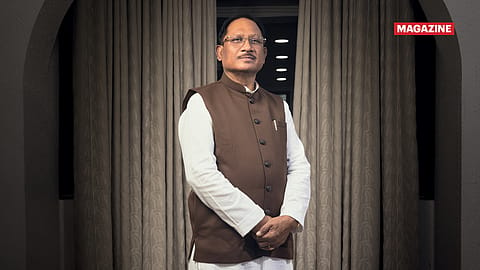
Vishnu Deo Sai, Chief Minister of Chhattisgarh. | Credits: Sanjay Rawat
This story belongs to the Fortune India Magazine october-2026-the-indian-luxury-boom issue.
VISHNU DEO SAI, the fourth chief minister of Chhattisgarh, says the state — which has signed memoranda of understanding (MoUs) worth ₹8.23 lakh crore with investors — is open for business. With cheap land, surplus electricity, a New Industrial Policy, and the goal of a Viksit Chhattisgarh for 2047, the state — located in the East-Central region of India — is wooing investments from all over the country and abroad. In an interview with Fortune India, the Chhattisgarh chief minister says that the state government — which has signed MoUs in the fields of semiconductors, data centres, artificial intelligence (AI), textiles, and power — will offer “every facilitation” that investors need. Edited excerpts:
The state government has an elaborate plan for 2047 called Viksit Chhattisgarh. What is the vision for the future growth of the state?
Prime Minister Narendra Modi has set before us a major goal of building a Viksit Bharat by 2047. Chhattisgarh will also play an effective role in achieving this goal. We have prepared a comprehensive strategy and are working on it.
We have also formulated a vision document for Viksit Chhattisgarh by 2047 [and] are working in that direction. We want to build manufacturing as the base for the future growth of the state. Being a mineral-rich state, Chhattisgarh has immense possibilities. The state also has potential for tourism, and food processing. The Gross State Domestic Product (GSDP) of Chhattisgarh at present is ₹6 lakh crore. By 2047, we have a target to take the GSDP to ₹75 lakh crore.
That is a colossal goal. What will be the levers that the state government will deploy to achieve this target?
Manufacturing will be the key focus area. There is a massive opportunity for industrial growth in the state. We have brought a new industrial policy for 2024-30. Ease of doing business is the primary aspect of the policy. Under this, we are promoting a one-click single-window system, ease of doing business and investment incentives. No-objection certificates (NOCs) for investments are provided online and expeditiously. For starting an enterprise, low-risk industries have been provided the facility of self-certification.
Job creation has been accorded primacy under the policy. Incentives to industry are tied to the employment generated. The policy sets a threshold of creating 1,000 jobs for the special incentives to kick off.
More Stories from this Issue
Around 450 reforms have been undertaken to make it easier to establish and operate enterprises. This includes the passage of the Jan Vishwas Act and de-criminalisation provisions. Multiple reforms have been brought about to facilitate industries and businesses, and towards the ultimate goal of Viksit Chhattisgarh.
What is the quantum of investments/MoUs finalised under the new industrial policy?
It has been two years since the policy was rolled out. Wide consultations with industry were held before bringing out the policy. So far, we have done MoUs worth ₹8.23 lakh crore… We are working in the semiconductor space, data centres, AI mission, textiles, and power. MoUs worth ₹3.5 lakh crore have been finalised in the power sector. In the coming years, the state will produce 30,000 megawatts of electricity. We are aggressively looking at new energy as well.
What mechanisms are in place to ensure that the investment proposals/MoUs translate into actual projects?
{{#most-powerful-women-snapshot-individual.slug}} {{/most-powerful-women-snapshot-individual.slug}} {{^most-powerful-women-snapshot-individual.slug}} {{/most-powerful-women-snapshot-individual.slug}} {{#showRanking}} {{current-rank}} {{/showRanking}} {{#photo.0.url}}
{{name}}
Our industries department continuously monitors the investment proposals we receive. We ensure that all possible facilities and support are provided to entrepreneurs seeking to invest in the state. We conduct regular review meetings, during which every investment proposal is discussed in detail. Continuous engagement with investors, followed by reviews based on their feedback, has significantly accelerated the conversion of investment proposals into actual investments.
Nava Raipur is being developed as a data centre and AI hub. How will the new developments in the region become an economic engine for the state’s economy?
Investments being facilitated through the New Industrial Policy are coming up in Nava Raipur. We are following a sector-based approach for investments there for data centres, AI, education, and healthcare.
An AI-based Special Economic Zone and data centre are being developed in Nava Raipur with an investment of around ₹1,000 crore. We have also launched the Chhattisgarh State AI Mission with a budget of ₹500 crore. [Under that] we will establish five AI Centres of Excellence and set up 100 AI data labs.
The most essential requirement for a data centre is reliable and uninterrupted power supply. One of Chhattisgarh’s major strengths is that it is a power-generating state. Alongside, we are also expanding our capacity in solar energy, pumped storage, and other clean energy sources.
For healthcare, a 100-acre medi-city is being developed, and an educational hub will also come up in the Nava Raipur region. A new Vidhan Sabha, Mantralaya, and residences for ministers will also come up [there]. Hospitality chains will also come up. An authority has been set up to develop a state capital region, including Raipur, Durg, and Bhilai. The roadmap for the region’s development is also being formulated.
For connectivity, work is progressing rapidly on the Raipur-Visakhapatnam Expressway and the Raipur-Dhanbad Economic Corridor. Cargo facilities have also commenced at Raipur airport.
Semiconductor is another major emerging area. How is the state tapping opportunities in this segment?
PM Modi described semiconductor chips as ‘digital diamonds’ at the launch of Semicon India. He said that while oil was considered ‘black gold’ in the last century, chips are the digital diamonds of this century.
In line with the PM’s vision, we have also encouraged the semiconductor industry in Chhattisgarh. When we visited Delhi for an investors’ summit, we met representatives of a semiconductor unit who expressed interest in investing in Chhattisgarh. Within the next three months, they had performed the bhoomi pujan for the unit. Polymatech Electronics is setting up a state-of-the-art manufacturing unit in Nava Raipur with an investment of ₹1,143 crore. The plant will produce 10 billion chips for use in telecommunications, 6G/7G, laptops, power electronics, and other technologies. The semiconductor sector is among our highest priorities, and we are working towards its development in the state.
The central government has successfully tackled Naxalism in Bastar. What are the key initiatives being taken up as part of the state government’s planned three-year development roadmap?
The home minister undertook a meeting here in 2024, as a part of review of Naxal-affected areas in the country. It was found that 75% of the affected areas was in Chhattisgarh, while the other six to seven states accounted for the remaining 25%. With the Centre’s new initiatives to put an end to Naxal infestation by December 2026, the situation has improved much. Bastar has been suffering from Naxalism for almost four decades now and was completely untouched by development. Now, major initiatives like road construction, power connectivity, water supply, and other major development initiatives are being taken up in the region.
More than 500 villages have benefitted; 421 schools have been established and telecommunication lines have been set up. Now that Naxalism is over, the security camps in the region are being converted into ‘Sewa Deras’ to skill villagers and facilitate food processing for produce such as tamarind.
Rice is another produce from the region for which we are facilitating processing, packaging, and exports. Seventy security camps will be converted into ‘Sewa Deras’ and opportunities will be tapped across more than 100 forest produce in the region. The region also offers tourism opportunities that the state will develop. In fact, tourism is also a part of the New Industrial Policy. The measures will have a major impact on job creation as well.
Today, states are not merely a part of the federal structure. They are also emerging as important economic engines. That also brings in a lot of competition among the states to bring in large scale investments. What is Chhattisgarh’s competitive moat to attract big investors?
There is competition. And there is both keen interest and cooperation from the Central government and PM Modi. We have conducted investor connect programmes for our New Industrial Policy in Delhi, Mumbai, Kolkata, Chennai, and Ahmedabad. We have also done the programmes in Japan and South Korea. We have showcased the policy and have urged investors to come and invest in the state. Here, land is cheap and we have surplus electricity.
What will be your message to investors and the corporate sector in the country and abroad?
I would urge industries to consider Chhattisgarh for their investments and business proposals. They must study our industrial policy. We would like to partner with them towards the goal of a Viksit Chhattisgarh. The state government will offer every facilitation the investors require. Due to Naxalism, there was an image that Chhattisgarh is not safe. Naxalism is over and there is a conducive atmosphere for industries and business.
Follow Fortune India
Sign in to read full story
To access our exclusive magazine content, sign in to your Fortune India account.
Sign In NowNEXT STORY