Eight ways Jio’s listing could reshape Indian business landscape
/ 3 min read
A valuation that places it among India’s largest listed companies could also strengthen the case for unlocking value in other Reliance businesses, particularly Reliance Retail. Here are eight distinct shifts to watch.
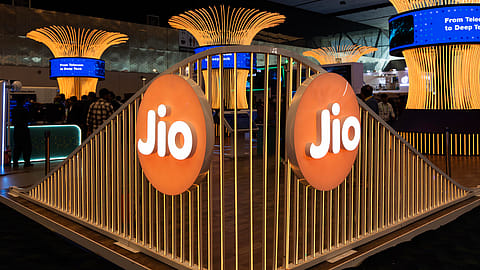
Reliance Jio IPO | Credits: Sanjay Rawat
From challenging Bharti Airtel’s market leadership to reviving hopes of a Reliance Retail IPO, Jio Platforms’ public-market debut could reshape investor strategies, telecom economics and the valuation of Mukesh Ambani’s empire.
Jio Platforms’ expected ₹30,000 crore IPO will test investors’ appetite for its technology ambitions and digital ecosystem. A valuation that places it among India’s largest listed companies could also strengthen the case for unlocking value in other Reliance businesses, particularly Reliance Retail. Here are eight distinct shifts to watch.
Could Jio join Reliance Industries at the top of India’s market?
Jio Platforms could emerge as one of India’s most valuable listed companies, potentially joining Reliance Industries, HDFC Bank, Bharti Airtel, ICICI Bank and TCS at the top. A separate listing would give investors a clearer view of Jio’s standalone market value and distinguish the digital business from RIL’s diversified operations. It could also reshape the hierarchy of India’s largest companies.
Can Jio revive investor confidence in telecom?
Bankruptcies, financial stress and prolonged disruption have weakened investor confidence in Indian telecom. Bharti Airtel has emerged as the sector’s strongest listed player, with a market capitalisation of ₹11.2 lakh crore and operations across India and Africa. Jio’s listing could attract fresh capital to the sector, while Vodafone Idea’s recovery, supported by regulatory relief, promoter funding and subscriber additions, could further improve sentiment.
Will Jio expand institutional investment in telecom?
Jio’s debut will give domestic and global funds another large, liquid stock through which to invest in India’s telecom growth. Before Jio’s listing, Bharti Airtel was the only major listed option for investors seeking exposure to the sector. Vodafone Idea’s financial stress had made it an unattractive investment for many of them.
Will the gap in ARPU determine the next phase of competition?
Airtel reported an average revenue per user (ARPU) of ₹264 in the June 2026 quarter, compared with Jio’s ₹215.6. However, Jio leads with 508 million subscribers, while Airtel has a subscriber base of 491 million. Globally, Airtel has more than 650 million subscribers. Investors will watch whether Jio can narrow the ARPU gap and whether both operators can raise tariffs without losing subscribers. The outcome will shape revenue growth and profitability.
Will network architecture shape the race towards 6G?
Jio’s standalone 5G network differs from Airtel’s non-standalone architecture, which uses its existing 4G core. This could influence how each operator develops advanced network capabilities, including 6G. But architecture alone will not determine the winner. Spectrum, fibre, equipment costs, borrowing requirements and returns on network investment will be equally important as both companies prepare for the next technology cycle, which will be capital-intensive.
Will Jio’s listing translate into direct wealth creation for the Ambanis?
The proposed IPO is a fresh issue of 27 crore shares, not an offer for sale by existing shareholders. Reliance Industries, India’s most valuable company, with a market capitalisation of ₹15.8 lakh crore, owns around 66.4% of Jio Platforms, rather than the Ambanis directly. Investors will assess whether Jio’s standalone valuation is fully reflected in RIL’s share price or reduced by a holding-company discount. The Ambani family’s wealth will therefore continue to be measured by the value of its Reliance Industries shares.
Could Jio’s valuation pave the way for a Reliance Retail IPO?
A successful Jio listing could revive expectations of a separate listing for Reliance Retail, which operates more than 20,000 stores across groceries, fashion, electronics and consumer brands. Such a move could give investors greater visibility into the retail business’s value, growth prospects and profitability.
Will investors value Jio as a technology platform or a telecom operator?
Jio’s businesses extend beyond mobile connectivity to broadband, enterprise services, cloud, entertainment and artificial intelligence. Its IPO will test whether public-market investors assign a premium to this broader digital ecosystem or value the company primarily on its telecom earnings. The decisive factor will be whether its technology businesses have the long-term potential to generate meaningful additional revenue and profits.
Follow Fortune India
NEXT STORY