From ₹1,000 to ₹50 lakh: Can Jio IPO investors replicate Reliance’s wealth-creation story?
/ 4 min read
Reliance’s decades-long wealth creation offers a benchmark for Jio Platforms investors, but future returns will hinge on earnings growth and IPO valuation.
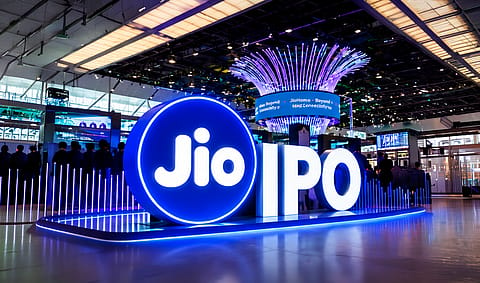
Jio Platforms' ₹30,213-crore IPO opens today | Credits: Fortune India
In January 1978, when Reliance Textile Industries, now known as Reliance Industries Ltd (RIL), made its debut on the Bombay Stock Exchange (BSE), few could have imagined the scale the business would eventually attain. Its public issue of 28.2 lakh shares at ₹10 apiece raised ₹2.82 crore and was subscribed 7.19 times. On its first day of trading, the stock reportedly changed hands at ₹17-18, giving early investors a listing premium of 70-80%.
Nearly five decades later, the public issue has become one of India's most striking examples of long-term wealth creation. An investment of ₹1,000 in the original offering, equivalent to 100 shares at the issue price, is estimated to be worth nearly ₹50 lakh today, excluding dividends, after accounting for subsequent bonus issues and share-price appreciation.
The story, however, is about more than a stock rising from ₹10 to a much higher price. It is also a tale of business transformation. What began as a textile enterprise expanded into petrochemicals, refining, energy and, eventually, telecommunications and digital services. Reliance's ability to enter new businesses, build scale and invest ahead of demand helped reshape its position in India's corporate landscape.
Now, as Jio Platforms prepares to enter the stock market with a ₹30,213-crore initial public offering (IPO) at a price band of ₹1,065-1,119 per share, investors are looking at another chapter in the Reliance story. The question is whether Jio can deliver the sustained compounding that made its parent a wealth-creation phenomenon, or whether expectations built around the group's legacy risk overshadowing the valuation and execution challenges ahead.
The power of starting early
Reliance’s history illustrates how corporate actions and sustained business growth can amplify long-term returns. Bonus issues in 1980 and 1983 increased the original 100 shares to 256. Subsequent 1:1 bonus issues in 1997, 2009, 2017 and 2024 took the holding to 4,096 shares, before accounting for other relevant corporate actions.
At its 2017 annual general meeting, Reliance said an investment of ₹1,000 in 1977 had grown to ₹16.5 lakh. Its market capitalisation had risen from about ₹10 crore at the time of the public issue to more than ₹5 lakh crore.
Nitant Darekar, research analyst at Bonanza, estimates that the original investment would be worth around ₹55-60 lakh today when subsequent corporate actions, including the demerger of Jio Financial Services, are considered.
But the historical return should not be treated as a template for future gains. Reliance’s valuation and business profile changed substantially over several decades. Its expansion into new industries created additional earnings streams and widened its addressable markets.
“Compounding was front-loaded and came from reinvention-from textiles to petrochemicals to refining to telecom-not from the issue price,” Darekar says.
A different starting point for Jio
Jio enters the market with an established customer base, nationwide network infrastructure and a substantial cash-generating business. It has 533 million customers and reported FY26 net profit of ₹30,049 crore and EBITDA of ₹76,255 crore.
At the upper end of the IPO price band, its valuation works out to around 34 times FY26 earnings and 13.5 times EBITDA. The multiples leave investors assessing not just Jio’s current profitability but also the growth required to sustain its valuation.
{{#most-powerful-women-snapshot-individual.slug}} {{/most-powerful-women-snapshot-individual.slug}} {{^most-powerful-women-snapshot-individual.slug}} {{/most-powerful-women-snapshot-individual.slug}} {{#showRanking}} {{current-rank}} {{/showRanking}} {{#photo.0.url}}
{{name}}
The IPO is entirely a fresh issue, with no offer for sale. Of the proceeds, up to ₹27,500 crore is expected to be used to repay or prepay borrowings of Reliance Jio Infocomm Ltd. RIL is expected to retain a 66.43% stake in Jio Platforms after the issue.
The anchor book attracted ₹8,109.85 crore from 212 investors, with bids exceeding ₹2.5 lakh crore. Strong institutional demand points to interest in the offering, but subscription demand alone cannot determine post-listing returns.
Jio’s average revenue per user (ARPU) stood at ₹215.6, below Bharti Airtel’s ₹263.9, according to Darekar. Further tariff increases, subscriber additions and growth in digital services could support revenue and profit expansion. However, the pace of these gains will matter because the IPO valuation already incorporates expectations of continued growth.
Darekar estimates that, to deliver low-to-mid-teens annual returns while its earnings multiple contracts to the mid-20s by FY31, Jio may need to grow profit to ₹75,000–80,000 crore. That would require profit to compound at close to 20% annually, alongside ARPU rising to ₹300–320 and the subscriber base approaching 600 million.
He also expects EBITDA to reach ₹1.5 lakh crore, with margins of 53–55%, and free cash flow to rise to ₹80,000–90,000 crore. These are projections, not assured outcomes.
Sarvam Goel, founder of Pocketful, takes a more moderate view. He expects Jio’s profit to reach around ₹50,000 crore by FY31, implying annual growth of 11–12%, with ARPU rising to ₹290–300 and free cash flow approaching ₹80,000 crore. He sees scope for better cash generation as the heavy investment phase of the 5G rollout eases.
Goel also points to digital services as a potential second growth engine, following 36% growth in the segment last year. Its ability to scale profitably could become an important factor in sustaining Jio’s valuation.
The Reliance trust premium
The Reliance name may help attract investors, but brand strength and historical returns cannot substitute for operating performance.
Anil Sharma, co-founder of IPO Central, says the group’s legacy and investor goodwill could support demand for Jio’s shares. However, telecom is already an established market, and much of the industry’s consolidation has taken place. Future returns will depend on ARPU growth, subscriber additions and the company’s ability to convert its customer base into higher earnings.
The completion of much of the 5G rollout could improve cash generation as capital expenditure moderates. But investors must also assess how much growth is already priced into the issue and whether future cash flows can support further gains.
Goel cautions that investor trust has limits: returns ultimately depend on the price paid. The performance of other Reliance-linked investments also shows that association with the group does not guarantee identical outcomes.
Reliance’s history highlights the power of long-term compounding, but Jio’s wealth-creation potential will depend on execution, earnings growth and IPO valuation, say analysts.
Follow Fortune India
NEXT STORY