Jio to use ₹27,500 crore IPO proceeds to repay RJIL debt; Akash targets 100 mn home broadband customers
/ 3 min read
The company aims to expand its home broadband customer base to 100 million from around 30 million currently. Jio has passed 40 million homes with its fibre network and is looking to expand its reach beyond larger cities.
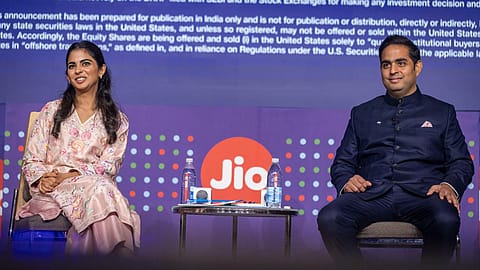
Isha and Akash Ambani at Jio IPO event | Credits: Apoorva Salkade
Jio Platforms plans to use up to ₹27,500 crore of the net proceeds from its ₹30,213-crore initial public offering (IPO) to repay or prepay borrowings of its material subsidiary, Reliance Jio Infocomm Ltd (RJIL), according to its red herring prospectus (RHP). Managing director Akash Ambani said at the IPO launch event that the proceeds would go towards reducing debt.
The company’s RHP specifies the repayment of RJIL’s borrowings as the primary use of the IPO proceeds, with the remaining amount earmarked for general corporate purposes.
Jio Platforms had gross debt of ₹61,372 crore and net debt of ₹9,539 crore as of June 30, 2026, according to the RHP. Net debt stood at ₹27,579 crore as of March 31, 2026. These are consolidated figures for Jio Platforms and its subsidiaries, and should be distinguished from the borrowings of RJIL that the IPO proceeds are intended to repay.
The IPO comprises a fresh issue of up to 27 crore equity shares. At the upper end of the price band of ₹1,119 per share, the issue size is ₹30,213 crore. The issue will open for subscription on October 21 and close on October 23.
Jio targets 100 million home broadband customers
Akash said Jio’s next phase of growth would focus on four areas — mobility, home broadband, enterprise services, and monetisation of its end-to-end technology stack.
The company aims to expand its home broadband customer base to 100 million from around 30 million currently. Jio has passed 40 million homes with its fibre network and is looking to expand its reach beyond larger cities.
Akash said 40% of broadband net additions were coming from outside Tier I and Tier II cities. The company is also combining broadband, television and digital applications to offer integrated services to households.
Jio had around 53 crore customers and a 5G subscriber base of more than 250 million, Akash said. Average monthly data consumption per customer has risen to 43.7 GB from around 200 MB when Jio launched in 2016.
On the scope for telecom tariff increases, Akash said there was room to raise prices but that the company wanted to focus on offering more services and charging customers according to the value delivered.
“What we want to do is, again, deliver more services to our users and price them accordingly, rather than playing a per-GB pricing game,” he said.
Jio is also looking to take its technology and managed services to international telecom operators through partnerships. Akash said the company’s proprietary technology stack could help India become an exporter of technology rather than an importer.
{{#most-powerful-women-snapshot-individual.slug}} {{/most-powerful-women-snapshot-individual.slug}} {{^most-powerful-women-snapshot-individual.slug}} {{/most-powerful-women-snapshot-individual.slug}} {{#showRanking}} {{current-rank}} {{/showRanking}} {{#photo.0.url}}
{{name}}
Isha Ambani stresses long-term approach
Isha Ambani said Reliance’s approach was built around long-term planning, scale and execution. She recalled how unreliable internet access was back home while she was studying in the US, which prompted conversations with her brother Akash about the need to build a digital technology platform in India. Jio was launched in 2016.
She said Reliance’s financial priorities included maintaining strong balance sheets and generating free cash flow that could be reinvested in growth.
Isha also referred to Reliance Industries’ public listing under Dhirubhai Ambani in 1977, saying the group’s founding vision was to enable Indians to participate in the country’s growth and prosperity.
Jio Platforms’ IPO marks the Reliance group’s return to the public markets after nearly two decades. The issue also includes reservations worth up to ₹2,500 crore for eligible Reliance Industries shareholders and ₹500 crore for eligible employees.
Follow Fortune India
NEXT STORY