Sebi to issue closing auction session guidelines in a week, says Tuhin Kanta Pandey
/ 2 min read
The regulator is also working to bring tender offers, share buybacks, and OFS within the interoperability framework for clearing corporations, with implementation targeted by the end of November 2026, says Pandey.
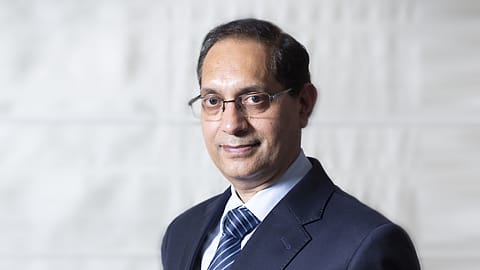
Tuhin Kanta Pandey, chairman, Sebi. | Credits: Sanjay Rawat
The Securities and Exchange Board of India (Sebi) is expected to issue guidelines on the closing auction session in about a week, following a review aimed at addressing concerns over the settlement price of derivatives on expiry days, Chairman Tuhin Kanta Pandey said on Saturday.
“Following review of the Closing Auction Session (CAS), a consultation paper was put out to address concerns in respect of settlement price of derivatives on expiry-day. We are currently examining the comments and hope to issue guidelines in about a week’s time,” Pandey said at the second Capital Market Confluence 2026, organised by the Bombay Stock Exchange Brokers’ Forum.
Interoperability for buybacks, OFS by November-end
Sebi is also working to bring tender offers, share buybacks, and offers for sale (OFS) within the interoperability framework for clearing corporations, with implementation targeted by the end of November 2026.
The Brokers’ Industry Standards Forum had flagged that these transactions remain outside the framework and require parallel clearing arrangements, increasing costs and compliance requirements.
The proposed changes are expected to improve capital efficiency and lower compliance costs while preserving settlement safety, Pandey said.
Sebi to issue guidelines on responsible AI use
Sebi will shortly issue guidelines for the responsible use of artificial intelligence (AI) and machine learning (ML), adopting a tiered approach with clear accountability, data controls, kill switches and human oversight.
The regulator will also align its approach with the International Organization of Securities Commissions’ Supervisory Toolkit for AI. “Technology cannot dilute accountability. Regulated entities remain responsible for AI outcomes, data quality, model governance and cyber resilience. Human oversight must remain clear,” Pandey said.
Sebi is also exploring tokenisation through its Demat 2.0 pilot for corporate bonds, which aims to make issuance, transfer, settlement and servicing more efficient using distributed ledger technology.
Digital onboarding for overseas investors
Sebi is likely to issue a circular shortly on simplifying digital onboarding for Persons Resident Outside India, removing the requirement for their physical presence. The regulator has received more than 400 comments on the proposal, Pandey said.
The regulator is also exploring graded compliance requirements for stockbrokers based on their scale, client exposure and dependence on technology. It is reviewing the Depositories and Participants Regulations to simplify rules and strengthen fraud prevention.
Pandey said Sebi had reviewed regulations governing stockbrokers, mutual funds, portfolio managers and settlement proceedings to simplify requirements and reduce interpretational gaps. It has also rationalised the penalty framework for brokers operating across multiple exchanges to avoid multiple penalties for the same violation.
{{#most-powerful-women-snapshot-individual.slug}} {{/most-powerful-women-snapshot-individual.slug}} {{^most-powerful-women-snapshot-individual.slug}} {{/most-powerful-women-snapshot-individual.slug}} {{#showRanking}} {{current-rank}} {{/showRanking}} {{#photo.0.url}}
{{name}}
Sebi steps up investor awareness
Pandey urged brokers to make investor awareness an integral part of onboarding and customer service as digital fraud, fake trading applications, and misleading investment claims pose growing risks.
Sebi has launched Project Jagrook, a nationwide investor-awareness initiative spanning television, print, radio, digital and social media in English, Hindi and 11 regional languages. Its WhatsApp channel has so far sent around 33 crore messages.
India’s capital markets have a market capitalisation of around ₹472 lakh crore and more than 15 crore unique investors. Mutual fund assets stand at approximately ₹87 lakh crore while outstanding corporate bonds total around ₹61 lakh crore, Pandey said.
He said India’s next phase of market development would require simpler, risk-based regulation, stronger market infrastructure and greater investor confidence. “Compete on technology. Compete on service. Compete on efficiency. But above all, compete on trust,” he added.
Follow Fortune India
NEXT STORY