Sensex, Nifty retreat from day’s highs despite IT rally; RIL shares rise 3% as Jio IPO opens
/ 3 min read
The Nifty IT index rose over 2%, led by gains in heavyweight stocks such as Infosys, Tech Mahindra, TCS and HCLTech.
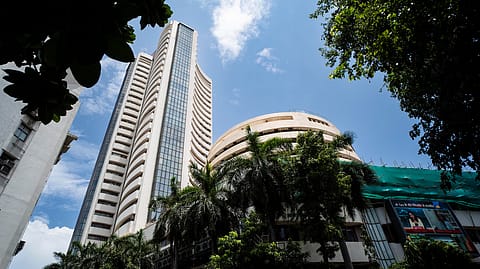
The BSE Sensex and NSE Nifty 50 gained up to 1% in early trade on Oct 21 | Credits: Getty Images
Indian equity benchmarks witnessed sharp volatility in early trade on Wednesday, with the Sensex and Nifty paring more than half of their initial gains as losses in auto, metals and consumer-facing stocks weighed on sentiment amid concerns over elevated crude oil prices, rising US bond yields and geopolitical uncertainty.
At 10:20 am, the BSE Sensex was up 249.50 points, or 0.34%, at 74,102.40, against its previous close of 73,852.90. The NSE Nifty 50 gained 41.85 points, or 0.18%, to 22,930.75.
In early trade, the 30-stock Sensex surged as much as 830 points, or 1.1%, to an intraday high of 74,682.19 before giving up most of its gains. Similarly, the Nifty 50 climbed 232 points to touch 23,120.90, rising over 1% from its previous close.
However, the broader market remained under pressure. The Nifty Midcap 100 declined 1.14% to 57,823.10, while the Nifty Smallcap 100 fell 1.34% to 18,681.80, indicating that the gains in benchmark indices were not broad-based.
Among individual stocks, Reliance Industries Ltd (RIL) rose nearly 3% as the initial public offering (IPO) of its digital services subsidiary, Jio Platforms, opened for subscription.
IT stocks lead gains
Information technology stocks led the sectoral rally, with the Nifty IT index rising over 2%, supported by gains in heavyweight stocks. Infosys advanced 3.30% to ₹1,167.30, while Tech Mahindra rose 2.22% to ₹1,817.55. HCLTech gained 2.01% to ₹1,404.65, and TCS climbed 1.99% to ₹2,510.05.
Among other Sensex constituents, ICICI Bank rose 1.74% to ₹1,406.05, while UltraTech Cement gained 2.16% to ₹10,850. Reliance Industries advanced 1.48% to ₹1,220.55 as Jio Platforms’ ₹30,213-crore IPO opened for subscription. ITC added 1.05% to ₹263.75.
Bharti Airtel, State Bank of India and Larsen & Toubro also traded higher, gaining 0.85%, 0.83% and 0.71%, respectively. Tata Steel edged up 0.46%.
However, selling pressure in several heavyweight stocks capped the benchmarks’ gains. Bajaj Finance fell 2.11% to ₹936.80, while Bajaj Finserv declined 1.55% to ₹1,676.40. Mahindra & Mahindra dropped 1.44% to ₹2,865, and Maruti Suzuki lost 1.32% to ₹11,331.15. Eternal slipped 1.31%, while Axis Bank declined 0.98%.
Other laggards included InterGlobe Aviation (IndiGo), down 0.93%, Trent, down 0.78%, and NTPC, which shed 0.68%.
The gains in IT stocks came as investors assessed the September-quarter earnings season for signs of improving growth and resilience in margins. The performance of large-cap IT companies and their management commentary on demand, deal pipelines and client spending are likely to remain key drivers of sectoral sentiment.
{{#most-powerful-women-snapshot-individual.slug}} {{/most-powerful-women-snapshot-individual.slug}} {{^most-powerful-women-snapshot-individual.slug}} {{/most-powerful-women-snapshot-individual.slug}} {{#showRanking}} {{current-rank}} {{/showRanking}} {{#photo.0.url}}
{{name}}
RIL rises as Jio Platforms IPO opens
Shares of Reliance Industries rose nearly 3% in early trade as Jio Platforms opened its ₹30,213-crore IPO for subscription. The issue has a price band of ₹1,065–1,119 per share and comprises up to 27 crore equity shares with a face value of ₹10 each.
At the upper end of the price band, the offering is expected to raise ₹30,213 crore, making it India’s largest public issue and surpassing Hyundai Motor India’s ₹27,856-crore IPO in 2024. At the lower end, the issue size would be ₹28,755 crore.
Investors will track subscription demand and the response from institutional and retail participants as the issue progresses.
Crude oil and bond yields remain key risks
Despite the gains in benchmark indices, the outlook for Indian equities remains sensitive to global macroeconomic developments. WTI crude was trading around $98–99 a barrel, while Brent hovered near $110, raising concerns over imported inflation, corporate input costs and the country’s external balance.
Developments involving Iran and the Strait of Hormuz remain a major source of uncertainty for energy markets. Any escalation could disrupt supplies and push crude prices higher, while signs of de-escalation could ease pressure on risk assets.
Elevated US bond yields are another concern, as they can weigh on global liquidity and emerging-market flows. Foreign institutional investor activity will therefore remain an important indicator of whether any recovery in Indian equities is supported by sustained overseas buying.
Optimism over a potential India–US trade deal could offer some support to domestic markets. However, a sustained recovery may prove difficult unless external risks ease and earnings growth strengthens.
Analysts expect stock-specific action
V K Vijayakumar, chief investment strategist at Geojit Investments Ltd, said elevated Brent crude prices and US bond yields were likely to keep markets under pressure in the near term.
However, he said improving earnings growth, fair valuations among large-cap stocks and strong domestic liquidity could support the market during declines. IT and banking stocks, which had performed well during the September quarter and were attractively valued, could attract domestic institutional investor buying on further corrections.
Ponmudi R, CEO of Enrich Money, said optimism over a potential India–US trade deal could support domestic equities, but elevated crude prices, rising global bond yields and geopolitical uncertainty remained key headwinds.
He expects the September-quarter earnings season to drive stock-specific movements as investors assess revenue growth, margins and management guidance amid rising input costs.
Follow Fortune India
NEXT STORY