Climate Data Week: A confluence of domains, tech, and expectations
/ 4 min read
Climate problems need people who can turn information into decisive action.
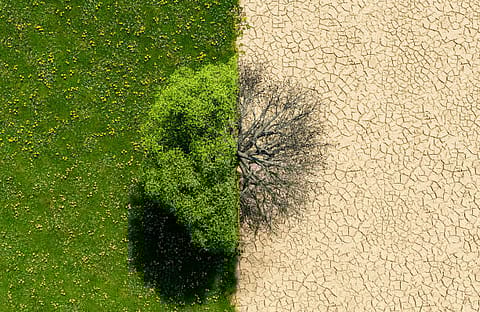
Credits: Getty Images
Does India need another climate week? Maybe yes and maybe no.
Climate change is a physical problem, but many of its solutions depend on solving a data problem. Glacier melt, flood prediction, energy demand, and renewable adoption all require us to collect and interpret vast amounts of data. The people who understand these challenges rarely collaborate with those building the data and AI systems.
Climate Data Week (CDW) is designed to close that gap: broader conversations that lead to data-backed solutions, and institutions that organise, share, and govern climate data well. It sets out to be an ecosystem catalyst through the collaborations it enables, the capital it attracts, and the policy attention it draws to climate challenges that go beyond borders. In the room: founders, researchers, corporate leaders, investors and policymakers. They leave with working partnerships, early sight of emerging categories, and evidence they can act on.
How can AI play a positive role in climate action?
There is enough general discourse about AI and climate; it is time to test real use cases. Illustratively, at the task level, AI helps in five ways: detecting faults in an electricity network; predicting demand; optimising the mix of wind, solar and storage; simulating scenarios; and discovering new materials for batteries and solar cells.
If we zoom out, the relationship between AI and climate spans four distinct pillars, each asking a different question:
1. AI for Climate Solutions: What can AI do for climate tech? Applications in products, operations, and assets that speed up decarbonisation, circularity, and resilience.
2. AI for Climate Intelligence: How can AI improve how we understand and govern climate? AI as a knowledge and decision layer: measurement, forecasting, MRV, risk assessment, and planning that inform governments, financiers and communities.
3. Sustainable AI: How can AI run on cleaner resources? Clean power for data centres, efficient water use, and lower lifecycle emissions across hardware supply chains.
4. Efficient AI: How can AI do more with less? Better algorithms, software and chips, judged against absolute demand, since a more efficient model that gets used ten times more is not necessarily a climate win.
{{#most-powerful-women-snapshot-individual.slug}} {{/most-powerful-women-snapshot-individual.slug}} {{^most-powerful-women-snapshot-individual.slug}} {{/most-powerful-women-snapshot-individual.slug}} {{#showRanking}} {{current-rank}} {{/showRanking}} {{#photo.0.url}}
{{name}}
Beyond a single domain
CDW’s conversations run across three themes: decarbonisation, adaptation and resilience, and circularity. Most forums treat them separately; they are intrinsically connected. Precise data helps cities find flood-prone areas and plan infrastructure. Accurate forecasting makes it easier to bring renewables onto the grid. And for farmers, timely data supports smarter decisions on irrigation and fertilisation as weather patterns shift. This first edition is built around those intersections: the four pillars give the programme its structure, and the three themes run across them.
Destination Bengaluru
Bengaluru attracts 58% of India’s AI startup funding, which makes it a natural home for the climate and data conversation. The real question is how that capability gets applied to problems that affect the planet and people’s lives. BLR-CDW 2026 is where we answer it.
Consider a founder building flood-prediction models for Indian cities and a researcher holding years of hydrological data that has never left the lab. The founder lacks reliable data; the researcher lacks a route to deployment. In the same room, they can agree on a pilot over a single cup of coffee (the rest, admittedly, takes longer). A corporation with flood exposure may become its first customer, an investor may spot the category early, and a policymaker may see the evidence working on a real map.
To make those connections happen, CDW brings together partners from across the climate, technology, and innovation ecosystem, including the Karnataka Digital Economy Mission (KDEM), Google, Climate Change AI, the Coalition for Disaster Resilient Infrastructure (CDRI), the Center for Study of Science, Technology and Policy (CSTEP), and the U.S.-India Business Council.
CDW is also a place to learn from peers how climate data solutions go from pilot to scale, and it gives innovations grounded in local realities a global stage.
Why this matters for the Global South
Much of the current discourse on AI and climate centres on technologies built elsewhere. The Global South has its own climate problems, datasets, infrastructure constraints, and deployment realities, and it needs room to build and test solutions around local conditions; the approaches that emerge can serve other regions too.
Take, for instance, SatSure, a global Earth Intelligence company founded in Bengaluru in 2017, which turns satellite and aerial data into decision intelligence for agriculture, banking, and infrastructure. The company now has a presence across SE Asia, the Middle East, and Africa. Last year the company signed an MoU with the Kenya Agricultural and Livestock Research Organisation (KALRO)—to use SatSure’s expertise for crop monitoring, yield forecasting, and climate resilience in Kenya.
Global technology players are also paying attention to innovative solutions in India. Google recently named four Indian startups—Terrastack, Varaha Climate, Farmers for Forests, and Climitra Carbon—as part of the cohort for Google DeepMind Accelerator: AI for the Planet in Asia-Pacific, a group of 16 organisations. Satellite-based land intelligence for small farmers, verified carbon removal, and agroforestry drone monitoring using AI are some of the areas in which these startups operate.
Measuring success by what it enables
So, back to the opening question: do we need another Climate Week? We think so, if its success is judged by what it enables: new collaborations, pathways from research to implementation, and opportunities for climate tech startups to scale.
Climate problems need people who can turn information into decisive action. AI and climate efforts must move beyond pilots to real collaboration on testing and deployment; that is how India puts its climate tech talent to work creating climate solutions worldwide.
(The author is co-founder, CCF. Views are personal.)
Follow Fortune India
NEXT STORY