Green construction will scale only when sustainability makes business sense
/ 4 min read
Green construction is becoming a competitive consideration, not simply a compliance requirement.
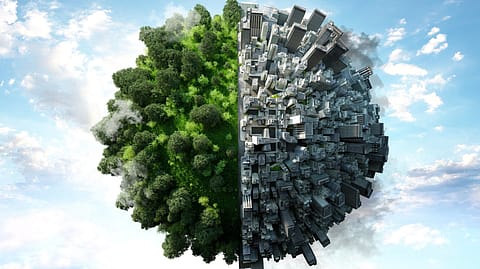
India’s green building materials market is projected to grow at 10-12% annually, reaching $70-80 billion by 2030. | Credits: Getty Images
India’s green finance market is moving from niche to mainstream. The government has issued ₹72,697 crore of sovereign green bonds since FY23, including ₹15,000 crore in FY26 alone. At the same time, SEBI’s BRSR framework is making sustainability disclosure part of mainstream corporate reporting. For construction and building materials, these are no longer distant signals. They are beginning to influence how projects are financed, designed, and valued.
The divide that is opening
Green construction is becoming a competitive consideration, not simply a compliance requirement. Developers that moved early on green certification are accessing a broader pool of capital, while occupiers increasingly view sustainability credentials as part of the baseline specification rather than a premium feature. Research cited by the World Green Building Council indicates that green buildings can achieve sales premiums of up to 31%, occupancy rates 23% higher and rental income up to 8% above comparable conventional stock. For investors, these are not just environmental credentials. They can have a direct bearing on the economics of an asset.
For developers that have yet to make the shift, the cost of staying with conventional approaches is also rising. As investors and lenders place greater weight on sustainability, conventional assets could face a smaller pool of buyers, lower valuations at exit and a widening gap in value versus certified alternatives. The cost of waiting may ultimately be greater than many mid-sized developers anticipate.
This does not mean every green building will command a premium, or that sustainability alone will determine an investment decision. It means that environmental performance is increasingly being considered alongside the financial performance of a project. For an industry that has often viewed sustainability through the lens of compliance or reputation, that is a meaningful change.
The economics are beginning to shift
India’s green building materials market is projected to grow at 10-12% annually, reaching $70-80 billion by 2030. Policy is reinforcing that demand. Under PMAY-U, the use of lower-carbon materials such as fly-ash bricks and autoclaved aerated concrete (AAC) blocks has already helped avoid an estimated 9 million tonnes of CO₂ emissions. Banks are also developing dedicated financing products for certified green homes.
The shift is not limited to domestic policy. SEBI’s BRSR framework is bringing sustainability information, including value-chain disclosures, into corporate reporting. In export markets, new carbon rules are beginning to put a direct value on the emissions embedded in materials such as cement, iron and steel and aluminium. The European Union's Carbon Border Adjustment Mechanism is one of the clearest examples, having entered its definitive regime in January 2026.
For Indian manufacturers selling into these markets, carbon performance is beginning to affect business, not just sustainability reporting. Within India too, regulation, financing and customer expectations are moving in the same direction. The environmental characteristics of a material or building are increasingly becoming part of the commercial conversation.
Why most of the industry has not caught up
The barriers, however, are real. Consistent project-level cost data on green construction remains scarce in India. Developers without their own experience base can therefore struggle to answer a basic question: what does going green actually cost, and what does it return?
Supply is another constraint. Outside major metros, green material supply chains still face challenges around availability, lead times and price stability. For smaller developers, upfront certification and material costs can also be difficult to absorb when margins are already tight.
There is also a mindset challenge. Green construction is still often treated as a premium proposition for particular buyers and markets. The bigger shift is to see sustainability as part of the economics of
mainstream development. The question is no longer simply whether a project can be made greener. It is whether it can be done in a way that creates enough value to justify the investment.
{{#most-powerful-women-snapshot-individual.slug}} {{/most-powerful-women-snapshot-individual.slug}} {{^most-powerful-women-snapshot-individual.slug}} {{/most-powerful-women-snapshot-individual.slug}} {{#showRanking}} {{current-rank}} {{/showRanking}} {{#photo.0.url}}
{{name}}
Building the business case
That makes better evidence increasingly important. Developers need to understand what green construction actually costs, what it saves over the life of a project, and whether it improves financing, occupancy or eventual value. Project-level experience can turn a broad sustainability argument into a business case grounded in real outcomes.
Execution matters too. Stronger relationships with manufacturers of certified green materials, supported by better specification and cost data, can make green construction more predictable. Over time, that can reduce both the cost and uncertainty involved in delivering green projects.
Certification also needs to be viewed differently. Rather than treating it simply as a compliance exercise, developers can use it to communicate a clearer proposition to investors and occupiers. Where sustainability credentials influence financing, tenant choice or asset value, certification becomes more than a badge. It becomes part of how an asset is positioned in the market.
The leadership moment
Sustainability and profitability are increasingly becoming part of the same decision in construction. The companies that understand this shift early will be better placed to respond as financing, regulation and customer expectations evolve.
The opportunity is not simply to build greener. It is to understand where sustainability creates economic value and then make that value part of how projects are designed, financed and brought to market.
That is what will determine whether green construction moves from a differentiated proposition to the new standard for India's next phase of infrastructure growth.
(The author is Chief Strategy and Growth Officer, BirlaNu. Views are personal.)
Follow Fortune India
NEXT STORY