Indonesia’s palm oil curbs could open the door for India to step up
/ 3 min read
The Southeast Asian nation recently moved to keep its ban on the export of palm oil mill effluent and crude used cooking oil in place to bolster its efforts to expand its biodiesel and sustainable aviation fuel programmes.
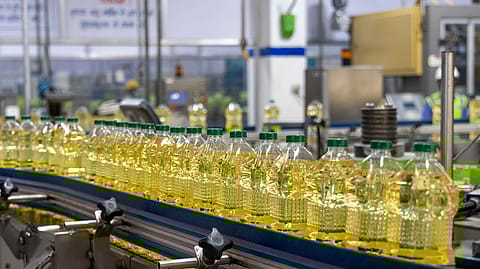
The Indian government launched the National Mission on Edible Oils-Oil Palm (NMEO-OP) in 2021 to boost domestic palm oil production. | Credits: Narendra Bisht
Indonesia’s move to curb exports of certain oil palm products serves as both a wakeup call and an opportunity for India to accelerate its own domestic production push.
The Southeast Asian nation recently moved to keep its ban on the export of palm oil mill effluent (POME) and crude used cooking oil (UCO) in place to bolster its efforts to expand its biodiesel and sustainable aviation fuel programmes. More recently, it has gone a step further—announcing plans to centralise exports of key commodities such as crude palm oil through a designated state-owned enterprise, effectively tightening control over global supply flows.
However, these new measures signal a clear shift towards greater state control over exports, with potential implications for global supply stability.
Nevertheless, stepping up domestic production of palm oil and weaning itself off exports will help India attain self-sufficiency in a key commodity that is present in everything from ketchup to soaps.
In doing so, it would shield India from global price volatility, bring down its dependence from imports and lift the burden imposed by imports on its exchequer.
And it’s achievable.
The Indian government launched the National Mission on Edible Oils-Oil Palm (NMEO-OP) in 2021 to boost domestic palm oil production. One of the mission’s stated aims was to bring 6.5 lakh hectares of land under oil palm cultivation by 2025-26.
Critics have said the mission is lagging behind its targets. Nevertheless, India had still managed to bring 6.4 lakh hectares under oil palm cultivation as of March 2026.
Output, while behind targets, is also expected to triple to as much as 1.5 million metric tonnes by 2030-31, as the crop begins generating yields, which typically takes anywhere between three to four years.
Another criticism levelled at India’s palm oil ambitions is that the country’s climate is simply not suitable for oil palm cultivation. This is, in fact, not true.
India’s landmass is vast and spans multiple climatic zones. Oil palm is best suited to humid tropical conditions typically found close to the equator, where temperature, rainfall and humidity remain consistently high.
{{#most-powerful-women-snapshot-individual.slug}} {{/most-powerful-women-snapshot-individual.slug}} {{^most-powerful-women-snapshot-individual.slug}} {{/most-powerful-women-snapshot-individual.slug}} {{#showRanking}} {{current-rank}} {{/showRanking}} {{#photo.0.url}}
{{name}}
While not all parts of India fall within this narrow equatorial band, several regions, particularly in southern India, offer agro-climatic conditions that are conducive to oil palm cultivation when supported by appropriate irrigation and agronomic practices.
This explains why states such as Andhra Pradesh and Telangana have emerged as leaders in oil palm cultivation, rather than being defined strictly by latitude.
Unsurprisingly, they have scripted India’s biggest oil palm success stories. Andhra Pradesh and Telangana account for 98% of India’s palm oil production.
What’s more, their success with the crop extends to incomes, with farmers in Andhra Pradesh reporting a tripling of incomes since switching over to oil palm cultivation, emphasising its role as a driver of economic prosperity.
In addition to the benefits it can deliver on a national scale, boosting domestic production of palm oil can therefore unleash a sweeping farmland transformation. And it can do it in a way that even sustainability hawks would approve of.
Palm oil cultivation has understandably acquired a bad reputation as it initially led to widespread ecological degradation, forest loss and biodiversity destruction, most notably in the case of the endangered orangutans. The loss of their tropical forest habitats, particularly in Indonesia and Malaysia, led to them being killed.
However, when undertaken sustainably, palm oil cultivation can coexist harmoniously with a region's biodiversity. And sustainability is at the heart of India’s palm oil push.
The reality is that India’s palm oil is deforestation-free. Plantations are being established on already degraded land or farmland used to grow less remunerative crops.
Additionally, oil palm is one of the most land-efficient oilseed crops, producing more oil per hectare than alternatives like soy or sunflower, thereby further minimising its footprint.
In fact, far from exacting an environmental toll, sustainable oil palm cultivation can further India’s climate neutrality goals.
Plantations can act as carbon sinks absorbing planet-warming carbon dioxide from the atmosphere.
Palm oil and its by-products, meanwhile, can serve as an efficient biofuel feedstock for biodiesel—the reason why Indonesia decided to maintain its export curbs on certain oil palm products—furthering India’s biofuels goals. This in turn will enable the country to slash diesel imports and their associated emissions. Godrej Agrovet, for instance, has already laid out plans to produce compressed biogas from POME which can serve as a substitute for natural gas in vehicles and cooking stoves, and also be used for electricity generation and chemical feedstocks.
The adoption of drip irrigation and the establishment of plantations in areas with high rainfall also mitigates the stress the otherwise thirsty crop places on the water table, unlike rice or sugarcane which exact a heavy toll on water resources.
Indonesia’s palm oil curbs are, therefore, far from a threat to India’s food security. They are instead an opportunity for the country to become self-sufficient, advance its sustainability goals and usher in a new age of prosperity for its farmers.
(The author is Chairperson-designate, Godrej Agrovet Limited. Views are personal.)
Follow Fortune India
NEXT STORY