The AI in classrooms debate: Pay heed but stay contextual
/ 4 min read
What India can learn from New York’s school AI moratorium.
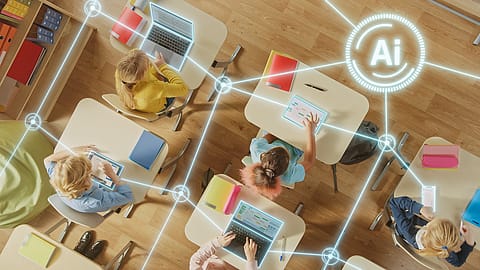
In India AI stops being a competitor to the teacher and starts being a backup. | Credits: Shutterstock
New York City just hit pause on school AI. Starting this school year, generative AI is off limits to nearly 600,000 students from kindergarten through eighth grade, for a full year, while a coalition of educators and technologists study what technology is actually doing to young minds. The city’s reasoning was that children need teachers and human connection to learn and grow, and they can’t put AI or chatbots in front of students without studying the implications.
It’s tempting for Indian educators to read this as validation and reach for the same lever. I’d resist that instinct. New York has correctly diagnosed a problem. Whether a blanket, one-year ban is the right treatment for an Indian classroom is a separate question, and I don’t think it is.
Let’s look at what New York got right. The worry about what happens to a 10-year-old’s brain when a chatbot hands over a ready answer is fair. Learning, at its core, is retrieving a half-remembered fact, testing a wrong hypothesis, going through the discomfort of not knowing before something finally clicks. This is productive struggle, if you like jargon. Skip that struggle, and the child still gets the answer, just not the synaptic connections that turn an answer into something robust. So while homework gets finished faster and worksheets get done quicker, test scores tell a different story. The numbers back this up. PISA 2025, released last month, recorded the lowest average scores the OECD has ever measured in reading and mathematics, with roughly one in five 15-year-olds now classified as a low performer across science, maths and reading.
Our context is different from New York’s, though. Their ban assumes AI is competing with strong, well-resourced teachers for a child’s attention. Most students already have a device in front of them, teachers are trained and credentialed, and the real worry is whether AI displaces something that’s already working.
Getting the context right
Walk into a government school in Bihar, or a private school in Uttar Pradesh, and the only device—if there’s one at all—is a projector, smartboard, or interactive panel at the front of the room, not in a child’s hands. (A few IB schools are the exception.) The teacher, often, is still teaching chalk-and-talk, sometimes without a confident command of the subject she’s been asked to teach because India’s B.Ed pipeline is stuck in the 20th century.
This context shift changes what AI is for in India vs. New York. It stops being a competitor to the teacher and starts being backup for a teacher who was never given the training or support she needed.
Take spoken English. In a school where the teacher’s own English is shaky and the child goes home to a house where nobody speaks a word of it, an AI tutor sitting alongside that teacher isn't replacing her. It’s doing the one thing she was never equipped to do, hour after hour, patiently, without embarrassment on either side.
Or take feedback. A teacher with 40 children and six subjects to cover cannot physically sit with every answer sheet and tell each child exactly where their reasoning went wrong, every week, for the whole year. An AI tool that reads the answer question by question and flags precisely where it broke down is doing something that was never going to happen otherwise. Not because the teacher doesn’t care, but because she doesn’t have the capacity to do so.
Personalised practice works the same way, with one condition: the system offers a hint, never the answer, so the child is still the one doing the thinking when it matters. The struggle a child needs doesn’t disappear in any of this. If anything, AI makes that struggle possible for every child in an overstretched classroom, not just the three or four the teacher has time to reach personally in a 40-minute period.
Borrowing New York's instinct
So the right Indian response should borrow New York’s instinct. It should treat children’s cognitive and emotional development as non-negotiable. It should restrict unsupervised chatbot access for young students, cap recreational screen time, and stay alert to the same worries about social media and screens that are pushing governments across the world towards restrictions right now. But it should contextualise that instinct for India by keeping the door open for AI that helps student learning in poor teacher-skill environments. AI Tutors should work in tandem with human teachers. AI feedback tools should multiply a teacher’s capacity. And AI assessments should help her personalise learning. In short, AI can solve India’s teacher skill shortage problem by empowering them rather than replacing them.
A one-year moratorium is the right call in a city with a device in every child’s hands and a trained teacher in every room. There, the only real question is how much AI is too much. Ours is a messier problem. Given how thin our teaching capacity already is in most classrooms, the question is where can AI supplement teachers and assist them so that every student can think and learn?
{{#most-powerful-women-snapshot-individual.slug}} {{/most-powerful-women-snapshot-individual.slug}} {{^most-powerful-women-snapshot-individual.slug}} {{/most-powerful-women-snapshot-individual.slug}} {{#showRanking}} {{current-rank}} {{/showRanking}} {{#photo.0.url}}
{{name}}
(The author is Co-founder & CEO, LEAD Group. Views are personal.)
Follow Fortune India
NEXT STORY