The business case for making sustainability India’s Infrastructure strategy
/ 5 min read
The economic value of an asset should be considered across its useful life, considering durability, maintenance, energy consumption, resource use and resilience.
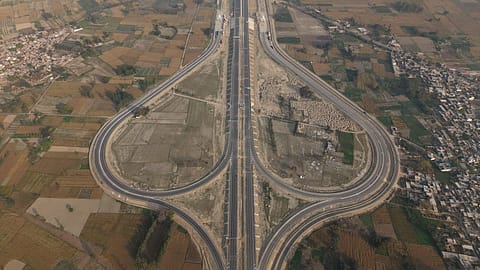
Infrastructure procurement typically focuses on upfront capital cost. | Credits: Adani Group
India is in a period of infrastructure and construction growth that will shape its economic landscape for decades. The buildings, industrial facilities, transport networks and urban infrastructure being created today will determine not only how much infrastructure the country has, but how efficiently it performs, what it costs to operate and maintain, and how resilient it remains as conditions change.
There is a strong economic case for paying closer attention to this. According to India’s Third National Communication to the UNFCCC, as cited by the Central Public Works Department, the buildings and construction sector contributed about 17% of India’s total greenhouse gas emissions in 2019. About 10 percentage points came from operational carbon and another 7 percentage points from embodied carbon.
The numbers point to an important distinction. India's sustainability challenge does not begin when a building is occupied, nor does it end at the factory where a material is manufactured. It runs through the entire lifecycle of an asset.
This raises a more fundamental question: are we measuring the cost of infrastructure at the right point in its life?
The cost of infrastructure does not end at completion
Infrastructure procurement typically focuses on upfront capital cost. Budgets are finite, procurement cycles are tightly managed and project timelines matter. But an asset, expected to serve people for decades, cannot be judged only by what it costs to build.
A material that is cheaper at the point of purchase but requires more frequent replacement, greater maintenance or higher energy consumption may ultimately be the more expensive choice. A building that meets today’s requirements but performs poorly under increasing heat can similarly transfer costs to its owners and occupants long after the original construction decision has disappeared.
This is where lifecycle thinking becomes important.
The economic value of an asset should be considered across its useful life, considering durability, maintenance, energy consumption, resource use and resilience. Environmental performance is not separate from this equation. In many cases, the same decisions that reduce environmental impact can also reduce operating costs and extend the useful life of an asset.
The challenge is that the person making the initial procurement decision is not always the person who bears the cost of operating the asset. That creates an incentive to optimise for what is visible today rather than what will matter over decades.
India's next infrastructure cycle needs to address this gap.
The most important decisions are made before construction begins
By the time a building or infrastructure asset is completed, many decisions determining its long-term performance have already been made. They are embedded in design, specifications, materials, manufacturing processes and construction methods.
{{#most-powerful-women-snapshot-individual.slug}} {{/most-powerful-women-snapshot-individual.slug}} {{^most-powerful-women-snapshot-individual.slug}} {{/most-powerful-women-snapshot-individual.slug}} {{#showRanking}} {{current-rank}} {{/showRanking}} {{#photo.0.url}}
{{name}}
Material specification is therefore not simply a procurement decision. It is a long-term economic decision. The possibilities are already visible across building-material categories.
AAC blocks, for example, can use fly ash as a key input while providing lightweight construction and thermal insulation.
In piping, the adoption of Organic Based Stabilisers, or OBS, represents another form of material innovation. Organic-based stabilisation in uPVC pipes is being adopted as an alternative to
conventional heavy-metal stabilisation, with manufacturers positioning it around environmental safety and product performance.
Similarly, thermally efficient roofing and high-performance walling systems can influence not only the environmental footprint of an asset, but also its comfort, maintenance requirements and operating economics.
The lesson is larger than any individual product category. Sustainability becomes commercially meaningful when it is designed into the material itself and into the performance expected from the asset.
The economics are becoming measurable
There is growing evidence that better-performing buildings can deliver measurable operating benefits. The Indian Green Building Council states that its Green New Buildings framework can deliver energy savings of 20-30% and water savings of around 30-50%.
These numbers matter because they change the sustainability conversation from aspiration to performance. They also demonstrate why decisions made at the design and specification stage can have consequences throughout the operating life of a building.
The institutional environment is changing alongside this. From 2022-23, Sebi made Business Responsibility and Sustainability Reporting (BRSR) mandatory for the top 1,000 listed entities by market capitalisation. Sebi states that BRSR is intended to provide quantitative and standardised ESG disclosures that enable comparison across companies, sectors and time.
This is significant, but disclosure alone will not make infrastructure more sustainable. The next step is to connect measurement with decisions about what gets designed, specified, financed and built.
The end user is changing too
There is another shift that deserves attention.
Sustainability is gradually moving from an institutional concern to a consumer expectation. PwC India’s 2024 Voice of the Consumer survey found that 60% of Indian consumers surveyed said they were buying more sustainable products or products with a reduced climate impact. The survey also found that Indian consumers said they were willing to pay an average 13.1% premium for sustainably produced or sourced goods, compared with 9.7% globally.
These findings should not be interpreted as evidence that every consumer will pay more for a sustainable building. But they do signal a broader shift in expectations. As consumers become more conscious of resource use, operating costs and environmental impact, the definition of a good building is likely to evolve as well.
That makes sustainability not only a regulatory or investment consideration, but increasingly a question of customer value.
India’s scale makes this a strategic opportunity
India does not have the luxury of choosing between rapid infrastructure creation and sustainability. The country needs more housing, industrial capacity, transport infrastructure, commercial buildings and urban services. Slowing this build-out is neither realistic nor desirable. The opportunity is to ensure that infrastructure created at this scale does not reproduce the inefficiencies of the past.
India has an important advantage: much of the infrastructure that will define its future has not yet been built. Decisions about materials, technologies, specifications and performance standards can still be made before they become embedded in decades of physical assets.
This is a strategic window. The next phase of India’s infrastructure story should therefore be measured not only by how much we build, but by how well what we build performs.
That requires governments, developers, architects, engineers, manufacturers, financiers and users to look beyond the initial cost of creating an asset and consider the economic and environmental value it delivers over its full life. Sustainability, in that sense, is not an additional ambition for India's infrastructure strategy. It is a more intelligent way of defining the strategy itself.
India is going to build. The question is whether what we build today will remain economically efficient, resilient and fit for purpose decades from now. The true measure of sustainable infrastructure will not be how green an asset appears when it is commissioned. It will be how well it performs throughout the life for which India's capital was committed.
That is not a sustainability premium. It is simply a better way to build.
(The author is MD & CEO – BirlaNu. Views are personal.)
Follow Fortune India
NEXT STORY