The economics of prevention: The hidden cost of poor nutrition and unsafe water in rural India
/ 4 min read
Preventable illness from unsafe water and poor nutrition can quietly erode India's workforce. The economics of prevention make a strong case for acting early.
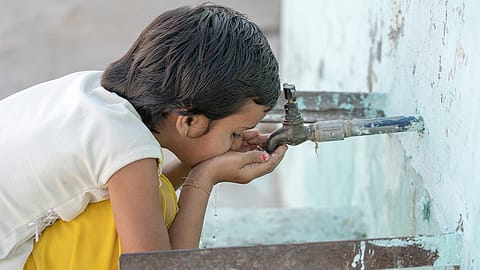
Credits: Shutterstock
Somewhere in India this morning, a worker stayed home with a stomach illness that safe drinking water would have prevented. A teenage girl sat through class too tired to concentrate, her haemoglobin too low to keep pace. Neither appears in a GDP release. Yet across millions of households, these quiet absences add up to one of the largest unmeasured impacts on the economy. The case for safe water and good nutrition is usually made as a health case. It is also an economic one.
A 2023 World Health Organization assessment of the Jal Jeevan Mission, prepared for the Ministry of Jal Shakti, estimates that safely managed drinking water for every household could avert nearly 400,000 diarrhoeal deaths and 14 million lost years of healthy life and deliver savings of up to $101 billion. Those gains depend on water being safe for drinking, not just available. Prevention is not a cost to be managed but an investment to be made and the government and communities in India are leading this from the front.
Illness taxes an economy in ways that rarely show up on a balance sheet. It translates as lost workdays, missed school, and reduced output from people working below their physical potential. Households feel this directly.
Access is not safety
Safe water shows how large the returns can be. The WHO assessment estimates that household taps could save 66.6 million hours of water collection every day, time that falls mostly to women and could go to work, study or leisure. Global evidence points the same way. A meta-analysis led by Nobel Laureate Professor Michael Kremer found that water treatment can reduce child mortality by roughly 20%.
This is where delivery matters. Governments are leading the expansion of safe water access, and the next task is ensuring the water stays safe where it is used. In Enamadala village in Andhra Pradesh, a pump operator once climbed the overhead tank every two weeks to pour in bleaching powder by hand, with no way to measure the dose. A small in-line chlorination device now treats the water supply automatically and chlorine levels at the household taps stay within the safe range. In India, Evidence Action, through its technical partner EAII Advisors, works with national and state governments across the full delivery system needed for reliable chlorination.
Nutrition and human capital
Nutrition follows the same logic and the two are linked: repeated gut infections from unsafe water impair children absorbing nutrients, which feeds anaemia and stunting. A 2019 Lancet analysis found malnutrition was the leading risk factor for child deaths in every state and accounted for about 17% of all health loss in India. The cost extends beyond health, because children who are anaemic or malnourished learn less and earn less as adults.
The Global Nutrition Report 2014 by International Food Policy Research Institute suggests that malnutrition is widespread in most countries in the world and costs up to 11% of the GDP annually of African and Asian countries. A study on Social Costs of Iron Deficiency Anaemia in 6–59-Month-Old Children in India estimates that iron deficiency anaemia in a single cohort of young children can cost about $24 billion in lifetime lost productivity. Newer research is needed to establish the unfinished agenda. Meanwhile, India is moving in the right direction. NFHS-6 data show child stunting down from 35.5% to 29.3%. The action for changing this situation on the ground continues. The national and state governments are currently rolling out an expanded and sharper Anaemia Mukht Bharat for further accelerating the decline in prevalence through an approach which caters to a wider population with more impactful tools.
The iron and folic acid supplementation and deworming model uses existing infrastructure, with teachers trained by health workers providing necessary preventive medications at schools. This is a clear example of government-led delivery without a new system.
Government-led school programmes show what scale looks like. In 2023, programmes supported by EAII Advisors, delivered deworming to 180 million children and adolescents and iron and folic acid supplementation to more than 35 million. The cost is about ₹5 per child per year for deworming and about₹48 for IFA supplementation.
The returns on prevention
Cost-effectiveness analyses suggest that water treatment is among the most efficient investments in public health. A meta-analysis led by Michael Kremer estimates that it can avert a year of healthy life for between $28 and $72, depending on the delivery approach. The Copenhagen Consensus has ranked school-based deworming and nutrition programmes among its top priorities. Few investments cost so little per person while keeping people productive for decades.
India's demographic dividend is not automatic. It pays out only if the workforce is healthy enough to realise it. Governments are leading the way, and the next step is to treat water and nutrition spending as investment, track its economic returns as rigorously as its health outcomes, and strengthen the partnerships that take programmes to quality at scale. Prevention rarely makes headlines, because its success is an illness that never happened. The worker who stays on the job and the girl who stays alert in class are not only health outcomes. They are the growth story.
{{#most-powerful-women-snapshot-individual.slug}} {{/most-powerful-women-snapshot-individual.slug}} {{^most-powerful-women-snapshot-individual.slug}} {{/most-powerful-women-snapshot-individual.slug}} {{#showRanking}} {{current-rank}} {{/showRanking}} {{#photo.0.url}}
{{name}}
(The author is India Country Director, EAII Advisors; EVP, Evidence Action. Views are personal.)
Follow Fortune India
NEXT STORY