The rise of affordable wellness: How healthier snacking is becoming an everyday choice
/ 4 min read
For years, the wellness premium was simply too unaffordable for most Indian families.
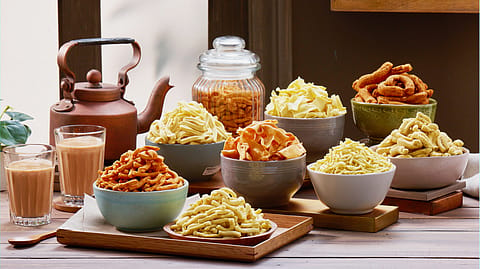
Indian consumers are not substituting makhana for bhujiya; they are adding.
Throughout history, dining has been inextricable from the cultural fabric of Indian society. The same can be said of snacking. It is an experience—the accompaniment to a monsoon evening, the ritualistic adhesive for chai-nashta, and the reason our grandmothers’ kitchens never seem to run dry.
For decades, our fondness for crispy fried goodness sat uneasily next to the practice of healthy eating. Health indicated a trade-off: either the austerity of a home-cooked meal or the import tax on a bag of muesli that would cost the average Indian household a week of groceries. Wellness was a lifestyle choice available to the select few who could afford the compromise.
This equation is now undergoing a discreet but undeniable shift. Urbanisation, digital connectivity, and a pervasive curiosity regarding consumption have steered Indian consumers towards a more conscious path. This demand has given rise to more affordable and accessible healthy snack offerings in the market. Snacking is still just as spontaneous. But now, it is also conscious and intentional.
The consumers driving this shift are no longer confined to Tier I cities either; good health is increasingly becoming a mass-market expectation, and the brands that endure are unlikely to be the ones chasing a premium niche. They will be the ones that address the tricky trilogy of affordability, accessibility, and familiarity.
Distribution from niche to mass-market
For years, the wellness premium was simply too unaffordable for most Indian families. And while this premium can’t be wished away, it can surely be engineered through a careful re-examination of economics: sourcing raw material locally, optimising manufacturing to protect lower price points, and offering smaller, more affordable packs that sit in the same price band as the snack they’re meant to replace. What was once a lifestyle purchase now must compete for the same rupee as a regular packet of chips. The real challenge, and opportunity, lies in making better nutrition more accessible without compromising on quality. And increasingly, that is beginning to happen.
When it comes to distribution, quick commerce has proven reliable as a platform for brands to pilot new formulations that can be measured and corrected within weeks. But in India, the real test of reach isn’t conducted on apps. It still primarily unfolds on the shelves of kirana stores in the interior folds of the country, right next to the traditional namkeen that has endured for epochs.
This is where FMCG networks also earn their keep. Sourcing indigenous grains, seeds, and superfoods like millets and makhana across changing seasons and landscapes is no mean feat. It is this immense logistical undertaking and foundational infrastructure that allows the product to reach the buyer, with its price tag reflecting the cost savings.
Consider makhana as a case in point. Once an unorganised and seasonal commodity, it has rapidly transformed into a structured, packaged snack category. Makhana alone now accounts for a significant share of total healthy snack revenue in organised retail. This level of penetration is possible when institutional supply chains stabilise pricing and bring standardised quality to a traditional staple.
Here, familiarity breeds business
If there is one number from the recent category data that deserves more attention, it is this: healthy chips grew 81.9% year-on-year. There’s almost nothing new about chips; it is the most familiar, indulgent, and impulse-driven snack. Also deemed one of the unhealthiest snacks. So, are these numbers unicorns? No. But they are a sobering lesson for snack brands.
Indian consumers do not adopt health by abandoning what they already love; they adopt it when what they already love gets better for them. Baked instead of fried. A millet base instead of refined flour. Mindful seasoning instead of the additive-heavy blend whose nutritional value they had long stopped checking. What’s illuminating isn’t the reformulation itself but that it’s finally landing within reach of ordinary households, both in terms of price and availability.
That, to my mind, is the real job of R&D. Not proving that a healthier chip can be made, but proving it can be made at a price close enough to its regular counterpart that trying it out isn’t really a decision at all. A reformulation that only clears a premium shelf is a pilot. One that clears the same shelf as the original, at the same price, is a category shift.
{{#most-powerful-women-snapshot-individual.slug}} {{/most-powerful-women-snapshot-individual.slug}} {{^most-powerful-women-snapshot-individual.slug}} {{/most-powerful-women-snapshot-individual.slug}} {{#showRanking}} {{current-rank}} {{/showRanking}} {{#photo.0.url}}
{{name}}
Addition, not substitution
In my experience, it is a lazy assumption that the rise of healthy snacks must come at the cost of traditional delicacies. That the samosa and the roadside chaat are somehow on borrowed time. The data, and more tellingly, the way Indian households actually shop, tell a different story.
Indian consumers are not substituting makhana for bhujiya; they are adding. While a whole-grain snack finds its way into the mid-afternoon slump, the Sunday family lunch remains an unapologetically hedonistic feast. Healthy savoury snacks growing upward of 40% year-on-year is not evidence of one pantry replacing another; it simply shows that there’s a second cabinet in the kitchen, one that made up 14.8% of total savoury snack sales this past quarter, as the category itself grew.
What’s next on the menu?
From where I stand, this is no longer a story of a niche trend finding its audience. That has already happened. The numbers and shelf space now point to something far more substantial: a genuine, sustained shift in how this country eats between meals. What will separate the companies that persist from those that simply had a good product moment is relevance, hard-earned trust, and the innovation to refine a product without losing what made someone reach for it in the first place. The real distinction lies in knowing the Indian consumer well enough to understand when to stick to the recipe and when to tweak it.
We are seeing a compelling shift across the FMCG sector as established conglomerates bring founder-led, digital-first wellness brands into larger, more resilient networks. When a legacy business commits to a category, it’s a vote of confidence in its long-term trajectory. The rise of everyday health is not a growth story to file away after a review. In a sense, it isn’t new at all. Our grandmothers’ kitchens were always healthier than most of what came after. What we are witnessing now is a bridge between that well-earned wisdom of what truly nourishes us and a new generation of agile brands built for how India snacks today. It is a category I expect to flourish for a long time to come.
(The author is MD & CEO, Marico Limited. Views are personal.)
Follow Fortune India
NEXT STORY