Fortune India Banking & NBFCs Summit 2026: Banks and NBFCs will complement each other for developed economy goals, say experts
/ 2 min read
Financial sector leaders point to India's low credit-to-GDP ratio, specialised lending capabilities, and cross-selling opportunities as banks and NBFCs seek to expand their reach.
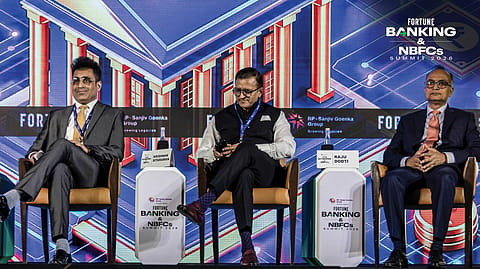
(L to R) Krishnan Sitaraman, Senior Director and Chief Ratings Officer, CRISIL; Raju Dodti, Whole-time Director and Chief Operating Officer, L&T Finance; and Paritosh Kashyap, Whole-time Director, Kotak Mahindra Bank, at the Fortune India Banking & NBFCs Summit 2026
Banks and non-banking financial companies (NBFCs) will complement, rather than compete, with each other as India seeks to expand credit penetration and achieve its developed-economy ambitions, industry leaders said at the Fortune India Banking & NBFCs Summit 2026 on Tuesday.
Speaking at a session titled ‘NBFCs vs Banks: Is the line blurring?’, executives highlighted how differences in regulation, funding advantages, and specialised lending models would shape the growth of the two segments.
Krishnan Sitaraman, Senior Director and Chief Ratings Officer at CRISIL, said headline growth figures could obscure underlying trends in bank and NBFC lending. Bank credit growth had been muted in the first half of the previous fiscal before accelerating sharply in the second half, creating a base effect, he said.
“15% is a very healthy growth in the bank sector,” Sitaraman said, citing policy measures, including GST cuts, and a shift in corporate borrowing from the bond market to bank loans as factors supporting credit growth. CRISIL's published outlook separately projected domestic bank credit growth of 14.5–15.5% in FY27.
Sitaraman said retail lending growth at NBFCs was around 22%, with the sector expected to record 18–19% growth in assets under management (AUM) this fiscal.
Credit penetration offers room for expansion
Sitaraman pointed to strong performance in gold loans and loans against property, a calibrated recovery in unsecured lending, steady growth in wealth finance and mortgages, and signs of a revival in microfinance.
L&T Finance Whole-time Director and Chief Operating Officer Raju Dodti said the company's strategy was to offer multiple products to existing customers and use initial product offerings to cross-sell other financial services.
“India’s credit-to-GDP ratio is around 65-66%, compared with over 100% in developed economies,” Dodti said, highlighting the opportunity to expand lending and benefit customers.
Specialisation gives lenders complementary roles
Paritosh Kashyap, Whole-time Director at Kotak Mahindra Bank, said banks and NBFCs operate under different regulatory frameworks. Banks face requirements relating to capital reserves and priority-sector lending, while NBFCs can specialise in segments such as digital lending and personal loans.
“Banks and NBFCs are complementary to each other instead of competing with each other in terms of their services,” Kashyap said.
The discussion highlighted how banks' funding capabilities and broader lending operations could work alongside NBFCs' specialised products and customer-focused strategies to deepen credit access as India's economy expands.
Follow Fortune India
NEXT STORY