EV insurance claims 14% costlier than ICE cars, monsoon pushes severity to ₹65,000: Report
/ 3 min read
Battery replacement can cost as much as 40–50% of a car’s total value, depending on the model, Policybazaar says.
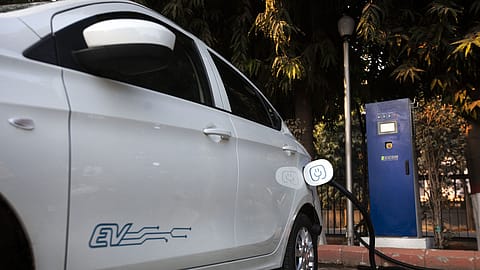
The data also shows a higher claim frequency in Tier-II cities, at 33 claims per 100 insured EVs, compared with 30 in Tier-I cities. | Credits: Sanjay Rawat
Electric vehicle (EV) insurance claims are significantly more expensive than those for conventional internal combustion engine (ICE) cars, with average claim severity for EVs at ₹41,543 compared with ₹36,185 for ICE vehicles, according to data from Policybazaar.
The data shows that EV claims are around 14% costlier on average. The comparison is based on vehicles in their first three years of ownership and within a comparable ₹10–15 lakh price bracket to ensure the two categories are broadly similar. The higher claim severity for EVs is attributed to the cost of battery systems, complex electronics, imported components and limited EV repair infrastructure, which can make repairs and replacements more expensive.
Battery replacement can cost as much as 40–50% of a car’s total value, depending on the model. Repair costs also extend beyond the battery and motor, with components such as battery cooling systems, advanced electronics and infotainment systems adding to the cost of repairs.
With EV repairs potentially involving high-value components, Policybazaar said customers need to assess whether their motor insurance policies provide adequate protection through relevant add-ons and coverage.
Nearly 80% EV owners opt for two or more add-ons
EV owners are also showing a greater preference for additional insurance protection. Around 80% of EV owners opt for at least two key add-ons, including battery protection, zero depreciation, roadside assistance (RSA) and consumables cover.
This compares with 75% of petrol-car owners and 77% of diesel-car owners. The higher adoption among EV owners indicates growing awareness of the potentially higher repair costs and battery-related risks associated with electric vehicles.
Battery protection cover has seen a sharp rise in adoption. Its penetration among EV owners increased from 51% to 70% over the past six months. The increase suggests growing awareness of the need to protect high-value battery systems against risks such as water ingress and power surges, subject to the terms and conditions of the policy.
Paras Pasricha, Head – Motor Insurance, Policybazaar, said EV claims are emerging as a distinct risk profile and customers need to look beyond the premium while choosing a policy.
“India’s EV claims experience is clearly emerging as a different risk profile. Customers need to look beyond just the premium when choosing a policy. With average EV claim severity already 14% higher than similar ICE cars and monsoon claims rising sharply, having the right protection can make a meaningful difference at the time of a claim,” Pasricha said.
He added that battery protection cover adoption had increased from 51% to 70% in the past six months, while nearly 80% of EV owners opt for two or more key add-ons.
“Covers such as battery protection, zero depreciation, roadside assistance and consumables can help address some of the additional costs that EV owners may face,” he said.
{{#most-powerful-women-snapshot-individual.slug}} {{/most-powerful-women-snapshot-individual.slug}} {{^most-powerful-women-snapshot-individual.slug}} {{/most-powerful-women-snapshot-individual.slug}} {{#showRanking}} {{current-rank}} {{/showRanking}} {{#photo.0.url}}
{{name}}
EV SUVs record higher claim frequency
The data also points to differences in claim frequency across EV body types. EV SUVs record around 19% higher claim frequency than sedans, while hatchbacks show an 8% higher frequency than sedans.
The higher claim frequency among EV SUVs could be linked to greater usage across varied road conditions, including longer-distance and highway driving, where the risk of underbody, tyre and suspension-related damage may be higher. For hatchbacks, the higher frequency could be linked to greater use in dense urban environments, where traffic, parking and minor collisions are more common.
Monsoon pushes average EV claim costs up 25%
Monsoon emerges as a particularly high-risk period for EV owners, with average claim severity rising sharply during the rainy season.
Average EV claim severity rises to nearly ₹65,000 during the monsoon, 25% higher than the ₹52,000 average recorded during the rest of the year. Flooding, waterlogging and adverse weather conditions are among the factors contributing to higher claim costs. The trend highlights the importance of adequate coverage for EV owners, particularly in regions prone to heavy rainfall and waterlogging.
Tier-II cities see higher claim frequency
The data also shows a higher claim frequency in Tier-II cities, at 33 claims per 100 insured EVs, compared with 30 in Tier-I cities.
At the regional level, East India records the highest EV claim frequency at 41 claims per 100 insured EVs, followed by North India at 34.
The higher frequency in smaller cities and different regions could reflect the impact of local weather conditions, road quality and the increasing use of EVs beyond major metropolitan centres. “As EV adoption grows beyond metros, understanding the specific risks of their vehicle, location and usage will be important for customers to choose adequate coverage rather than simply the cheapest policy,” Pasricha added.
Follow Fortune India
NEXT STORY