Silver crashes 55% from January record high: Can it reclaim $100 an ounce?
/ 3 min read
HSBC sees a modest recovery in 2027, but a stronger dollar, elevated yields, weakening industrial demand and rising supply could cap gains.
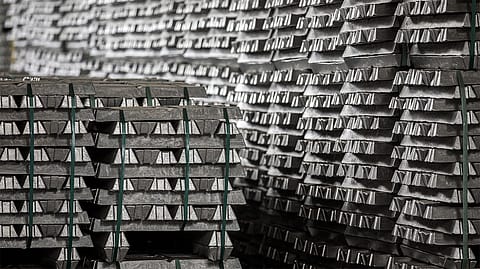
Silver price has fallen 55% to nearly $54 an ounce on Oct 26 | Credits: Shutterstock
Silver and gold are traditionally considered safe-haven assets, often moving in tandem during periods of market uncertainty. However, both precious metals have faced sharp corrections in 2026, following a stellar performance in 2025. Silver surged 138% last year, emerging as one of the best-performing precious metals despite volatility in the broader market.
After touching a record $121 an ounce on January 29, 2026, silver has experienced sharp price swings and a steep sell-off, plunging around 55% to nearly $54 an ounce. The correction has wiped out much of the euphoria that fuelled the rally at the start of the year.
The sharp decline has left investors grappling with a key question: can silver stage a comeback and reclaim the $100-an-ounce mark?
HSBC Global Investment Research is not seeing that happening anytime soon. In a latest report, the agency said silver prices could gradually recover, but it does not expect a sharp rally in the near term. Its outlook for 2027 is more measured, with gold likely to provide some support.
“Short of an eruption tariff concerns, we do not see silver challenging $100/oz in the foreseeable future,” HSBC said.
Why silver prices crashed
Silver’s rally earlier this year was fuelled by record-high gold prices, tariff concerns, geopolitical uncertainty and tightness in the physical market. Prices more than doubled between December 2025 and January 2026, as gold approached $5,600 an ounce.
The reversal began as the Middle East conflict drove oil prices higher, stoking inflation concerns and shifting expectations from US rate cuts towards a more neutral policy stance and potential rate hikes. A stronger dollar and higher bond yields further weakened the appeal of precious metals.
The return of silver stocks from New York to London also eased physical-market tightness, removing another source of support.
Gold’s decline added to the pressure. The gold-silver ratio narrowed from around 61:1 at the start of 2026 to 46:1 when both metals hit record highs in January. It subsequently widened to around 72:1 as silver fell more sharply than gold, HSBC said.
Supply deficit narrows sharply
The outlook for silver is also impacted by a significant easing in the market’s supply-demand imbalance. HSBC estimates that the silver market recorded a deficit of 140 million ounces in 2025. It expects the shortfall to shrink to just 5 million ounces in 2026 before widening slightly to 12 million ounces in 2027.
“Moderating deficits help explain our view that prices are near equilibrium levels and may be supportive but do not augur for robust rallies,” the agency said.
{{#most-powerful-women-snapshot-individual.slug}} {{/most-powerful-women-snapshot-individual.slug}} {{^most-powerful-women-snapshot-individual.slug}} {{/most-powerful-women-snapshot-individual.slug}} {{#showRanking}} {{current-rank}} {{/showRanking}} {{#photo.0.url}}
{{name}}
Mine production is expected to increase materially in 2027, while recycling supply could rise as bullion holders sell their holdings amid concerns over further price declines. Industrial and jewellery demand, meanwhile, is expected to weaken.
However, investment demand could provide some support. HSBC expects purchases of large silver bars to increase, particularly from institutional investors in China and India. Silver exchange-traded funds, which liquidated holdings earlier this year, are also rebuilding positions.
Can silver recover?
HSBC remains moderately positive on precious metals, expecting gold to lend support to silver. Renewed tariff concerns or a shift towards easier monetary policy could also trigger a recovery. However, the agency cautioned that a stronger US dollar, elevated bond yields, weakening industrial and jewellery demand, and rising mine and recycling supply could cap gains.
Vikram Subburaj, CEO of Giottus, said the near-term direction of gold and silver would depend on US inflation data, Treasury yields and the dollar ahead of the Federal Reserve’s October 27–28 meeting. He added that the current weakness did not necessarily signal a prolonged downtrend.
Ponmudi R, CEO of Enrich Money, struck a more cautious note on silver’s technical outlook. “The near-term bias remains negative,” he said, identifying ₹2,00,000–₹2,02,000 per kg as the immediate resistance zone for MCX silver. A decisive break below ₹1,92,000–₹1,94,000 could expose prices to further downside towards ₹1,83,000–₹1,85,000.
For international prices, Ponmudi said a sustained move above $56–$56.50 an ounce would strengthen the recovery in COMEX silver. Conversely, a decisive break below $53.50–$54 could expose the metal to further losses towards $51.50–$52.
(DISCLAIMER: The views and opinions expressed by investment experts on fortuneindia.com are either their own or of their organisations, but not necessarily that of fortuneindia.com and its editorial team. Readers are advised to consult certified experts before taking investment decisions.)
Follow Fortune India
NEXT STORY