Flying Wedge unveils FWD Supreme prototype for AI-piloted combat aircraft programme
/ 2 min read
The company says its Supreme Lite variant is expected to make its maiden flight within the next two months.
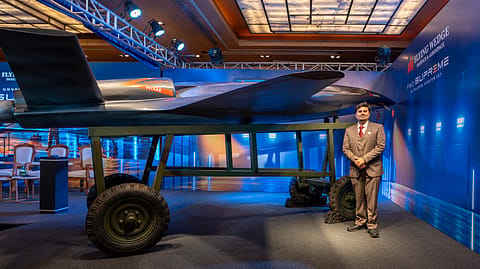
FWD Supreme with Suhas Tejaskanda, ounder of Flying Wedge Defence & Aerospace
Flying Wedge Defence & Aerospace on Tuesday unveiled a full-scale static prototype of FWD Supreme, a proposed family of AI-piloted combat aircraft designed for surveillance, strike and collaborative combat missions. The company describes it as India’s first AI-piloted fighter aircraft programme, a claim its founder says rests on the platform’s intended autonomous decision-making capabilities.
Speaking to Fortune India, Suhas Tejaskanda, founder of Flying Wedge Defence & Aerospace, said the programme differs from existing unmanned combat aircraft initiatives such as the Defence Research and Development Organisation’s Ghatak and Hindustan Aeronautics Limited’s CATS Warrior.
“There are a lot of UCAV programmes in India, such as Ghatak and CATS Warrior. But there is no autonomous programme happening in India,” Tejaskanda said, explaining why the company considers FWD Supreme the first of its kind.
“The key difference lies in the decision-making architecture and reliance on external command structures. Traditional unmanned combat aerial vehicles are generally remotely piloted, whereas autonomous AI-piloted fighter aircraft such as FWD Supreme are designed to operate more independently and execute coordinated group tactics,” he added.
The launch was held in the presence of defence officials, but the company has no formal agreement with the Ministry of Defence for the programme, the founder said.
“This is a programme that has started, and we are now trying to get the government’s help. No (government) funding as such has been received till date. We're looking for funding from private equity and venture capital market,” Tejaskanda said.
According to Tracxn, Flying Wedge Defence & Aerospace has raised $3.44 million across eight funding rounds. The Bengaluru-based company was founded in 2022, with its latest funding round listed as a seed round dated April 4, 2026.
The company plans to develop the aircraft through what it calls Operation Triple Seven, an initiative intended to bring international partners into an India-led development and manufacturing programme.
Heavy variant still under development
FWD Supreme Heavy is being developed for autonomous combat operations, with potential roles in intelligence, surveillance and reconnaissance (ISR), strikes and collaborative missions. The company has unveiled a full-scale static prototype; it has not announced a maiden flight for the Heavy variant.
The release describes the aircraft as a one-tonne-class platform, while its specifications also refer to a weight class exceeding 1,500 kg. Tejaskanda said the final configuration would depend on operational requirements and the trade-off between fuel and payload.
“The aircraft will be somewhere between one tonne and 1.5 tonnes, depending on the payload. If you carry more fuel, you carry less payload for longer range, and vice versa. The final configuration will be frozen after testing,” he said.
{{#most-powerful-women-snapshot-individual.slug}} {{/most-powerful-women-snapshot-individual.slug}} {{^most-powerful-women-snapshot-individual.slug}} {{/most-powerful-women-snapshot-individual.slug}} {{#showRanking}} {{current-rank}} {{/showRanking}} {{#photo.0.url}}
{{name}}
The company has outlined a projected range of more than 1,500 km, a payload of around 350 kg and a maximum speed of Mach 0.8–0.85.
Supreme Lite maiden flight expected in two months
The smaller FWD Supreme Lite variant has completed taxi trials and is being prepared for its maiden flight. Tejaskanda said the flight is expected within the next one-and-a-half to two months.
The company has not yet announced the outcome of a maiden flight for the Lite variant. Its progress will be an important next step in demonstrating the programme’s development beyond the static prototype stage.
Follow Fortune India
NEXT STORY