Temple is now smallest wearable and ‘10^10’ more powerful, says Deepinder Goyal
/ 3 min read
Temple is positioned as a performance and health-tracking wearable rather than a conventional smartwatch. It is worn against the side of the forehead and is intended to collect physiological signals associated with brain circulation and other aspects of physical and cognitive performance.
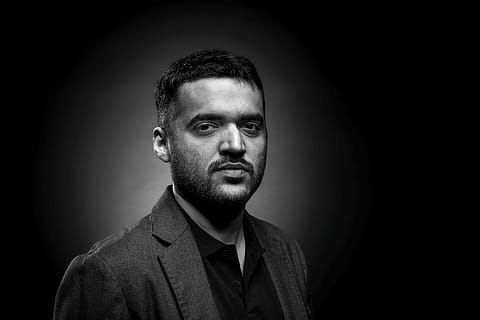
Deepinder Goyal, founder, Temple, and co-founder, Eternal | Credits: Special Arrangement
Deepinder Goyal’s health-tech startup Temple is moving closer to a commercial launch, with the Eternal founder saying the wearable has been redesigned to less than half the size of the version shown earlier and that pre-orders for a limited launch edition will open soon.
“Temple is now less than half the size of what you've seen so far,” Goyal said in a post on X on Friday. He claimed that, by volume, Temple is now “the smallest wearable on the market” and “the most^10 powerful”. He did not provide measurements or independent benchmarks to substantiate either claim. Goyal said shipments of the limited launch edition would begin before the end of 2026.
The latest announcement marks a shift from Temple's controlled early-access phase towards a wider consumer launch.
From brain-flow experiment to wearable startup
Temple began as an experimental device developed around Goyal's interest in the relationship between ageing, gravity and blood circulation. Goyal has said the original objective was to build a device capable of measuring blood flow to the brain, but that the team subsequently found the temple region offered a wider range of physiological signals than locations such as the wrist or finger.
In a Financial Times interview in May, Goyal said the team eventually set aside the original “gravity ageing hypothesis” and focused on the device after finding that the temple was a particularly useful location for collecting physiological data.
Temple is positioned as a performance and health-tracking wearable rather than a conventional smartwatch. It is worn against the side of the forehead and is intended to collect physiological signals associated with brain circulation and other aspects of physical and cognitive performance. However, independent validation of its broader health claims remains limited, with medical experts previously cautioning that the technology needs scientific testing.
$54 million raised at $190 million valuation
Temple has already attracted substantial backing. In February, Goyal announced that the startup had raised $54 million in a friends-and-family round at a post-money valuation of about $190 million.
The round included Peak XV Partners, Steadview Capital, Dharana Capital and Info Edge Ventures, along with more than 80 individual investors. More than 30 Temple employees also invested their own money at the same valuation, according to reports based on regulatory filings.
Goyal had described the investors as founder friends and early-stage Zomato backers who wanted to participate regardless of whether Temple eventually reached the market.
The company is now reportedly seeking fresh capital at a valuation of around $500 million, while earlier reports indicated that its first commercial wearable could be priced at around ₹75,000-80,000. Those figures have not been formally announced by Temple.
Limited launch follows early-access programme
Temple began its first controlled rollout in May, when Goyal said the first 100 devices were ready to ship. The company invited athletes, scientists, founders, doctors, creators and people interested in physical and cognitive health to become its founding users.
{{#most-powerful-women-snapshot-individual.slug}} {{/most-powerful-women-snapshot-individual.slug}} {{^most-powerful-women-snapshot-individual.slug}} {{/most-powerful-women-snapshot-individual.slug}} {{#showRanking}} {{current-rank}} {{/showRanking}} {{#photo.0.url}}
{{name}}
The device has since attracted attention in professional sport, with badminton player PV Sindhu seen wearing Temple during the 2026 BWF World Championships. The company has positioned athletes and high-performance users among its early target audience.
Temple also announced a biomarker called “Entropy” in June, describing it as a measure of the physiological “cost” of staying alive. The company said it would publish evidence and conduct external validation, meaning the claim should currently be treated as a company-reported research development rather than an established medical measure.
NEXT STORY