The FAQs are AI-generated, and Fortune India is not responsible for its content or any associated copyright issues.
₹203-crore TDIP revamp targets 6G, global standards push; govt opens telecom scheme to startups, MSMEs
/ 2 min read
New guidelines for 2026–31 aim to boost India’s role in ITU, 3GPP forums while funding pilots, PoCs, and global tech contributions
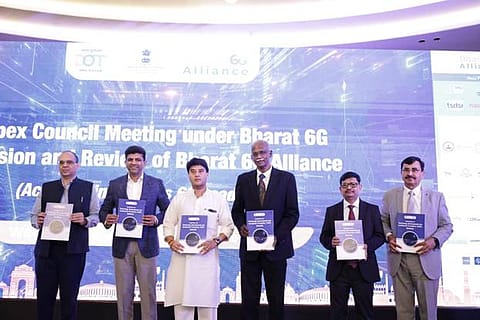
The scheme, anchored by the Department of Telecommunications, is designed as a targeted funding mechanism to support participation in international standard-setting platforms | Credits: PIB
India has revamped the Technology Development and Investment Promotion (TDIP) Scheme with a ₹203-crore outlay for 2026–31, sharpening its focus on global telecom standardisation and next-generation technologies such as 5G Advanced and 6G. The revised guidelines, announced by Union Minister Jyotiraditya M. Scindia, aim to position Indian firms and institutions as active contributors—and eventual standard-setters—in the global telecom ecosystem.
The scheme, anchored by the Department of Telecommunications, is designed as a targeted funding mechanism to support participation in international standard-setting platforms, while also accelerating domestic innovation and commercialisation. The move comes as countries intensify efforts to shape global standards that underpin future telecom networks and digital infrastructure.
Push for global standardisation leadership
A core pillar of the revamped TDIP framework is to expand India’s footprint in key global bodies such as the International Telecommunication Union, 3GPP, and oneM2M. The scheme will fund participation in international meetings, enable the submission of technical papers, and support leadership roles in study groups.
It also includes provisions to host global standardisation events in India, a move aimed at increasing influence in shaping future telecom protocols. By backing sustained engagement, the government expects Indian contributions to be embedded in globally accepted standards, boosting intellectual property creation and export competitiveness.
Wider ecosystem participation, real-world deployment
The revised guidelines expand eligibility to startups, MSMEs, academia, research bodies, telecom operators, and industry players, marking a shift from a limited-participation model to a broader ecosystem approach. This is expected to deepen innovation pipelines and improve collaboration across the value chain.
Importantly, the scheme introduces support for pilot projects, proof-of-concept (PoC) initiatives, and technology demonstrations. This is aimed at bridging the gap between lab-scale innovation and commercial deployment—often a bottleneck for deep-tech telecom solutions.
Institutional backing and strategic alignment
Implementation will be routed through institutions such as the Telecommunications Standards Development Society India, Telecom Centres of Excellence, and Telecommunications Consultants India Limited, which will coordinate industry participation and capacity building.
The TDIP revamp complements ongoing programmes like the Telecom Technology Development Fund and the Bharat 6G Mission, forming a broader policy stack to drive indigenous R&D and global integration. With supply chains being reshaped and demand rising for trusted telecom partners, the government is betting on standards-led growth to transition India from a technology adopter to a global telecom innovator.
Follow Fortune India
Frequently Asked Questions
NEXT STORY