Agnikul Cosmos inaugurates facilities to test reusable rocket stages, manufacture critical launch-vehicles
/ 2 min read
The facilities are expected to strengthen Agnikul’s vertically integrated capabilities across propulsion, avionics, component manufacturing, stage-level testing, and recovery operations.
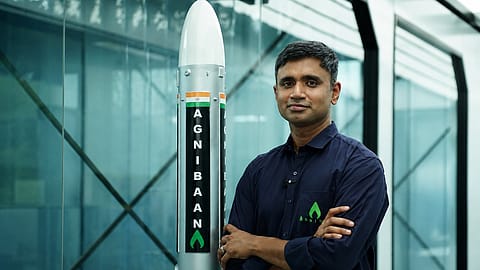
Agnikul co-founder and CEO Srinath Ravichandran said STIF would enable the company to test complete rocket stages for mission-duration burns and subsequently inspect and requalify recovered stages. | Credits: Agnikul
Chennai-based space-tech company Agnikul Cosmos has inaugurated two new facilities at its Assembly & Testing Facility in Chennai, expanding its capabilities to test reusable rocket stages under flight-like conditions and manufacture critical launch-vehicle components in-house.
The Stage Testing & Inspection Facility (STIF) and the Pressurant Tank Realization, Over-wrapping and Outfitting Facility (PROOF) were inaugurated in the presence of Group Captain Shubhanshu Shukla, a Gaganyaan astronaut.
The facilities are expected to strengthen Agnikul’s vertically integrated capabilities across propulsion, avionics, component manufacturing, stage-level testing, and recovery operations.
STIF to support reusable-stage testing
STIF has been designed and fabricated in-house to test reusable rocket stages under flight-like operating conditions. The facility enables full-stage testing with propulsion and avionics integrated, including clusters of Agnikul’s patented, single-piece, semi-cryogenic, electric pump-fed 3D-printed engines.
The facility supports thrust levels ranging from 1 kN to 200 kN, LOX sub-cooling down to 73 Kelvin and full-duration burns of up to 150 seconds.
Importantly, STIF is also designed to support post-flight inspection and requalification of recovered stages. This will allow Agnikul to develop a repeatable cycle of building, testing, flying, recovering, inspecting, requalifying and flying rocket stages again. The company said the capability will be important for its efforts to develop reusable launch vehicles and support its upcoming Mission-02.
PROOF brings pressure-vessel manufacturing in-house
The PROOF facility will enable Agnikul to manufacture high-pressure composite overwrapped pressure vessels (COPVs) in-house. The facility has a production capacity of more than 10 vessels a month, including vessels with capacities of up to 3,500 litres and pressure ratings of up to 350 bar.
By bringing pressure-vessel manufacturing in-house, Agnikul aims to gain greater control over production and quality while reducing dependence on external suppliers and shortening production and iteration cycles.
Together, STIF and PROOF expand the company’s in-house capabilities from propulsion and avionics development to component manufacturing, stage testing and recovery assessment.
“India’s space programme is entering an exciting phase, with capabilities being built across the country that will enable increasingly ambitious missions. It is encouraging to see Agnikul continue to expand its capabilities in advanced manufacturing and testing. The emergence of such capabilities across the industry will play an important role in building a deeper and more self-reliant space ecosystem for India,” said Group Captain Shubhanshu Shukla.
Focus on reusability and launch cadence
Agnikul co-founder and CEO Srinath Ravichandran said STIF would enable the company to test complete rocket stages for mission-duration burns and subsequently inspect and requalify recovered stages.
{{#most-powerful-women-snapshot-individual.slug}} {{/most-powerful-women-snapshot-individual.slug}} {{^most-powerful-women-snapshot-individual.slug}} {{/most-powerful-women-snapshot-individual.slug}} {{#showRanking}} {{current-rank}} {{/showRanking}} {{#photo.0.url}}
{{name}}
“The vision of bringing reusability to launch requires us to think beyond a single flight and build the capability to test, recover, inspect and prepare a stage for its next flight,” Ravichandran said. He added that PROOF would strengthen the company’s end-to-end in-house quality control as it works towards Mission-02.
Agnikul co-founder and COO Moin SPM said the two facilities would bring critical capabilities for vehicle recovery and manufacturing operations in-house.
“The ability to manufacture high-pressure composite overwrapped vessels at production scale gives us greater control over the process, quality and turnaround time,” he said, adding that the capability would support higher manufacturing capacity and launch cadence.
Building on Mission-01
The new facilities add to Agnikul’s existing in-house manufacturing and testing infrastructure. The company designs and manufactures its single-piece, 3D-printed semi-cryogenic engines in-house and is also developing avionics, propulsion and other vehicle systems.
Agnikul’s Mission-01, launched on May 30, 2024, demonstrated a controlled ascent using the company’s single-piece 3D-printed engine and in-house autopilot architecture.
With STIF and PROOF, the company is extending its in-house capabilities beyond individual propulsion and vehicle components to stage-level testing, recovery assessment and composite overwrapped pressure-vessel manufacturing.
Follow Fortune India
NEXT STORY