Before John Ternus’ first Apple keynote, here’s what Steve Jobs and Tim Cook said in theirs
/ 4 min read
John Ternus is about to face one of the most closely watched moments in Apple’s history—his first product keynote as CEO
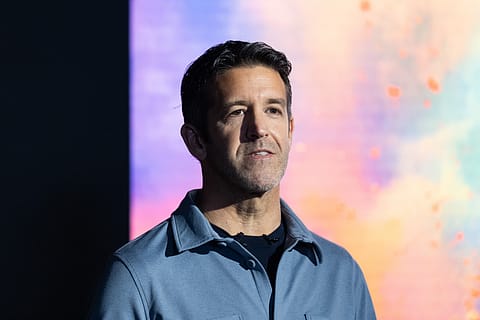
John Ternus, CEO, Aapple Inc | Credits: Getty Images
Apple’s September 9 event, titled “Surprise and Shine”, will be Ternus’ first major public appearance as the company’s chief executive after taking over from Tim Cook on September 1. Apple is expected to unveil the iPhone 18 Pro and iPhone 18 Pro Max, along with what could be its first foldable iPhone. A revamped Siri and new Apple Watch and AirPods models are also expected to feature at the event.
But before Ternus takes the stage, it is worth looking back at what Apple’s two most consequential modern CEOs said when they first stepped up to present the company’s products.
Steve Jobs and his two 'first' keynotes
There are actually two important “firsts” when it comes to Steve Jobs.
The first was in 1984, when Jobs introduced the original Macintosh. The second was in 1997, when he returned to Apple and delivered his first major keynote after coming back to the company he had co-founded.
Colloquially, Jobs' keynotes were called 'Stevenotes', thereby setting a precedent for CEOs to present product launches with detailed presentations and theatrics to capture both the audience's and investors' attention.
At Apple’s annual shareholders meeting on January 24, 1984, Jobs walked on stage to introduce the Macintosh. He positioned it as the third major milestone in the personal-computer industry, following the Apple II and IBM PC.
“What we need now is the third industry milestone product, and that’s what Macintosh is all about,” Jobs told the audience. Then came one of the most iconic product introductions in technology history.
Jobs pulled the Macintosh out of a bag.“Hello. I am Macintosh. It sure is great to get out of that bag,” the computer said, and the audience erupted. Jobs then demonstrated the Macintosh’s graphical interface, mouse and software, showing an audience a very different way of interacting with a computer.
But when Jobs returned to Apple more than a decade later, the tone was very different.
At the 1997 Macworld Expo in Boston, Apple was struggling, fearing bankruptcy, and Jobs had returned to the company following Apple’s acquisition of NeXT. He was serving as interim CEO, although he did not yet formally take the permanent CEO position.
There was no revolutionary new product on stage. Instead, Jobs diagnosed what he believed had gone wrong. “Apple is executing wonderfully on many of the wrong things,” he said.
{{#most-powerful-women-snapshot-individual.slug}} {{/most-powerful-women-snapshot-individual.slug}} {{^most-powerful-women-snapshot-individual.slug}} {{/most-powerful-women-snapshot-individual.slug}} {{#showRanking}} {{current-rank}} {{/showRanking}} {{#photo.0.url}}
{{name}}
His solution was to simplify Apple’s sprawling product strategy, focus its resources and rebuild the company’s relationship with its customers and developers. He also announced a surprising partnership with Microsoft’s Bill Gates, including a $150 million investment in Apple.
The audience initially booed the Microsoft deal. Jobs’ response became another defining line from the keynote. “We have to let go of this notion that for Apple to win, Microsoft has to lose.”
His point was that Apple did not need to defeat Microsoft to survive; it needed to become healthy again. "The era of setting this up as a competition between Apple and Microsoft is over, as far as I'm concerned. This is about getting Apple healthy, and this is about Apple being able to make incredibly great contributions to the industry to get healthy and prosper again," he said.
Tim Cook's ‘I love Apple’ statement
Fourteen years later, Tim Cook walked onto the stage for his first product launch as Apple’s CEO.
Steve Jobs had resigned as CEO in August 2011, with Cook taking over. Jobs died just one day after Cook’s first product launch, the October 4, 2011 event that introduced the iPhone 4S.
Cook opened the “Let’s Talk iPhone” event by acknowledging the obvious. “This is my first product launch since being named CEO — I’m sure you didn’t know that,” he joked.
Then came a much more personal statement. “I love Apple, and I consider it a privilege to work here.”
Cook also promised that the company would continue to focus on innovation across mobile OS, apps, services and hardware.
The product itself was significant, but it was not a revolutionary redesign, as the iPhone 4S retained the basic design of the iPhone 4 while introducing a faster A5 chip, an improved camera and, most notably, Siri.
Cook did not try to imitate Jobs’ theatrical style. Instead, he presented an Apple that was increasingly built around its broader ecosystem and its ability to execute. His tenure would eventually take Apple into products and categories well beyond the core Mac and iPhone businesses, including Apple Watch, AirPods and Vision Pro. Not only that, but he would also lead it to make Apple one of the most valuable companies in the world.
Now, it is John Ternus’ turn
Ternus is entering the CEO role under circumstances that are different from both Jobs and Cook. He inherits one of the world’s most valuable companies and an enormous installed base of Apple devices.
But he also faces a different kind of pressure, starting with the foldable iPhone. Apple is expected to unveil its first foldable smartphone at the September 9 event, entering a category where Samsung, Google and Chinese manufacturers have already spent years experimenting. The expectation is that Apple will try to differentiate its version through engineering, including a thinner design and a less visible crease, rather than simply being first.
AI will be the other major test. Apple has been under pressure to demonstrate that it can catch up with rivals in generative AI, particularly after delays to its revamped Siri. Reports suggest Apple is preparing a much deeper Siri overhaul, with Google’s AI technology reportedly playing a role behind the scenes.
That gives Ternus two very different things to sell on his first major stage as CEO—a new piece of hardware and Apple’s answer to the AI race.
Follow Fortune India
NEXT STORY