Dario Amodei absent from Trump-Xi White House dinner as OpenAI, Google, Meta join tech guest list
/ 3 min read
Anthropic chief’s exclusion from high-stakes Trump-Xi AI dinner raises questions as vocal safety advocate is sidelined while rival tech leaders take their seats at the White House table
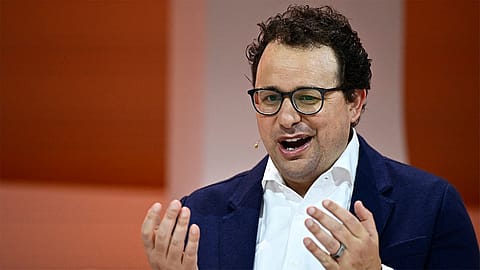
Dario Amodei, CEO, Anthropic. | Credits: Getty Images
Anthropic CEO Dario Amodei was not among the technology executives invited to US President Donald Trump’s state dinner for Chinese President Xi Jinping on September 24, even as OpenAI CEO Sam Altman, Nvidia CEO Jensen Huang, Apple executive chairman Tim Cook, Meta CEO Mark Zuckerberg and Tesla CEO Elon Musk joined the White House gathering.
The omission comes at an interesting moment for Amodei, who has emerged as one of the more vocal CEOs calling for the pace of frontier AI development to be controlled even as the US works to maintain its lead over China.
Amodei laid out that position earlier this month in a 3,800-word essay titled “We Must Pace the Frontier”. His argument was not for stopping AI development. Instead, he called for frontier AI companies to slow the pace at which model capabilities improve enough to give governments, companies, and independent evaluators more time to put safety measures in place.
“We must slow the pace at which we improve the capabilities of AI models,” Amodei wrote, while stressing that progress would remain fast.
His proposal rests on three layers--independent evaluators embedded within frontier AI companies, coordination among AI labs on safety standards, and eventually international cooperation to manage the risks posed by increasingly capable systems.
The essay also made clear that Amodei’s call for pacing is not a call for the US to surrender its advantage to China. He argued that any slowdown among democratic countries should be limited by the need to maintain a lead over authoritarian regimes, particularly China. He has separately called for tighter controls on China’s access to advanced AI chips, model distillation, and stolen model weights.
Right after that, Trump, in a Truth Social post, Trump rejected calls for stronger AI guardrails and singled out Amodei, writing that his administration had stopped AI companies from doing “bad, or potentially bad” things, “like Dario (Anthropic!),” whom he sarcastically described as a “perfect little angel”.
Trump went on to warn that there was a “SICK conspiracy” against AI and data centres, arguing that China would be the main beneficiary of efforts to constrain the US industry. “WHOEVER WINS AI, WINS!” he wrote. In the same post, Trump warned “Conspiracy Theorists, Treasonists, Traitors, and Leakers” to beware.
Amodei’s China position
In his essay, Amodei argued that a Chinese lead in advanced AI would pose a serious risk to the US and the wider world. His prescription was not to disengage from the AI race, but to ensure that democratically governed countries remain ahead while putting stronger safeguards around frontier models.
He has also argued for restrictions on China’s access to the computing infrastructure required to develop advanced AI systems. That position matters because Nvidia, whose CEO Huang attended the dinner, is the dominant supplier of the GPUs used to train and run many of the world’s leading AI models.
{{#most-powerful-women-snapshot-individual.slug}} {{/most-powerful-women-snapshot-individual.slug}} {{^most-powerful-women-snapshot-individual.slug}} {{/most-powerful-women-snapshot-individual.slug}} {{#showRanking}} {{current-rank}} {{/showRanking}} {{#photo.0.url}}
{{name}}
The US-China AI relationship was also directly relevant to the Trump-Xi meeting. AI was among the issues discussed by the two leaders, while Washington and Beijing have been exploring ways to establish dialogue around the technology even as they remain locked in a broader technology rivalry.
Amodei’s position has faced pushback from Beijing. Chinese officials have criticised arguments framing China’s AI development as a threat and have objected to US restrictions on technology exports.
Why his absence stands out
The White House dinner brought together executives representing different layers of the US technology stack. Altman’s OpenAI develops frontier models; Huang’s Nvidia supplies the computing infrastructure that powers them; Zuckerberg’s Meta is developing its own AI models and products; while Cook’s Apple represents the enormous consumer technology ecosystem that increasingly depends on AI. Amodei leads one of the other major US frontier AI labs.
His absence is therefore notable, particularly because it comes just a day after he and Altman appeared before the UN Security Council to discuss the risks and opportunities created by increasingly powerful AI systems. Both called for greater international cooperation on AI safeguards. Altman argued that countries that compete with one another can still cooperate when confronted with powerful new technologies.
There is, however, no public evidence establishing why Amodei was not on the White House guest list. Anthropic had not confirmed his attendance ahead of the dinner, and the White House’s published list subsequently did not include him.
Follow Fortune India
NEXT STORY