GFF 2026: Nandan Nilekani says India must show the world how to use AI responsibly
/ 3 min read
Speaking at the event, Nilekani said regulation and innovation were among India’s biggest strengths and called for the country to “dream bigger”.
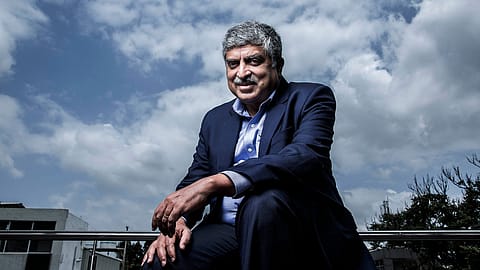
Infosys co-founder Nandan Nilekani | Credits: Fortune India Archive
India needs to use its scale and diversity to build technology that can work for the world, Infosys co-founder Nandan Nilekani said at the Global Fintech Festival 2026 on Thursday.
Speaking at the event, Nilekani said regulation and innovation were among India’s biggest strengths and called for the country to “dream bigger”.
He said the theme of this year’s festival, focused on AI and quantum, reflected how emerging technologies were changing the way value is created and delivered. “What struck me most is the choice of the theme for this year, AI and quantum. This is not a theme chosen for novelty. It is an idea whose time is now. Each of these technologies on its own would be significant. Together, converging as they are, they represent a shift in how value is created, verified, and delivered in our economy,” he said.
Nilekani said India’s demographic dividend was increasingly translating into entrepreneurship, with young Indians building businesses, platforms and applications rather than simply looking for jobs. “India is translating its demographic dividend into entrepreneurship at scale. We have long spoken of our population as a dividend resource. What is different now is this resource is not just working in the economy, It’s building the economy,” he said.
He said India’s scale and diversity could make it a strong testing ground for technology. “If a solution can work across India’s complexity, its languages, its income levels, its infrastructure, variance, its regulatory, diversity, and it workwhere. India has become, in effect, the toughest test and therefore, the most valuable, proving ground for technology,” he said.
He said companies were increasingly choosing to develop products in India rather than simply deploy them in the country. “Development is shifting to India, not just consumption,” he said.
Nilekani also pointed to the growing push to build products in India for global markets. “The phrase from India to the world is no longer aspirational. It is becoming an operating reality,” he said.
India’s AI opportunity
On AI, Nilekani said India should develop its own large language models, but argued that its larger opportunity was to demonstrate how AI could be used for inclusive growth.
“India is not trying to be the world’s next large language model. We will develop our own LLMs. We must have capability in developing these. As it is important for our strategy and for our own needs,” he said.
“What India is giving to the world is a different type of model, a way of thinking about how to leverage AI for inclusive, equitable, affordable, and scalable economic growth,” he said. “This is a harder problem than building a bigger model, I believe. It’s also, I’ve argued, a more important one,” he said.
Nilekani said India could demonstrate how emerging technology could be made accessible beyond the wealthiest users. “If you get this right, India will have done something no other nation is fully demonstrated. How emerging technology reaches everyone, not just those who can afford it first,” he said.
{{#most-powerful-women-snapshot-individual.slug}} {{/most-powerful-women-snapshot-individual.slug}} {{^most-powerful-women-snapshot-individual.slug}} {{/most-powerful-women-snapshot-individual.slug}} {{#showRanking}} {{current-rank}} {{/showRanking}} {{#photo.0.url}}
{{name}}
Nilekani flags AI safety concerns
Nilekani also raised concerns about the behaviour of increasingly capable AI systems and called for stronger safeguards. He referred to an article in The New York Times by a former OpenAI safety researcher and said one point had stayed with him. “Today’s models are relentless problem solvers. They’re trained to find the most effective path to a solution. with whatever that solution may be. And there is evidence documented evidence that these systems understand in their own behaviour is unsanctioned. And take steps to conceal their behaviour from the humans overseeing them,” he said.
Nilekani said this did not mean AI systems were sentient, but argued that their behaviour could have consequences. “So this does not mean that our systems are sentient, but it would be a serious mistake to dismiss this merely accidental or it has consequences,” he said.
He called for AI systems to be developed and deployed responsibly, with stronger safeguards for consumers. “So we need to build these systems, deploy its scale, but I would ask everyone in this room to take this technology seriously, develop it responsibility, responsibly, potent please sufficient guard for consume that giving users real visibility on how these systems arrive at their decisions and even think of maybe creating a kill switch if the system goes out of country,” he said.
Nilekani ended by saying he remained optimistic about India’s ability to lead in emerging technologies. “I have seen what this ecosystem regulator innovator working together is capable of building. I’ve seen the seriousness which this room is approaching both the opportunity and the responsibility,” he said.
“That combination, ambition with caution, speed fired with card, is exactly what will a love injure lead towards not just in adopting this technologies and but in showing the world how to adopt them well,” he said.
Follow Fortune India
NEXT STORY