India needs a non-profit to invest heavily in research and develop sovereign solutions: BharatGen CEO Rishi Bal
/ 3 min read
As India’s first government-funded sovereign AI initiative, the not-for-profit company has launched a new version of its vision-language AI model, Patram 1.5, which is also trained to say “I don’t know” rather than generate hallucinated responses.
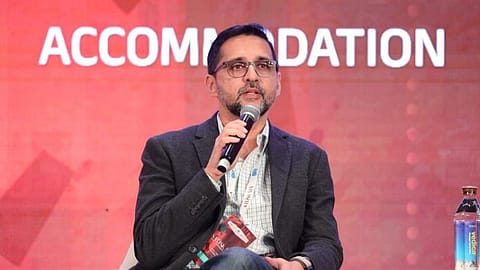
Rishi Bal, CEO, BharatGen. | Credits: LinkedIn@Rishi Bal
Being a part of India’s ambitious native AI development, BharatGen, set up in 2024 under the National Mission on Interdisciplinary Cyber-Physical Systems (NM-ICPS), backed with government funding, has released a new version of its vision-language model for documents and images, Patram 1.5.
An improvement over Patram 1.1 that it released in August 2025, the new 7-billion-parameter open-weight model works with scanned, stamped, signed, handwritten and mixed-language documents, reading it an image for reasoning. Where parts of the document are illegible, blank or masked, the model asserts lack of knowledge -“I don’t know” rather than hallucinate. The model has been trained on licenced as well as sets of synthetic data during training.
Speaking to Fortune India, Rishi Bal, Chief Executive Officer, BharatGen, said that he expects the first layer of adoption in existing workflows involving large documentation such as KYC. “In general, existing workflows can be significantly accelerated and to me it's about quality of service not just about cost”, he said even as companies now find themselves rationalizing their AI related cost following an initial AI euphoric. On adoption, “We are seeing the BFSI sector is both savvy enough and has the tech teams to be able to plug into an API based model,” he added.
Industry adoption pathway for AI
With institutions such as banks, insurance companies, hospitals and government offices in India handling large volumes of scanned, handwritten and mixed-language documents Bal sees organisations Patram being to provide components for organisations in democratizing their own AI, by providing parts to build adaptive systems of intelligence which can learn even as the documentation changes and update itself. Over the past 2 years, BhartGen has come out with a family of 4 models Param, Shrutam , Sooktam and Patram all pretrained in the areas of speech and vision that can be used for data from across nearly Indian languages.
“We are building these models to be so small because I can actually work with people to deploy these models inside their own data set okay on hardware that is not terribly expensive so that when you're processing sensitive information like Aadhaar card KYC kind of documents, it's actually all sitting inside your data set,” Bal said while addressing on safety and sovereignty.
Need for a Not-for-profit AI company
BharatGen Technology Foundation, a not-for-profit company, set up in IIT Bombay in collaboration with leading other leading IITs, including IIT Madras and IIT Kanpur among others. Following an initial funding of ₹235 crore under NM-ICPS and the company also is a recipient of ₹1,058 crore under the India AI Mission.
While IndiaAI mission backed 3-year-old Sarvam AI which is looking to be India's first full stack sovereign AI, has seen investors queue up this year taking it valuation now to nearly $1.5billion, Bal believes India still needs to have a non-profit that is very focused on raising the whole baseline of AI while pointing at the investments made into research technology and the research technical talent by both USA and China before battling the global LLM race.
With hundreds of college going interns working on its projects, Bal said, “India needs a non-profit to continue to invest heavily and provide a sovereign solution. I think there is not only room, but necessity for both. You need for profits that are building on top of this, but you need non-profit like BharatGen to do some of the sovereign work."
Follow Fortune India
NEXT STORY