'India's NVIDIA moment': Nivruti Rai charts semicon growth path; identifies white spaces
/ 3 min read
Rai flags AI-led memory boom and advanced packaging as key opportunities for India to deepen its semiconductor supply-chain presence
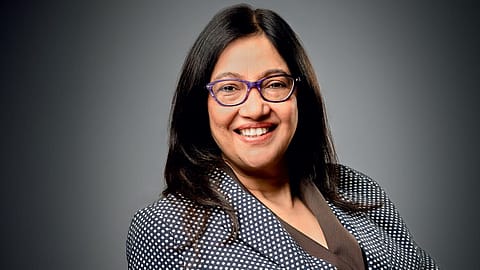
Nivruti Rai, managing director and CEO of Invest India | Credits: Narendra Bisht
Nivruti Rai, managing director and CEO of Invest India, has called for greater investment in advanced semiconductor packaging, materials and memory as India looks to expand its position in the global semiconductor supply chain. Speaking on Day 2 of Semicon India 2026 in New Delhi, Rai said government incentives can act as catalysts for investment, but demand must be at the centre of any semiconductor investment decision.
“Investment is great. Incentives are great catalysts, but if you don’t have demand in the market, what are you building for?” she said. “Then you’re commoditising.”
Rai, who has spent around three decades in the semiconductor industry before moving into investment, outlined the evolution of the industry through three broad phases. She described the period from 1995 to roughly 2007 as the PC and integrated device manufacturer (IDM) era, followed by the foundry era from 2008 through the next decade. The current phase, according to Rai, is being driven by artificial intelligence (AI) and advanced packaging.
She pointed to the rise of Nvidia and the increasing complexity of AI chips as defining features of the latest phase. “2019 to 2025 is the era driven by AI and packaging,” Rai said, adding that AI’s demand for parallel computing and complex chip architectures has increased the importance of advanced packaging.
AI, memory demand create new investment opportunities
Rai said the global semiconductor market is expanding rapidly, with memory emerging as a particularly important area because of the AI boom. According to her, the global semiconductor market is expected to reach around $1.5 trillion in 2026 and could approach $2 trillion next year. She said memory alone could account for around $800 billion in 2026.
Rai also highlighted high-bandwidth memory (HBM), saying AI has changed the economics of the memory business. “Before HBM, memory had become a commodity. HBM has productised it,” she said.
She also pointed to the growing power requirements of AI data centres. According to Rai, global data-centre power demand could rise from around 90 GW currently to 180 GW by 2030. This will drive demand not only for GPUs and CPUs, but also for DRAM and storage. She said the semiconductor industry could face a capacity gap as AI infrastructure expands, arguing that India needs to identify areas where it can address global bottlenecks.
Rai identified HBM advanced packaging and substrate materials as two areas where India could potentially contribute to global supply-chain requirements. “I want to rope in investors ans show them their demand and I want to show them the return,” she said, adding that an estimated 15% return over five years was being considered in some of the opportunities.
India needs to move from credibility to predictability
Rai said India has established credibility in semiconductors through government support and approved projects, but the next stage will require demonstrating execution capabilities. “Having worked in the semiconductor industry for 30 years, we have a journey from credibility to predictability to excellence,” she said. “Predictability is proof of what you’re committed to. Show me the wafer. Show me the yield.”
She said India is already strong in semiconductor design, while fabrication is at an early stage. Advanced packaging and semiconductor materials, she added, require greater focus. “We have to grow up in the value in terms of the purity and quality required by semiconductors,” Rai said, referring to the opportunity for India’s chemical and materials industries.
She also highlighted glass substrates and heterogeneous integration as potential areas for investment. Rai said 3DGS is investing around $2.2 billion in Odisha and that the government is offering a 35% subsidy. She said glass-substrate supply for AI, HBM and defence programmes could mature in India by 2032.
{{#most-powerful-women-snapshot-individual.slug}} {{/most-powerful-women-snapshot-individual.slug}} {{^most-powerful-women-snapshot-individual.slug}} {{/most-powerful-women-snapshot-individual.slug}} {{#showRanking}} {{current-rank}} {{/showRanking}} {{#photo.0.url}}
{{name}}
Rai also called for India to develop larger semiconductor design companies, saying she wants to see at least two design houses with revenue of more than $1 billion. Looking ahead, she described the next phase of semiconductor growth as an “AI plus memory supercycle”, with packaging expected to play a key role. “The future is AI plus memory supercycle,” she said. “I really believe the global demand with AI and memory is going to skyrocket.”
She also called for greater international collaboration, particularly with Japan, Europe, and the US, across tools, materials, power, intellectual property, lithography, R&D, and technology know-how. “I really see this is the Nvidia moment for India,” Rai said.
Follow Fortune India
NEXT STORY