Semicon India 2026: ASML to deepen India presence beyond Tata Electronics fab, sees $120 billion semiconductor market by 2030
/ 4 min read
ASML sees India emerging as a key semiconductor hub, with Tata Electronics’ Gujarat fab expected to anchor a wider ecosystem of fabs, suppliers and technology partners.
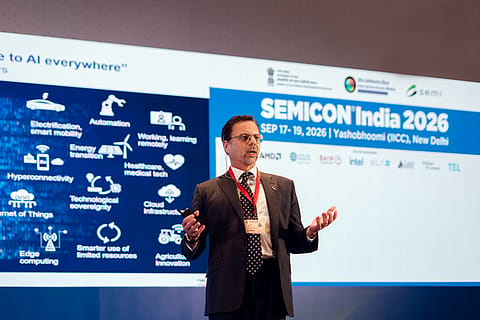
Wayne Allan, Executive Vice President and Chief Strategic Sourcing & Procurement Officer of ASML at Semicon India 2026 | Credits: ASML
ASML (Advanced Semiconductor Materials International) is preparing to significantly expand its presence in India as the country builds out its semiconductor manufacturing ecosystem, with Tata Electronics’ upcoming 300mm fab in Gujarat serving as the company’s first major manufacturing customer in the country.
Allan Wayne, Chief Strategic Sourcing and Procurement Officer at ASML, said in his keynote at Semicon India 2026 that the company’s presence in India had so far been relatively limited, but that the Tata Electronics project marked a turning point. “Typically, ASML is, of course, focused on our customer base. We didn’t have a customer here in India, so recently, now we have the semiconductor [customer], who’s going to be the first 300-millimetre silicon fab in the country,” Wayne said.
He said ASML’s India opportunity was much broader than supporting a single fab, pointing to the rapid expansion of semiconductor demand as artificial intelligence becomes embedded across industries. “If you look at the industry today, we used to talk about chips everywhere, and we talked about chips that are a force in any type of automation and electrification in vehicles. It’s just everywhere. And we were just talking about that just a few years ago. And now we talk about AI everywhere,” Wayne said.
According to Wayne, global semiconductor demand could reach at least $1.6 trillion by 2030. For India specifically, Wayne said the semiconductor market could reach around $120 billion by 2030. “The potential for India is huge,” he said, adding that India could become a significant part of the global semiconductor growth story and “take its place as a semiconductor powerhouse”.
ASML plans wider India semiconductor ecosystem
Wayne said the growth in AI would not only increase demand for advanced processors but would also drive semiconductor requirements across other segments because AI systems depend on sensors and the data generated by applications across industries. “The thing about AI isn’t just boost the requirements and boost the amount of capacity needed for all of these other segments, because AI is, of course, fed by all the sensors and all the data that’s coming from all of these different types of applications,” he said.
ASML expects Tata Electronics’ first 300mm fab to be up and running and producing chips by 2028, according to Wayne. The company is already working on building the engineering and customer-support capabilities required to support the facility. “If we’re going to be scaling this up, we need to be able to build many fabs here,” Wayne said.
He said ASML’s role would extend beyond supplying lithography equipment. The company plans to build a broader ecosystem involving equipment partners, suppliers, process partners and academia. “When we jump into a region, we jump in fully so that we can also not only support the customer, but also look at leveraging all of the talent that surrounds us,” Wayne said.
ASML’s technology footprint in India will initially focus on mainstream semiconductor manufacturing. Wayne cautioned against viewing older process technologies as synonymous with a lack of innovation, arguing that technologies at 28nm and above remain important to the semiconductor industry. “The vast majority of semiconductors are built on more mature technology. I don’t like to call it mature technology. There’s not always maturity. I think there’s still innovation,” he said.
He pointed to innovation in materials and architectures in these technologies, which are used across analogue, mainstream logic, power, non-optical sensors and other applications.
ASML’s India offering will include its DUV lithography systems as well as metrology and inspection capabilities. Its broader “holistic lithography” approach combines lithography with measurement, inspection and computational techniques to optimise wafer patterning.
Wayne said EUV technology, which is used for leading-edge semiconductor manufacturing, is not part of ASML’s initial India offering, although it could eventually be introduced as India develops more advanced manufacturing capabilities.
{{#most-powerful-women-snapshot-individual.slug}} {{/most-powerful-women-snapshot-individual.slug}} {{^most-powerful-women-snapshot-individual.slug}} {{/most-powerful-women-snapshot-individual.slug}} {{#showRanking}} {{current-rank}} {{/showRanking}} {{#photo.0.url}}
{{name}}
India’s longer-term semiconductor ambitions will require substantial additional capacity, Wayne said. He pointed to an ambition for 15% to 25% of India’s domestic semiconductor demand to be manufactured locally by 2032, rising to 35% to 50% by 2035.
“That means you’re going to have to have several fabs by 2032,” he said.
As India scales up its fab ecosystem, ASML is also looking at ways to make equipment deployment more cost-effective. Wayne said refurbished equipment could be an option for some facilities where new equipment is not essential. “Sometimes in the market you don’t need to have a new tool, you can have a refurbished, it’s just as good quality,” he said.
No ASML manufacturing plans yet
While ASML sees India developing into a major semiconductor manufacturing location, Wayne said the company does not currently have plans to manufacture its semiconductor equipment in the country. “There are no plans for that, as it stands,” he said.
He added that ASML would first need to see the development of a sufficiently strong local supply chain before considering manufacturing. “We really need to build up a supply chain before we start to really talk about having a manufacturing presence here,” Wayne said.
Wayne also pointed to the possibility of India eventually developing leading-edge semiconductor capabilities, although he stopped short of putting a firm timeline on when that could happen. “At some point there will be leading-edge here. Who knows when? I don’t want to put 2035, 2040,” he said.
For ASML, the immediate priority is to ensure that Tata Electronics’ first fab can meet its targets on quality, yield and schedule. “I think it’s important that this first fab is able to test and qualify both quality and yielding and on schedule,” Wayne said, stressing that delays in the first facility could affect the pace at which the wider ecosystem develops.
He said India would also need to focus on infrastructure, manufacturing innovation and time-to-market while building the talent base needed to support additional fabs. “You’re going to start to see, I think, many more of our customers coming into India,” Wayne said.
The company is therefore positioning its India strategy around more than Tata Electronics alone, with Wayne signalling that ASML expects its footprint in the country to grow alongside India’s semiconductor ambitions. “You’re going to see a lot more of us as we start to build this also here in India,” he said. ASML, Wayne added, is committed to being “a big part of making India a powerhouse” in semiconductors.
Follow Fortune India
NEXT STORY