Trump’s new Russia law puts India’s oil trade back in the crosshairs
/ 3 min read
The India-relevant tariff is conditional and reviewed every 180 days — not an automatic 100% levy — while the law separately allows duties of up to 500% on Russian imports
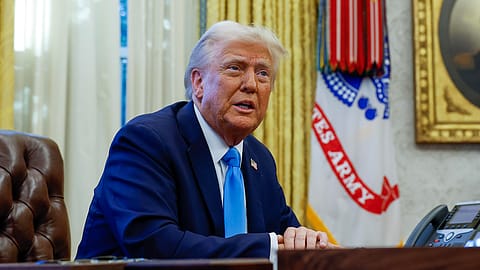
US President Donald Trump. | Credits: Getty
US President Donald Trump on September 18 signed H.R. 5334, the Lindsey O. Graham Sanctioning Russia and Iran Act of 2026, into law, giving his administration expanded powers to impose sanctions and tariffs linked to Russia’s energy trade.
The law has two distinct tariff tracks. Section 112 allows the President to raise duties on goods imported directly from Russia to up to 500%. Section 113, which is more relevant for India, allows duties of up to 100% on goods from a third country if that country ranks among the five largest importers, by volume, of Russian crude oil or natural gas over the preceding 12 months and knowingly makes new purchases 30 days after the law’s enactment.
The US Trade Representative must reassess the top-five list every 180 days. The law also provides the President with waiver authority, subject to a national-interest certification to Congress, while the tariff regime itself is set to expire after five years.
The distinction is important: the law does not automatically impose a 100% tariff on India. It creates the authority for such action if the specified conditions are met.
Russian crude exposure has already started falling
India's exposure to Russian crude remains substantial, although its share of imports has declined. Kpler ship-tracking data showed Russia accounting for roughly 45% of India's crude imports in August 2026, down from a July high, after US sanctions on Rosneft and Lukoil pushed Reliance Industries and state refiners towards non-sanctioned intermediaries.
The economics of Russian crude have also changed.
Nomura, in a client note reportedly said the Urals-to-Brent discount was holding near $2.4 a barrel, a level that it said “implies no impact on Indian refiners' core GRMs.” Nomura added that Reliance and BPCL “are likely to benefit more from Russian crude sourcing” than HPCL or IOC.
That narrowing discount is significant because the savings from Russian crude are now much smaller than they were earlier in the Ukraine war.
Brokerages see manageable refinery impact — but higher oil risk
Goldman Sachs, reviewing Reliance Industries' December-quarter results, noted that refining-margin strength more than offset lower Russian crude intake and higher freight costs.
Jefferies has estimated the earnings benefit from Russian crude at around 2.1% of Reliance's projected FY2027 consolidated EBITDA, describing a full exit from Russian crude as “manageable.”
Morgan Stanley, assessing an earlier round of tanker sanctions, warned that “Russia's seaborne exports may indeed be impacted,” indicating a potential supply-chain risk for Indian buyers if restrictions further constrain the movement of Russian barrels.
{{#most-powerful-women-snapshot-individual.slug}} {{/most-powerful-women-snapshot-individual.slug}} {{^most-powerful-women-snapshot-individual.slug}} {{/most-powerful-women-snapshot-individual.slug}} {{#showRanking}} {{current-rank}} {{/showRanking}} {{#photo.0.url}}
{{name}}
The broader macroeconomic impact could be more important if India is forced to replace Russian crude at higher prices. Analysts cited by PTI estimate that a complete replacement of Russian barrels could add $9–11 billion to India's annual import bill.
Fitch Ratings has said the sanctions “may not materially affect” oil marketing companies' refining margins because higher crude costs can largely be passed through, although the duration of any disruption would matter.
Kpler's Sumit Ritolia has described the combined EU origin-tracking measures and US tariff pressure as “a squeeze from both ends.”
Petroleum Minister Hardeep Singh Puri, meanwhile, has maintained that “there are no sanctions on Russian oil” and that India buys crude wherever it is cheapest.
The broad brokerage view is that the new law raises policy risk without guaranteeing immediate action. The key questions now are whether Washington designates India among the five largest buyers when the US Trade Representative conducts its determination, whether a waiver is granted, and how quickly Indian refiners can shift towards Middle Eastern, US and Latin American crude without substantially increasing the country's import bill.
Follow Fortune India
NEXT STORY