Xi Jinping in US: Trade truce, tariffs and rare earths top agenda as Washington and Beijing seek business reset
/ 2 min read
Xi Jinping’s three-day US visit comes as Washington and Beijing seek greater certainty on tariffs, trade and critical-mineral supplies, with businesses watching for a more durable framework for bilateral commerce.
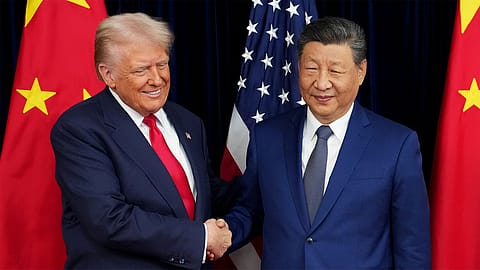
US President Donald Trump and Chinese President Xi Jinping during a previous meeting, as the two leaders prepare for talks on trade, technology, AI and critical mineral supply chains. | Credits: Getty Images
Chinese President Xi Jinping’s visit to the United States (US) from September 23 to 25 puts the world’s two largest economies back at the negotiating table at a crucial point for their commercial relationship. The focus is expected to be on sustaining the recent trade détente, reducing uncertainty for businesses and addressing contentious areas including tariffs, rare earths and technology restrictions.
The timing is significant for companies on both sides. To be sure, the current US-China trade arrangement is due to expire on November 10, leaving the Trump-Xi engagement with a potentially important role in determining whether the tariff truce is extended. As per leading economists, any agreement could influence sourcing decisions, investment plans and supply chains spanning manufacturing, electronics, automobiles and other industries.
Trade truce and tariffs in focus
US and Chinese officials have been working towards the leaders’ meeting, with trade, rare earths and technology among the issues under discussion. For businesses, maintaining lower tariff barriers would provide greater visibility on the cost of importing components and finished goods between the two markets.
The two governments are also examining areas where commercial commitments could provide tangible outcomes. Potential Chinese purchases of US goods, including aircraft, have emerged as part of the broader discussions, while Washington continues to seek greater access to Chinese markets and more predictable trade flows.
Rare earths emerge as a critical business issue
Rare earths remain one of the most important pressure points in the economic relationship. China occupies a dominant position in the processing of several rare earth elements used across electric vehicles, electronics, renewable-energy equipment and defence-related manufacturing.
Chinese Foreign Ministry spokesperson Guo Jiakun said ahead of Xi’s visit that Beijing wanted to “strengthen dialogue and cooperation, and properly manage differences”. He also said the two countries should work to keep “the global industrial and supply chains of critical minerals safe and stable”.
AI, technology and corporate opportunities
Technology is another major component of the economic relationship. US restrictions on advanced semiconductors and computing technology have become a major source of friction, while Chinese companies remain important players across manufacturing and technology supply chains.
For multinational companies, the outcome of the Xi-Trump discussions will be measured less by the symbolism of the state visit and more by whether Washington and Beijing can provide clarity on tariffs, market access, critical minerals and technology flows.
Follow Fortune India
NEXT STORY