
Renault Duster Strong Hybrid E-Tech 160 launched at ₹16.99 lakh; read more for details
ADVERTISEMENT
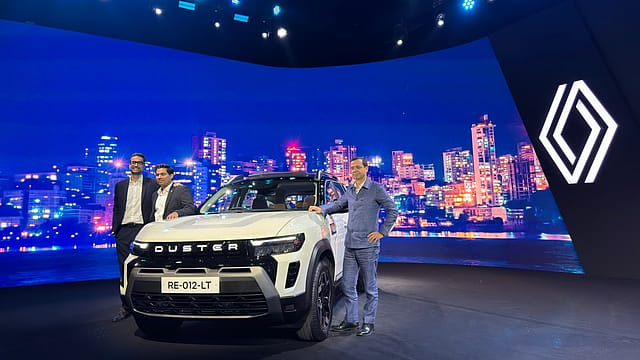
Renault India has launched the Duster Strong Hybrid E-Tech 160 in India at an introductory price of ₹16.99 lakh (ex-showroom). The hybrid Duster is available in three variants—Evolution, Techno and Emotion—with prices going up to ₹19.49 lakh for the top-spec Emotion variant.
The Evolution variant is priced at ₹16.99 lakh, while the Techno and Emotion variants cost ₹18.99 lakh and ₹19.49 lakh, respectively. Renault says the introductory prices will apply to deliveries made until December 31, 2026. Deliveries of the new Duster hybrid will begin from November 6, with R-Pass customers receiving priority.
The Duster Strong Hybrid E-Tech 160 is Renault’s third powertrain option for the new-generation SUV in India, alongside the 1.0-litre and 1.3-litre turbo-petrol engines. It also marks Renault’s entry into the strong-hybrid SUV segment in India, where it takes on the Maruti Suzuki Grand Vitara, Maruti Suzuki Victoris and Toyota Urban Cruiser Hyryder.
Renault claims an ARAI-certified fuel efficiency of 29 kmpl for the Duster Strong Hybrid. The company also says the powertrain can enable up to 80% of city driving in electric mode.
The company claims the hybrid can deliver up to 40% lower CO2 emissions per kg, while its presentation highlights a 0-100 kmph acceleration time of 9.6 seconds.
How E-Tech 160 competes with Toyota, Maruti hybrids
The Duster Strong Hybrid E-Tech 160 uses a 1.8-litre four-cylinder petrol engine, a 1.4kWh/247V battery, a high-voltage starter generator, a high-power traction motor and a multi-mode automatic gearbox.
Renault’s E-Tech system differs from the hybrid architecture used by Toyota in the Grand Vitara, Hyryder and Victoris. The Duster uses two electric motors and a multi-mode transmission, while Toyota’s strong-hybrid system uses an e-CVT and power-split arrangement. Renault’s system also uses a larger 1.4kWh battery, compared with the roughly 0.6kWh battery used in Toyota’s hybrid system.
Renault says the Duster’s hybrid system produces a maximum system output of 160 PS and maximum motor torque of 208 Nm. The combination is designed to use electric propulsion extensively in urban driving, with the petrol engine stepping in when additional power or sustained operation is required.
The 29 kmpl claimed efficiency puts the Duster at the top end of the segment. The Maruti Suzuki Victoris strong hybrid is officially rated at 28.65 kmpl, while the Grand Vitara’s strong-hybrid variants are rated at 27.97 kmpl.
That gives Renault a clear efficiency-led pitch, although the Duster starts at ₹16.99 lakh, making its entry hybrid variant relatively aggressive against the Victoris. The Victoris strong-hybrid range currently starts at ₹16.42 lakh, while higher Victoris hybrid variants extend to nearly ₹20 lakh.
Beyond the hybrid powertrain, Renault is using the Duster to lay out a broader India strategy under its “futureReady” roadmap. The company says it is targeting a seven-product lineup with full-spectrum electrification, becoming a top-three Renault market globally, generating €2 billion in annual exports from India by 2030 and building India into an engineering hub for global products.