
Fortune India Banking & NBFCs Summit 2026: IDFC FIRST Bank's next leg of growth easier, says Vaidyanathan; eyes ₹10 lakh crore loan book
ADVERTISEMENT
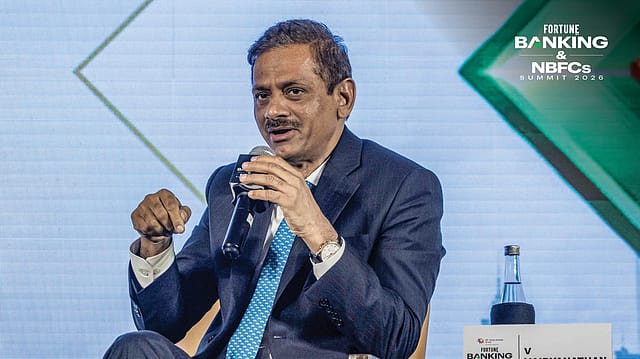
IDFC FIRST Bank managing director and chief executive officer V. Vaidyanathan expects the lender's next phase of expansion to be relatively easier than the journey so far, as he reflected on leaving ICICI Bank to build his own financial institution and scaling its loan book from around ₹30,000 crore to ₹3 lakh crore.
“I am very confident that ₹3 lakh crore loan book will be ₹6 lakh crore, ₹10 lakh crore. That is going to be relatively easier,” Vaidyanathan said during a fireside chat titled ‘Entrepreneurial Banker: The IDFC FIRST Bank Story’ at the Fortune India Banking & NBFCs Summit 2026.
He acknowledged that the early stages of building a financial institution were far more difficult, particularly when the business was smaller and access to capital was uncertain.
When asked whether IDFC FIRST Bank would look at acquisitions to expand its business. Vaidyanathan said the bank was “not so fussed about acquiring anybody”, before turning to the importance of scale, capital and funding in building a lender.
From ICICI Bank to entrepreneurship
Vaidyanathan said the idea of starting a non-banking financial company (NBFC) and eventually turning it into a bank had occurred to him around 2005, after the Reserve Bank of India announced new banking licences for Kotak Mahindra Bank and YES Bank.
“I kept telling myself that, you know, I was ICICI at that time. I should get an idea of why don't you also leave and get a bank licence,” he said.
He did not act on the idea immediately. After joining the ICICI Bank board in 2006, he revisited it in 2009, when K.V. Kamath became non-executive chairman.
Vaidyanathan eventually left ICICI Bank in 2010 to pursue the entrepreneurial opportunity. He acquired a stake in an existing NBFC and subsequently built Capital First into a retail and small-business lender. Capital First merged with IDFC Bank in December 2018 to form IDFC FIRST Bank.
Why scale changes the equation
Vaidyanathan said a lender's ability to expand eventually depends on its capacity to raise capital and borrowings.
“Beyond a point of time, you will run out of capital. Beyond a point of time, you will run out of borrowings,” he said.
He described the challenge of building a business when investors are reluctant to provide funds until it achieves greater scale.
“You need scale. For scale, you need capital. So, you are stuck in a loop,” he said.
The banker added that lenders must keep addressing challenges such as high unsecured lending exposure and low capital levels as they grow. Such issues do not disappear with expansion; they have to be managed alongside growth.
He contrasted the early uncertainty of building a smaller institution with the greater stability that comes with a larger loan book, deposit base and capital position.
Building beyond the NBFC model
Vaidyanathan also discussed the differences between operating an NBFC and a bank, including the latter's regulatory requirements, liquidity management and treasury operations.
While an NBFC helped him establish a retail lending franchise, the merger with IDFC Bank gave Capital First access to a banking platform. The combination brought together Capital First's retail lending business and IDFC Bank's existing banking infrastructure.