
From bicycle parts to AI: Sunil Mittal's next chapter for Bharti Airtel
ADVERTISEMENT
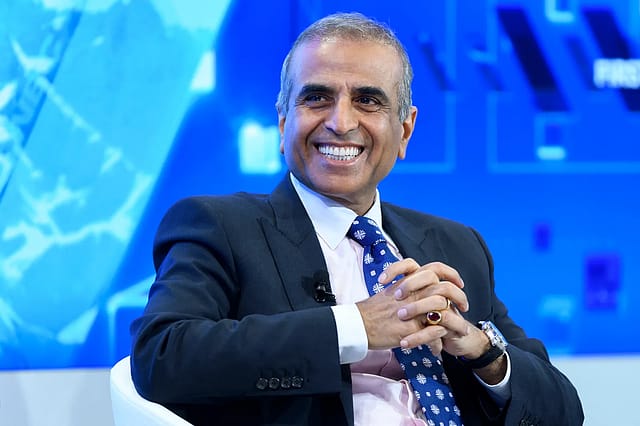
When Sunil Bharti Mittal set up a small manufacturing unit making bicycle parts in Ludhiana in 1976, he was barely 18. Fifty years later, the founder of Bharti Enterprises is presiding over a business empire whose flagship, Bharti Airtel, has become one of the world's largest telecommunications companies.
The journey from bicycle crankshafts to mobile networks, submarine cables and satellite communications has been marked by bets that often ran ahead of the market, setbacks triggered by policy changes and three major crises that Mittal describes as Bharti's "Mahabharatas".
Now, as the group marks its 50th anniversary, Mittal is preparing for another transformation. He wants Airtel to evolve from a telecommunications operator into a digitally enabled technology company, with connectivity at its core and businesses spanning artificial intelligence, sovereign cloud, digital finance and satellite services.
His prescription for India's digital economy is equally expansive: higher mobile tariffs, financially stronger telecom operators, a substantial expansion of network infrastructure and greater national control over strategic communications systems.
The most immediate part of that agenda concerns what consumers pay for mobile services. Mittal believes average revenue per user, or ARPU, in India should rise to about Rs 350 a month against the Rs 300 benchmark he advocated roughly a decade ago. Rising operating costs and the investment needed to expand digital infrastructure justify the higher level, he said.
"Everything is up. So, 350 would be the right ARPU for our industry," Mittal told PTI in an interview.
He compared the cost of mobile services with everyday purchases. "Now, you buy soap and a packet of chips. You know what it costs. Having a bottle of Pepsi costs you a lot more than that".
At Rs 10-12 a day, he argued, consumers receive access not only to calls and data but also to banking, education, healthcare records, direct benefit transfers, UPI payments and entertainment. "I think you can't say that is not affordable."
Airtel reported mobile ARPU of Rs 271 in the September quarter, up from Rs 256 a year earlier. Reaching Mittal's proposed level would require about a 29 per cent increase from the latest figure. The last major industry-wide tariff revision came in June 2024, when operators raised prices by around 10-25 per cent. Mittal did not give a timeline for reaching Rs 350, saying, "I don't know".
FROM A BICYCLE CRANKSHAFT TO MOBILE PHONES
--------------------------------------------------------
Mittal's first venture was a modest manufacturing operation in Ludhiana, making bicycle components for the city's established bicycle industry.
"I was only 18 at that time, and I started with manufacturing, not trading in bicycle parts, which, as you know, Ludhiana is pretty famous for," he recalled.
"The dream is to sort of, you know, do something, create something for yourself, make your ends meet, and get enough fuel to fire your ambitions or dreams that one has at that time and age," he said.
Bicycle parts were followed by hosiery and stainless steel sheets. Mittal then moved into importing and trading products that were relatively new to Indian consumers, including portable generators, push-button telephones, cordless phones, answering machines and fax machines.
"They were flying off the shelves. The margins were good," he said.
But an early success also brought a lesson in the risks of doing business in India's tightly controlled economy. His portable generator business, which had become highly profitable, collapsed after the government changed its import policy.
"Generator business, which was a very thriving, successful business for a few years, just went out overnight because the policy changed," he said.
Having already built a business around telephone equipment, Mittal saw mobile services as the next step in communications. He had observed the development of cellular telephony in markets such as Britain and France and believed India would eventually embrace the technology, despite the high cost of handsets and services.
Bharti launched Airtel's mobile services in Delhi in 1995. The market was then in its infancy, with mobile phones largely beyond the reach of ordinary consumers. An agency survey had estimated that Delhi would have only 10,000 mobile subscribers in 10 years.
"I knew that was not going to be the case," Mittal said. Airtel crossed that number within its first year.
Even he had not anticipated how deeply mobile phones would transform everyday life. "Nobody could have imagined" that mobile telephony would become the "fabric of everybody's lives", he said. Airtel's early slogan was "Power to keep in touch". There was not even an SMS service at the time.
The bet on markets rivals questioned
One of the defining decisions in Airtel's expansion was its push beyond major cities into smaller towns and difficult markets, where demand was uncertain, and network deployment was more challenging.
Mittal recalled that Hutchison's then chief executive, Hashim Ghosh, questioned the strategy.
"You're making a big mistake going into these places. They will not have enough demand," Ghosh told him, according to Mittal.
Airtel nevertheless pursued a pan-India presence, investing in markets including Bihar, Odisha, Assam and the northeast. In some of these regions, Mittal said, the company was, for some time, the only operator.
"That's what I would say gave us the scale and the confidence to keep growing the business," he said.
The strategy was based on the expectation that falling tariffs and rising affordability would unlock demand well beyond affluent urban consumers. The subsequent expansion of mobile telephony across the country vindicated the decision and helped Airtel build a nationwide network.
Another consequential decision concerned how the company would manage that network. When Airtel had around four to five million subscribers and wanted to expand to 25-35 million, it recognised that building all the necessary engineering, information technology and operational capabilities in-house would be difficult.
Bharti vice-chairman Akhil Gupta proposed outsourcing network and IT operations to specialist vendors. The idea faced internal resistance, but Mittal backed it.
The model allowed Airtel to focus on customers, marketing and business strategy, while external partners took responsibility for much of the network equipment and its management. It drew surprise and criticism from international telecom peers before becoming a reference point for other operators.
"It eventually became a Harvard case study, and a lot of companies followed that model later on," Mittal said.
Bharti also invested ahead of demand in long-distance networks, enterprise connectivity and submarine cable infrastructure. Mittal described the Chennai-Singapore cable, built during the tenure of Prime Minister Atal Bihari Vajpayee, as India's first such project.
Three major battles and the jio disruption
The expansion was not without existential challenges. Mittal has identified 2002, 2009 and 2016 as three particularly difficult periods for Bharti, describing them as the company's "Mahabharatas".
The 2016 crisis coincided with Reliance Jio's entry into the market, when free introductory services and aggressive pricing triggered a price war and accelerated consolidation. Several operators exited or merged, while surviving companies faced pressure to invest in networks and retain customers.
Mittal credits employees with helping Airtel withstand the disruption, recalling frontline teams engaging customers across states even as rivals offered free services.
"In our case, our raw material was not the balance sheet. It was not the technology, because ultimately, it is the same technology. It was our people," he said.
The upheaval left India with a far smaller number of major operators.
Mittal believes the country should not return to the era when more than a dozen companies competed for subscribers.
"India went too far into over a dozen operators," he said, arguing that fragmentation weakened balance sheets, divided spectrum and reduced the industry's capacity to invest.
He considers three private operators, alongside state-owned BSNL, an appropriate structure for India. The comments come as Vodafone Idea continues to face financial challenges and BSNL works to rebuild its network and competitive position.
Telecommunications, he said, is no longer simply a business of voice calls and data. UPI payments, banking, healthcare records, government benefit transfers, e-commerce, delivery platforms and streaming services all depend on reliable connectivity.
Mittal also argued that existing networks have room to accommodate more customers and traffic.
"All of us are running at 20, 30 per cent of our capacity of networks. So, we can take more traffic, we can take more customers," he said.
Telcos seek a bigger share of digital value
Mittal's call for stronger operators is linked to what he sees as an imbalance in the digital economy: telecom companies bear the cost of building spectrum, towers, fibre and network infrastructure, while online platforms often command much higher valuations.
"We do all the hard work, but we don't get the same valuation and the profitability that those who don't make these investments get," he said.
He cited the valuations of companies such as Google, Facebook and Netflix, as well as e-commerce, quick-commerce and streaming platforms that rely on telecom networks to reach customers.
The issue reflects a longstanding tension in the global telecom industry, where operators make large, recurring capital investments while much of the commercial value generated by rising internet use is captured by digital services.
Mittal welcomed Reliance Jio's recent listing, saying it would bring greater investor attention and research coverage to the sector. But he said the listing had no direct bearing on Airtel's valuation, which he described as already placing it among a relatively small group of global telecom companies valued above USD 100 billion.
5G's revenue shortfall and the next technology cyle
Despite investment in next-generation networks, Mittal acknowledged that 5G has not delivered the new revenue streams operators had expected, particularly from industrial applications such as connected factories and automation.
"That's been a disappointment globally," he said.
The rollout has involved spectrum expenditure running into lakhs of crores of rupees across operators, with network deployment costs estimated by Mittal at another Rs 1.5 lakh crore.
He nevertheless sees the investment as necessary to support future demand.
The next opportunity could emerge from 6G and what he described as "sensing networks", potentially taking shape over the next three to five years.
In that environment, connected glasses, rings, watches and earpods could perform functions now handled by smartphones, and networks would increasingly interact with users' artificial intelligence agents.
For Airtel, the ambition is to build businesses around growing demand for connectivity and computing rather than depend principally on mobile subscriptions and tariffs.
Asked what the company might look like a decade from now, Mittal said: "It will be a digitally enabled technology company where connectivity will be at its core because everything will need connectivity".
The vision includes digital financial services, sovereign cloud infrastructure, AI computing, fibre connections to homes and satellite links for remote areas. Mittal believes India has the potential to develop capabilities in artificial intelligence, large language models, quantum computing and space technology.
But that will require a substantial expansion of physical infrastructure.
India has around 350,000 mobile towers, compared to more than one million in China, he said, arguing that the country needs to double its tower base at least. More fibre, submarine cables, satellites and AI data centres will also be required.
Satellites and strategic autonomy
Satellite communications are another part of Mittal's strategy through Eutelsat OneWeb, in which Bharti has invested. The low-Earth-orbit network is intended to connect remote villages, forests, mountains, ships and aircraft where conventional mobile and fibre networks cannot economically reach.
Mittal recalled persuading the British government to commit USD 500 million to the venture during the pandemic and said he subsequently invested USD 1 billion of his own money.
He sees satellite services as complementary to terrestrial networks, rather than a substitute for them.
"Where there is fibre, radio cannot compete with it. Where there is a radio, satellite cannot compete with it," he said.
The commercial opportunity is only one part of the case. Mittal argues that satellite communications are increasingly important to national security, particularly as conflicts demonstrate the role of space-based connectivity in military operations.
"The kill switch, as we call it, should not be sitting somewhere else.
India must have control over its own space destiny," he said.
He believes India needs multiple satellite providers, oversight of equipment and systems entering the country, and control over how data is routed. The position reflects growing concerns among governments about dependence on foreign-controlled communications infrastructure.
Mittal said OneWeb services were functioning, with the company awaiting the final government signal to expand commercial operations. He cited the use of terminals for emergency services and recalled economic adviser Sanjeev Sanyal using one during a boat journey to Oman.
The businesses Bharti left behind
Mittal's career has also involved exits from businesses that did not become central to the group's strategy. Bharti entered modern retail through a partnership with Walmart and expanded into insurance through international partnerships, but eventually stepped back from those ventures.
The Walmart venture faced resistance in India and did not develop as originally envisaged.
"Walmart was literally blocked out of this country," Mittal said, adding that the American retailer later returned through its acquisition of Flipkart.
Bharti also sold its general insurance business to ICICI Lombard and is bringing Prudential in as a partner in life insurance.
Asked whether he regretted leaving businesses behind, Mittal said: "There are no regrets. We were too busy building our telecom story".
The response reflects his emphasis on concentrating capital and management attention on businesses where the group believes it can build scale.
Fifty years after starting with a single bicycle component, Mittal's ambitions now extend to the infrastructure underpinning artificial intelligence, cloud computing and space-based communications. His central argument is that India's digital economy will require more investment in networks and stronger operators - even if that means consumers paying more for mobile services.
The entrepreneur who once bet that mobile phones would find millions of customers beyond the major cities is now making a broader wager: that connectivity will remain the foundation of a much larger technology economy.