
Has Jio IPO brought foreign capital, steadied rupee and revived market sentiments
ADVERTISEMENT
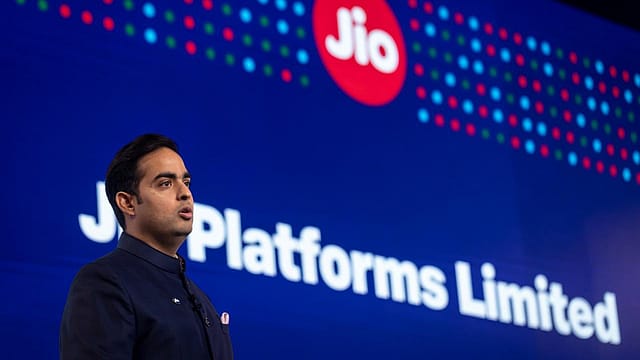
On October 21, when Jio Platforms Ltd (JPL) opened its IPO subscription, Brent crude was trading at around $108 a barrel. It rose to $117 by the close of its first two trading days. However, the rupee depreciated less at 0.6% against the dollar to 94.91. Besides the Reserve Bank of India's measures to cool dollar demand, foreign capital inflows into JPL also helped the rupee hold below the 95 mark, said experts.
The JPL listing also helped revive stock market sentiment, with the Nifty rising 1.3% over the last two trading days despite declines in US and European markets. The return of foreign institutional investors (FIIs) as net buyers was another positive. They invested ₹3,598 crore on Friday despite escalating tensions in the Middle East, reports of vessels hitting mines in the Strait of Hormuz and crude prices crossing $117 a barrel.
"It was heartening to see what happened to the rupee (since IPO subscription started)," said Akash Ambani during a media interaction following the Q2 results announcement. "So that was something that I don't think any other IPO has ever caused," he said.
The ₹30,000-crore initial public offering (IPO) of JPL has emerged as more than a landmark capital-market event. At a time when escalating tensions in the Middle East, rising crude prices and foreign capital outflows were weighing on Indian financial markets, the offering brought a fresh wave of investor interest, boosting equity-market liquidity and supporting the rupee, said experts.
JPL IPO draws foreign capital as FIIs turn buyers
The subscription, which opened on October 21, attracted substantial institutional and foreign investor participation. On the first day, the combined traded value was ₹26,000 crore, while the listing price was 21.36% higher than the IPO price, reflecting the scale of investor demand. The mobilisation of such a large pool of capital helped improve market liquidity and confidence.
"We were raising Rs 30,000 crore odd, and we saw demand of over 7.5 lakh crore, that's 24.5 times," said Akash Ambani.
"We've known how markets are on the global picture," he said. Foreign portfolio investors (FPIs) withdrew around ₹48,056 crore from Indian equities in October. "In a market situation like that, for us to make our debut was very proud that the people were realising of the business that we've built," he said.
"JPL had a fantastic anchor book that has not been present in India ever before, both by the international funds and the domestic funds and happy to see tech investors like Dragon Global and Ninty One come in," he added.
The timing was significant. Foreign investors had remained cautious about Indian equities amid geopolitical uncertainty and concerns over expensive crude imports. The strong response to JPL helped improve sentiment towards Indian stocks, which had been struggling to attract overseas capital.
Foreign capital attracted by the JPL offering supported dollar inflows and demand for Indian assets, providing some relief to the currency. While the IPO cannot be considered the sole reason for the rupee's resilience, it offered an important counterweight to pressure from expensive oil and geopolitical uncertainty. Any prolonged disruption to energy supplies through the Strait of Hormuz could reverse these gains.
There is a historical parallel in JPL's influential journey. Its launch in 2016 disrupted the telecom industry by making data affordable and transforming consumption patterns. During the Covid-19 pandemic, when global economic uncertainty triggered volatility in financial markets, Jio attracted investments from some of the world's biggest technology companies and private equity investors. Meta and Google joined global investment firms such as Silver Lake, KKR, General Atlantic and TPG in backing Jio's digital ambitions. These investments demonstrated the ability of an Indian business to attract substantial international capital even during a global crisis. The latest IPO has extended that proposition to public markets, opening Jio's growth story to a much wider pool of domestic and foreign investors.
However, the gains in the currency and equity markets remain vulnerable to external developments. If the Middle East conflict escalates into a wider war, disruptions to oil supplies could alter the equation.